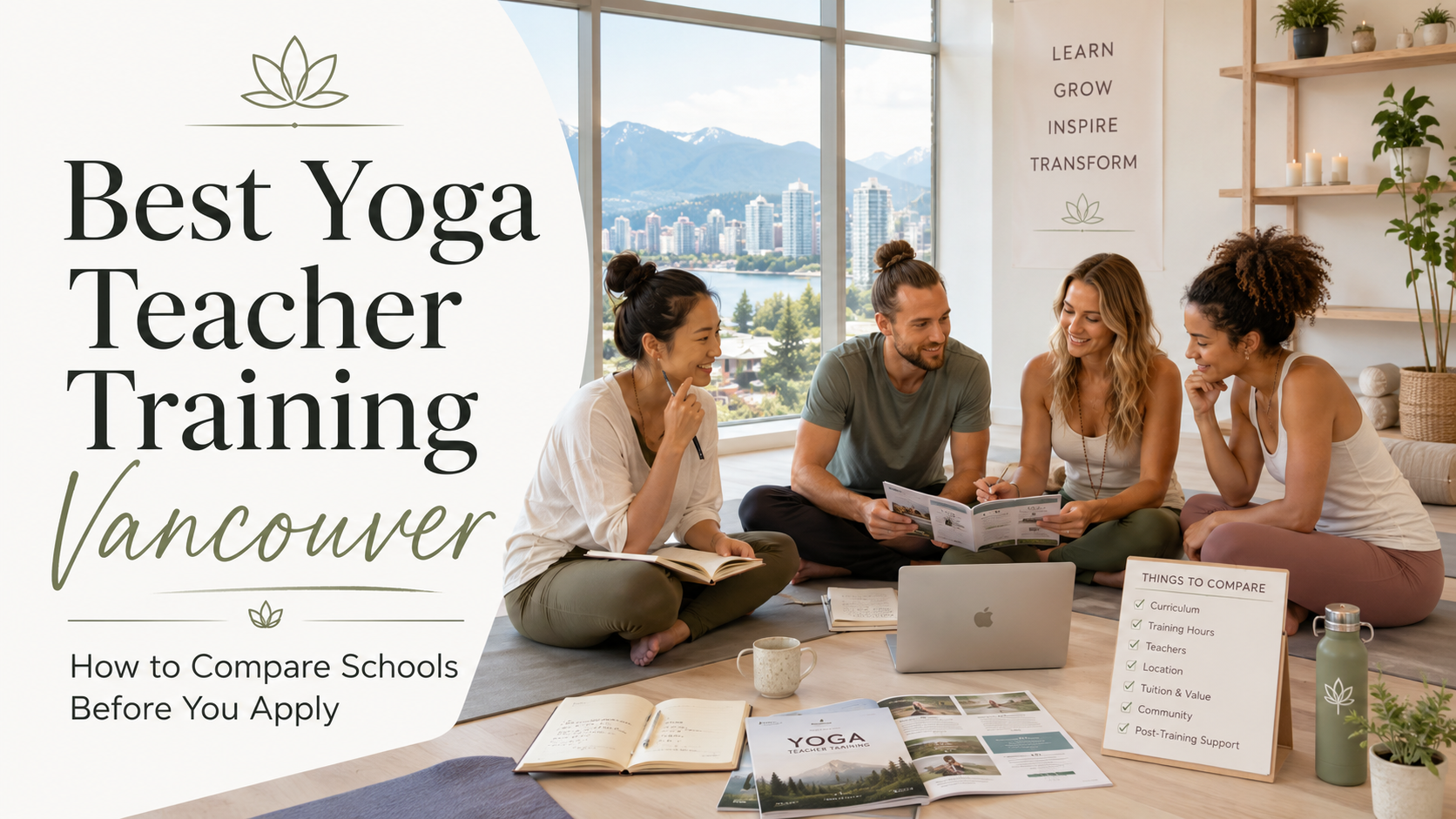
 Best Yoga Teacher Training Vancouver: How to Compare Schools Before You Apply
Vancouver has one of the busiest yoga scenes in Canada. That’s good news if you want to become a teacher. It’s also the problem. With so many 200-hour programs to choose from, picking the right one can feel overwhelming.
Some schools focus on alignment-based Hatha. Others build their training around Vinyasa flow, yoga therapy, or a specific lineage. Prices range from under two thousand dollars to well over four thousand. Schedules run the gamut too, from weekday intensives to weekend-only formats stretched across several months.
This guide breaks down exactly what to look for. You’ll learn how to compare accreditation, teaching staff, curriculum, cost, and schedule before you commit your time and money. By the end, you’ll have a clear framework for finding the best yoga teacher training Vancouver has to offer, one that actually fits your goals.
Why the Right School Matters More Than the Price Tag
A yoga teacher training isn’t just a certificate. It’s the foundation for how you’ll teach for years to come. The habits, cues, and safety knowledge you pick up during your 200 hours will shape every class you lead afterward.
This is why price shouldn’t be your first filter. A cheaper program that skips anatomy depth or offers minimal practice teaching time can leave you underprepared. A more expensive program isn’t automatically better either. Some schools charge a premium for brand recognition rather than instructional quality.
The smarter approach is to evaluate schools the way you’d evaluate any serious education investment. Look at who teaches, what they teach, how much hands-on practice you’ll get, and what happens after graduation. Vancouver’s cost of living already makes training here more expensive than in many other cities, so getting real value out of your tuition matters even more.
Think about your own goals too. Someone who wants to teach at a local studio needs different things than someone who wants to run retreats or work with a specific population, like prenatal students or older adults. The right school for your friend might not be the right school for you. Use the categories below to build your own shortlist, then compare programs side by side using the same questions.
Start With Accreditation: What Yoga Alliance Registration Actually Means
Most reputable yoga teacher trainings register with Yoga Alliance, the largest nonprofit organization setting standards for yoga education worldwide. When a school holds RYS 200 status (Registered Yoga School, 200-hour level), it means the curriculum meets a defined set of hour requirements and content categories, covering asana, teaching methodology, anatomy and physiology, philosophy, and practicum.
Graduating from an RYS 200 program lets you apply for the RYT 200 credential (Registered Yoga Teacher). This is the entry-level title most studios expect when hiring new teachers. It’s worth noting that Yoga Alliance registration is voluntary, not legally required to teach yoga in Canada. Some well-run schools operate outside the system by choice. But registration gives you an external benchmark, and it makes your certification portable if you ever move or want to teach abroad.
Don’t just take a school’s word that it’s accredited. Check the Yoga Alliance school directory yourself and confirm the listing is current and matches the exact program name. Standards have changed over time too. Yoga Alliance updated its 200-hour requirements in 2020, adding a defined core curriculum and tightening lead trainer qualifications, so a school that registered years ago should still be meeting the current version of the standard, not an outdated one.
If a school isn’t Yoga Alliance registered, ask why. Some independent programs are excellent and simply choose a different path. Others skip registration because they don’t meet the hour or curriculum requirements. Ask directly what standards they do follow, and don’t be shy about requesting a full syllabus before you apply.
 Check the Lead Trainer’s Credentials, Not Just Their Bio
The instructor leading your training matters more than almost anything else on this list. Under current Yoga Alliance standards, lead trainers for an RYS 200 program must hold the E-RYT 500 credential. That means they’ve completed at least 500 hours of registered training themselves, logged a minimum of 2,000 teaching hours, and taught for at least four years since their original certification.
This standard exists for a reason. Teaching yoga postures safely, correcting alignment, and building a curriculum from scratch requires far more experience than a 200-hour certificate alone provides. When you’re comparing schools, ask specifically who will be in the room teaching you, not just whose name appears on the marketing page. Some schools list a celebrity founder but hand most of the actual teaching to newer staff.
Look up each lead trainer’s individual profile on the Yoga Alliance directory. Confirm their credential level and how long they’ve held it. Ask the school directly: How many hours will each lead trainer personally teach during this program? Yoga Alliance now requires lead trainers to deliver the majority of the curriculum themselves, so a program stacked with guest teachers and substitutes may not meet that bar.
It’s also worth asking about teaching style compatibility. A lead trainer with a strongly opinionated approach to alignment or sequencing will shape how you teach for years. Sit in on a class taught by that instructor if the school allows drop-ins. Watching how they cue, correct, and explain postures tells you more than any bio ever will.
Compare Curriculum Depth, Not Just the Number of Hours
Every RYS 200 program covers the same broad categories: asana, anatomy, philosophy, teaching methodology, and practicum. But “covers anatomy” can mean two very different things depending on the school. Some programs spend real, structured hours on musculoskeletal anatomy, contraindications, and injury prevention. Others touch on it briefly and move on.
Ask for a detailed, hour-by-hour breakdown of the syllabus before you apply, not just a marketing summary. A strong curriculum should specify how many hours go toward each category and what specific topics are covered within them. If a school can’t produce this document, that’s a warning sign.
Pay attention to how much time is dedicated to teaching methodology and hands-on assisting, since this is the part of training that translates most directly into your first classes. Yoga Alliance requires trainees to complete a minimum number of hours actively practice-teaching as the lead instructor, not just observing or assisting others. Ask how those hours are structured. Will you teach short segments to your peers throughout the course, or is practice teaching crammed into the final week?
Philosophy content varies widely too. Some schools ground their training in classical texts like the Yoga Sutras and the Bhagavad Gita. Others focus more on modern, secular applications of mindfulness and breathwork. Neither approach is wrong, but you should know which one you’re signing up for. If a program emphasizes a specific lineage or cultural tradition, ask how that history and context is taught, and whether the school addresses questions around cultural respect and appropriation directly, since this has become an increasingly important part of teacher training conversations.
Class Size and Actual Teaching Practice Hours
A 200-hour certificate means little if you never actually got to teach during your training. Class size directly affects how much individual feedback and practice time you receive. A cohort of ten to fifteen students allows far more personalized correction than a cohort of forty.
Ask each school directly: What is your maximum class size? How many total hours will I spend practice-teaching in front of the group, not just assisting or observing? Yoga Alliance sets a minimum threshold for lead-teaching hours, but many strong programs exceed that minimum considerably.
Also ask what feedback looks like. Do lead trainers give individual, recorded, or written feedback after each practice-teaching session? Some schools use peer feedback exclusively, which has value but isn’t a substitute for guidance from an experienced trainer. Ask whether you’ll get to teach a full class sequence from start to finish at least once before graduating, since this is often the moment that reveals whether you’re actually ready.
Smaller schools sometimes advertise “intimate” training groups as a selling point, and this is genuinely worth prioritizing if teaching confidence is your main goal. Larger schools can offer more scheduling flexibility and a bigger post-graduation community, which matters for some students more than individual attention does. Neither format is universally better. Match the class size to what you personally need in order to feel ready to teach your first real class.
 In-Person, Hybrid, or Online: What Actually Fits Your Life
Vancouver schools now offer training in several formats. Fully in-person programs run as either a short daily intensive, often four to six weeks, or a part-time weekend format stretched across three to ten months. Hybrid programs combine online lecture content with in-person weekend intensives. Fully online programs exist too, though Yoga Alliance currently caps how many hours of a 200-hour program can be delivered virtually, requiring the remaining hours to happen in person.
Think honestly about your schedule and learning style before choosing a format. An intensive month-long program demands that you clear your calendar almost entirely. It suits people between jobs, students on summer break, or anyone who learns best through full immersion. A weekend format spread across several months works better if you have a job or family commitments you can’t pause, though it requires more sustained motivation over a longer stretch.
Hybrid and online components can make training more affordable and accessible, especially if you don’t live centrally in Vancouver. But physical asana instruction, hands-on assisting practice, and live teaching feedback are hard to replicate through a screen. If a program is heavily online, ask exactly how many in-person contact hours are included and what happens during those hours.
Whatever format you choose, ask about attendance policies. What happens if you miss a weekend or a lecture? Can you make it up in a future cohort, and is there an extra fee for that? Missing course content because of unclear makeup policies is one of the most common reasons trainees fall behind.
Cost, Payment Plans, and Hidden Fees
Tuition for 200-hour programs in the Vancouver area generally runs from around two thousand to over four thousand Canadian dollars, depending on format, school reputation, and included materials. Before comparing price tags directly, find out exactly what’s included in each figure.
Ask whether the training manual is included or sold separately. Some schools bundle a printed manual into tuition, while others charge an additional fifty to one hundred dollars for course materials. Ask whether a deposit is refundable, and under what conditions. Many schools require a non-refundable deposit to hold your spot, which is standard practice, but the refund policy on the remaining tuition varies significantly if your circumstances change.
Ask about payment plan options too. Spreading tuition across monthly installments can make a more expensive, higher-quality program accessible without a large upfront cost. Some schools also offer partial scholarships or sliding-scale tuition for students facing financial barriers, so it’s worth asking directly even if it isn’t advertised.
Factor in costs beyond tuition as well. Will you need to purchase props, a specific type of mat, or required reading beyond the manual? Do you need to attend outside yoga classes in the weeks before training starts, as some schools recommend or require? Add these extras to your comparison so you’re evaluating the true total cost, not just the advertised tuition figure.
Read Reviews Critically, Not Just Enthusiastically
Google reviews and testimonials are useful, but they’re also easy to game and often written in a moment of post-graduation euphoria. Read them with a slightly more analytical eye. Look for reviews that mention specific, concrete details, like how feedback was delivered, how confident the graduate felt teaching their first class, or how the school handled a scheduling conflict.
Vague, glowing reviews that only describe a program as “life-changing” or “transformative” tell you very little about instructional quality. Reviews that mention specific trainers by name, describe how anatomy was taught, or explain how practice teaching was structured are far more useful for comparison purposes.
Where possible, talk to a recent graduate directly rather than relying only on written reviews. Ask the school if they can connect you with an alumna or alumnus willing to answer questions. Ask that person how prepared they felt to teach their first class immediately after graduating, and whether they’ve stayed in touch with the school’s community since finishing.
Also check whether the school has any public complaints or unresolved disputes, particularly around refund policies or last-minute cancellations. A single negative review isn’t necessarily disqualifying, but a pattern of similar complaints across multiple platforms is worth taking seriously.
Ask About Post-Training Support and Community
Graduating with your RYT 200 is the beginning of your teaching career, not the end of it. What happens after your final practicum matters just as much as what happens during training. Ask each school what kind of ongoing support they offer graduates.
Some schools offer continuing education workshops, mentorship programs, or opportunities to substitute-teach or co-teach at their affiliated studio. Others host alumni events or maintain an active community group where graduates can ask questions and find teaching opportunities. This kind of ongoing structure can make a real difference in how quickly you start teaching paid classes after graduation.
Ask specifically whether the school helps place new teachers, even informally. Do they maintain relationships with local studios that hire recent graduates? Is there a job board or referral system? Not every school offers this, and it’s not mandatory for a good training, but it’s a meaningful bonus worth factoring into your decision, especially if building a teaching career quickly matters to you.
Finally, ask about continuing education pathways. If you eventually want to pursue a 300-hour advanced training or a specialty certification in areas like prenatal or trauma-informed yoga, does this school offer that next step, or a discount if you return? Thinking one step ahead can save you money and help you build a coherent educational path rather than a scattered collection of unrelated certificates.
 Location and Schedule Logistics Specific to Vancouver
Vancouver’s geography adds a practical layer to your decision that students in smaller cities don’t usually have to think about. Traffic between neighborhoods like Kitsilano, Gastown, North Vancouver, and the North Shore can add significant time to your commute, especially for weekend-format trainings that meet regularly over several months.
Consider realistically how far you’re willing to travel, particularly if your training runs on weekday evenings after work. A program that’s a quick transit ride away is easier to sustain over several months than one requiring an hour-long drive each way, even if the second option looks slightly better on paper.
Also factor in local seasonal patterns. Programs that run through Vancouver’s rainy winter months may affect your commute and motivation differently than a summer intensive. Some schools schedule their more immersive programs deliberately around the drier months for this reason.
If you’re coming from outside the Lower Mainland, check whether the school offers any guidance on short-term accommodation nearby, particularly for weekday intensive formats that require full-day attendance for several consecutive weeks. A few schools partner informally with nearby accommodations or maintain a list of trainee-friendly rentals, which can simplify logistics considerably.
Questions to Ask Before You Apply: A Practical Checklist
Once you’ve narrowed your list to two or three schools, go through this checklist with each one directly. Having consistent answers across schools makes comparison much easier than relying on memory or scattered notes.
- Is this program Yoga Alliance registered, and can I verify that listing myself?
- Who are the lead trainers, and do they hold the E-RYT 500 credential?
- How many hours will each lead trainer personally teach, versus guest or assistant staff?
- What is the maximum class size for this cohort?
- How many hours are dedicated specifically to practice teaching as the lead instructor?
- What does individual feedback look like during practice teaching sessions?
- What is the full, itemized cost, including manual, materials, and any optional add-ons?
- What is the deposit and refund policy in writing?
- Is a payment plan available?
- What support, mentorship, or community exists after graduation?
- Can I speak with a recent graduate before applying?
Bring written answers to these questions when comparing schools side by side. A program that answers clearly and specifically is usually more organized and transparent than one that gives vague or evasive responses.
Conclusion: Finding the Best Yoga Teacher Training Vancouver Has to Offer
Choosing among the best yoga teacher training Vancouver programs comes down to asking the right questions before you apply, not after. Verify Yoga Alliance accreditation directly. Check that lead trainers hold the E-RYT 500 credential and will actually be teaching most of your hours. Compare detailed curriculum breakdowns rather than just headline hour counts. Look closely at class size, practice-teaching hours, and what feedback actually looks like. Add up the true cost, including materials and fees. Read reviews with a critical eye, and ask about what support exists after you graduate.
The right training should match your schedule, your budget, and your teaching goals, not just the loudest marketing page. Take the time to compare a few schools side by side using the checklist above, and you’ll walk into your first day of training with real confidence that you chose well.
If you’re ready to take the next step, our 200-hour Yoga Teacher Training program is built around exactly the standards outlined in this guide. Check out the page to see our curriculum, trainer credentials, and upcoming schedule.