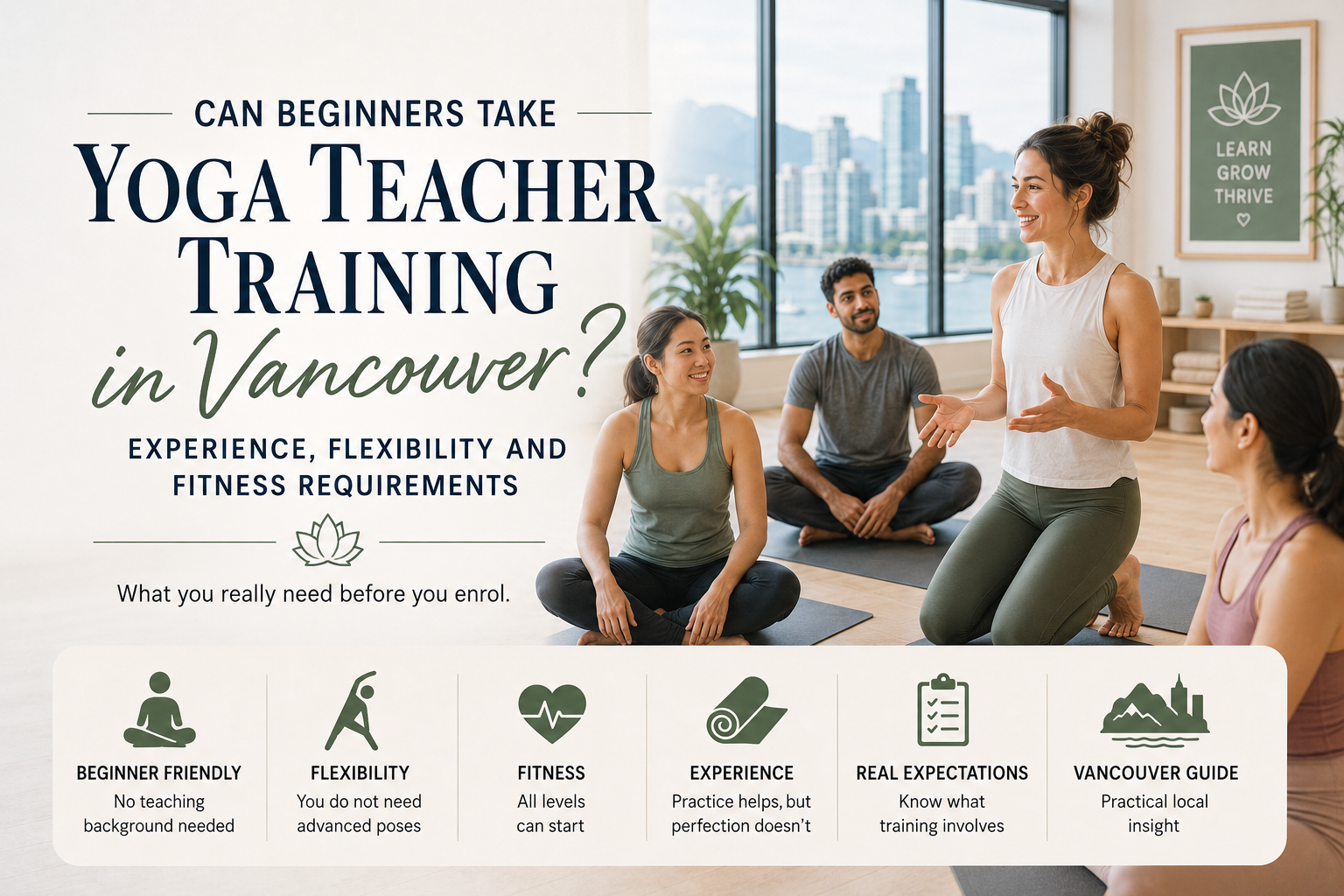
 Can Beginners Take Yoga Teacher Training in Vancouver? Experience, Flexibility and Fitness Requirements
If you love yoga but you’ve only been practicing for a few months, you might wonder if you’re allowed to sign up for teacher training. It’s one of the most common questions we hear from people exploring this path. Can beginners take yoga teacher training in Vancouver? Experience, flexibility and fitness requirements all matter, but maybe not in the way you think.
The short answer is yes. Most yoga teacher training (YTT) programs welcome beginners. You don’t need years of practice. You don’t need to touch your toes. You don’t need to be in peak physical shape. What you need is genuine interest, a willingness to learn, and enough consistency in your practice to understand the basics.
This guide breaks down exactly what training programs expect from you, what “beginner” really means in this context, and how to prepare so you walk into your first day of training feeling confident instead of anxious.
Yes, Beginners Can Join Yoga Teacher Training
Yoga teacher training isn’t reserved for advanced yogis who can fold into a full split or balance on one arm. Most 200-hour programs, including many offered in Vancouver, are designed to teach you yoga from the ground up. That includes anatomy, philosophy, teaching methodology, and pose alignment, not just how to strike a pretty shape for a photo.
Training providers know that people arrive with different backgrounds. Some have practiced for a decade. Others started six months ago after a friend dragged them to a class. Both types of students often end up in the same training room, and that’s by design. A good program teaches foundational skills so everyone leaves with the same base level of knowledge, regardless of where they started.
The Yoga Alliance International is a nonprofit association representing the yoga profession, sets minimum training hour standards for 200-hour and 500-hour programs, but it does not require a minimum number of years of practice before you enroll. Individual schools set their own prerequisites, and most ask for a basic, consistent practice rather than advanced skill.
That said, “beginner-friendly” doesn’t mean “no preparation needed.” Training is intensive. You’ll spend long days learning, practicing, and often teaching in front of your peers. Beginners who do well tend to have some familiarity with a regular class setting, even if it’s just a few months of attending weekly sessions. This isn’t a strict rule, but it makes the experience smoother and less overwhelming.
How Much Yoga Experience Do You Really Need?
There’s no universal number here, and any teacher training school that promises a hard rule like “you need exactly one year of practice” is oversimplifying things. What actually matters is your comfort level with basic movement and vocabulary.
Here’s what most training programs expect, informally:
- You can move through a Sun Salutation without needing every step explained
- You understand basic pose names like Downward Dog, Warrior II, and Child’s Pose
- You’ve attended enough classes to have a feel for breath-based movement
- You’re comfortable being a student in a room full of other students
Notice that none of these require years of dedicated practice. Someone who has taken two classes a week for four months can often meet this bar. Someone who has taken one class a year for five years might actually need more preparation, because consistency matters more than tenure.
Some schools do ask for a minimum practice period, often around six months to one year, before starting training. This isn’t about gatekeeping. It’s about making sure you get real value from the program instead of struggling to keep up. If a school has this requirement, it’s usually stated clearly on their program page, so it’s worth checking before you apply.
If you’re unsure whether your current experience level is enough, most training providers are happy to have a conversation with you before you commit. A short call or email exchange can clarify whether you’re ready now or whether a few more months of regular practice would help. This is a much better approach than guessing, and reputable schools want you to succeed, not just enroll.
Do You Need to Be Flexible to Become a Yoga Teacher?
This is probably the biggest myth in the entire yoga world, and it stops a lot of capable people from even considering training. Flexibility is not a requirement for yoga teacher training. It’s also not a requirement for teaching yoga well.
Yoga is a physical practice, but it’s built on far more than deep backbends and splits. Teaching yoga involves breathing techniques, alignment cues, sequencing, philosophy, anatomy, poses and the ability to hold space for a room full of students with different bodies and abilities. A teacher with less natural flexibility often becomes better at explaining modifications, because they’ve had to work through their own limitations first.
Research on flexibility backs this up. According to the Mayo Clinic, flexibility varies significantly between individuals based on genetics, joint structure, age, and training history, and it can be improved gradually over time with consistent practice. It is not a fixed trait you either have or don’t have.
In a training program, you’ll practice poses daily, which naturally improves flexibility over the weeks. But the goal of training isn’t to turn you into a contortionist. It’s to teach you how yoga works, so you can guide others safely and effectively. Some of the most respected yoga teachers in the world have naturally stiff hips or tight hamstrings. What makes them effective isn’t their flexibility. It’s their understanding of how the body moves and how to communicate that to students.
If tight hamstrings or a stiff lower back have been holding you back from applying, let this be the sign to stop waiting. Flexibility develops with practice. Teaching skill develops with training. Neither requires you to start as a finished product.
Fitness Requirements: What Level of Physical Health Is Expected?
Yoga teacher training is physically demanding in a different way than most people expect. It’s not about strength or cardio endurance in the traditional sense. It’s about stamina, since you’ll be moving, sitting, and practicing for several hours a day over multiple weeks or weekends, depending on the program format.
You don’t need to run five kilometers or lift weights to prepare. What helps more is building a baseline of general movement tolerance. Can you sit comfortably on the floor for extended periods? Can you stand and move for a few hours without significant discomfort? Can you handle a moderately paced physical activity without needing long breaks? If yes, you’re likely fit enough to begin.
Training days often include multiple practice sessions, workshops, and teaching labs. This adds up to more physical activity in a single day than a typical yoga class. According to the National Center for Complementary and Integrative Health, yoga combines physical postures, breathing techniques, and meditation, and its intensity can range from gentle to vigorous depending on the style. Teacher training tends to sit on the more vigorous end simply because of the volume of practice involved, not because any single posture is extreme.
If you have a pre-existing injury, chronic pain condition, or a medical concern, it’s worth having a conversation with both your healthcare provider and the training school before enrolling. Most programs can accommodate modifications, but they need to know in advance so they can support you properly. Being upfront about physical limitations is far more useful than pushing through pain silently, which helps no one and can lead to injury.
Overall, fitness matters less than most people assume. Willingness to show up, move your body daily, and rest when needed matters more.
 What a Typical 200-Hour YTT in Vancouver Looks Like
Understanding the actual structure of training helps put the experience and fitness questions into perspective. A 200-hour yoga teacher training program is the foundational certification level recognized across the yoga industry. It typically covers five core areas: asana (postures), pranayama (breathwork), teaching methodology, anatomy and physiology, and yoga philosophy and ethics.
Programs are often structured in one of two formats. Some run as an intensive, several weeks in a row, full days. Others run part-time over a few months, usually on weekends, so students can continue working or attending school during the week. Vancouver, with its strong wellness and fitness culture, offers both formats, giving beginners flexibility in choosing what fits their schedule and energy levels.
A typical day of training includes a morning practice session, lecture-style learning blocks covering anatomy or philosophy, small group teaching practice, and a closing practice or discussion. This rhythm allows the body to move, rest, and then move again, which is part of why extreme fitness isn’t necessary. The structure itself builds in recovery time.
By the end of a 200-hour program, most graduates meet the training hour requirement set by the Yoga Alliance International for Registered Yoga School standards, which outlines the minimum contact hours and curriculum categories a program must cover. This is the credential most new yoga teachers pursue before teaching publicly, and it’s the standard many studios look for when hiring.
Knowing this structure in advance helps beginners set realistic expectations. You’re not walking into a bootcamp designed to test your limits. You’re walking into a structured educational program designed to build your knowledge and skill step by step.
How to Prepare as a Beginner Before Training Starts
Preparation makes a real difference in how confident and comfortable you feel once training begins. You don’t need to become an expert before day one, but a few months of intentional groundwork goes a long way.
Start by attending classes consistently, ideally two to three times a week, for at least a few months before your program starts. This builds physical familiarity with common poses and helps your body adjust to regular movement. It also helps you get comfortable being a student, which makes the transition to being a student-teacher smoother.
Read a beginner-friendly book on yoga philosophy or anatomy. You don’t need to memorize anything. Just get familiar with terms like chakra, dosha, or vinyasa so they don’t feel foreign on day one. Many training programs provide a reading list before the course starts, so check with your chosen school for specific recommendations.
Work on basic breath awareness outside of class. Simple practices like deep belly breathing or box breathing for a few minutes a day build the kind of body awareness that supports pranayama training later.
Consider your physical routine leading up to training. Light stretching, short walks, or gentle strength work can help build the stamina needed for longer practice days. This isn’t about intense preparation. It’s about giving your body a gentle head start.
Finally, talk to the training provider directly. Ask about prerequisites, daily schedules, and what past beginners found challenging. A transparent school will answer honestly and help you understand exactly what to expect, which reduces first-day nerves significantly.
Common Concerns Beginners Have (and Honest Answers)
Most beginners considering yoga teacher training share a similar set of worries. Addressing them directly helps separate real concerns from myths.
“I’m not flexible enough.” As covered earlier, flexibility isn’t a prerequisite. It improves with consistent practice, and training itself builds it naturally over time.
“I don’t know enough yoga terminology.” Training programs teach terminology from the start. You’re not expected to arrive fluent in Sanskrit terms or philosophy concepts. That’s literally what the curriculum covers.
“I’ll be the least experienced person in the room.” This happens less often than people fear, since most trainings have a real mix of experience levels. Even if you are less experienced, this isn’t a disadvantage. Beginners often bring fresh curiosity that benefits group discussions.
“What if I can’t keep up physically?” Training paces are designed to be sustainable across many days, not a single intense workout. Programs build in rest, and modifications are standard practice, not a special accommodation.
“Will I actually be qualified to teach after this?” A completed 200-hour program that meets Yoga Alliance International standards qualifies you to register as an RYT (Registered Yoga Teacher) and begin teaching. Many graduates start with substitute teaching or assisting before building their own class schedule, which is a normal and low-pressure way to gain experience.
“Is this too big a commitment for someone still new to yoga?” Commitment matters more than experience level. Training asks for consistent effort and openness to learning, not years of prior mastery. Beginners who commit fully often do just as well as, or better than, students who arrived with more physical experience but less enthusiasm for the learning process.
 Signs You’re Ready to Start Your YTT Journey
Instead of measuring readiness by flexibility or fitness level, it helps to look at a different set of signals. These indicators tend to predict success in training far more reliably than how deep your backbend is.
You’re curious about the “why” behind poses, not just the “how.” If you find yourself wondering why a certain alignment cue matters, or why breath and movement are linked, that curiosity will serve you well in a training environment built around understanding, not just performing.
You attend classes because you want to, not because you feel obligated. Genuine enjoyment of practice, even inconsistent practice, suggests you’ll stay engaged during an intensive program.
You’re comfortable with being a beginner in other areas of life. Teacher training asks you to learn new skills, including public speaking and teaching methodology, which most people haven’t done before. If you’re generally open to learning uncomfortable new skills, that mindset transfers well.
You have the time and energy to commit fully during the training period. Whether it’s a few weeks of full-time immersion or several months of weekends, having realistic bandwidth matters more than any physical benchmark.
You want to deepen your practice, whether or not you plan to teach professionally afterward. Many students take teacher training purely for personal growth, and that’s a completely valid reason to enroll.
If most of these apply to you, you’re likely ready, regardless of how many years you’ve practiced or how flexible you currently are.
Conclusion: Can Beginners Take Yoga Teacher Training in Vancouver?
So, can beginners take yoga teacher training in Vancouver? Experience, flexibility and fitness requirements matter less than most people assume, and the answer is a clear yes. What actually matters is consistency in your current practice, curiosity about how yoga works, and a genuine willingness to learn and grow, both physically and mentally.
Flexibility develops over time. Fitness builds gradually through the structure of the training itself. Experience deepens naturally as you move through a well-designed curriculum covering anatomy, philosophy, and teaching methodology. None of these need to be perfected before you start. They’re part of what training is designed to build.
If you’ve been holding back because you don’t feel “advanced enough,” let this be your sign to reconsider. Teacher training rooms are full of people who started exactly where you are now: curious, a little nervous, and ready to learn.
If you’re ready to become a yoga teacher, check out our 200-hour YTT program to see how you can start your journey, wherever your practice currently stands.