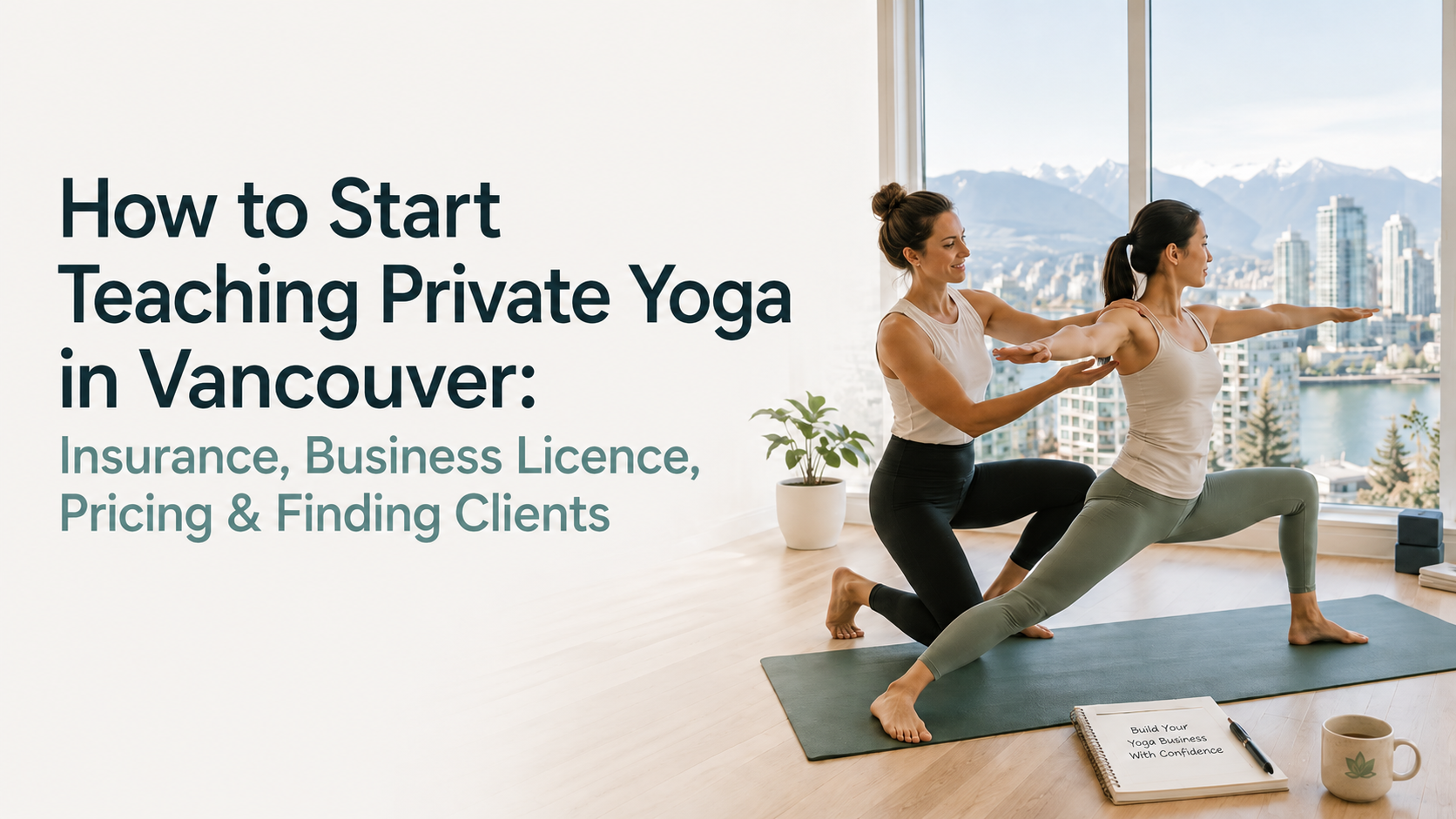
 How to Start Teaching Private Yoga in Vancouver: Insurance, Business Licence, Pricing & Finding Clients
Teaching private yoga can be one of the best ways to turn yoga instruction into a sustainable business. You are not limited by a studio schedule. You can work directly with students, set your own rates, choose your teaching hours, and create sessions around the needs of each client.
But private teaching also changes your responsibilities. When you work independently, you are not simply the person leading the class. You are also running a small business. You need to think about insurance, municipal licensing, taxes, client records, pricing, cancellations, marketing, and how you will actually find people willing to pay for one-on-one instruction.
How to Start Teaching Private Yoga in Vancouver: Insurance, Business Licence, Pricing & Finding Clients walks through those steps in practical order.
This guide is written for yoga teachers working in the City of Vancouver, although many of the business principles apply throughout British Columbia. Municipal rules can differ between Vancouver, Burnaby, Richmond, North Vancouver, Surrey, and other municipalities, so always check the rules where your business is actually based.
If you have recently graduated and are still deciding how private teaching fits into your larger career, also read our How to Get Your First Yoga Teaching Job in Vancouver guide. Read the guide
1. Decide What Your Private Yoga Business Actually Looks Like
Before applying for licences or setting prices, decide how you will deliver your sessions.
A private yoga business can operate in several ways.
You might travel to clients’ homes. You might teach from your own home. You could rent treatment, fitness, or studio space by the hour. You might teach small groups in condominium amenity rooms. Some teachers combine in-person sessions with online instruction. Others add corporate yoga, hotel sessions, workshops, or outdoor classes.
Your business model affects almost everything that follows.
A teacher who drives to clients throughout Kitsilano, Mount Pleasant, Yaletown, and downtown has different costs from someone who teaches from one home studio. Travel adds unpaid time. Parking adds expenses. Carrying mats, blocks, straps, and bolsters adds another layer of work.
Teaching from home removes much of that travel, but home-based businesses in Vancouver have specific rules. Renting studio space adds professional separation and may allow you to charge more, but the rental cost must be reflected in your rate.
Start with a narrow offer.
Instead of advertising yourself simply as “a private yoga teacher,” explain who you help and what the client receives.
Examples include private yoga for beginners, mobility-focused yoga for active adults, gentle yoga for older adults, private vinyasa instruction, restorative yoga, private yoga for couples, or individualized yoga for people who feel uncomfortable in large group classes.
Do not claim to diagnose, treat, rehabilitate, or cure medical conditions unless you hold appropriate professional qualifications that allow you to provide those services. Good private teaching often involves working around limitations. It does not require presenting yourself as a healthcare provider.
If you are still building your teaching experience, our Life After 200 Hours: How to Actually Start Teaching Yoga in Vancouver article covers the broader transition from training into paid work. Read Life After 200 Hours
 2. Get Yoga Teacher Liability Insurance Before Taking Private Clients
Insurance should be one of the first expenses in your private yoga business.
There is no general Canadian law that automatically requires every yoga instructor to carry liability insurance. However, studios, recreation facilities, corporate clients, landlords, and other venues may require proof of insurance before allowing you to teach. Independent teachers also face liability directly because there is no studio standing between the teacher and the client.
A yoga insurance policy commonly includes two important forms of protection.
Commercial general liability insurance deals with risks such as bodily injury or property damage. For example, a client could trip over equipment during a session or allege that something was damaged while you were teaching in their home.
Professional liability insurance, sometimes called errors and omissions insurance, addresses allegations connected to your professional instruction. A client might claim that your cueing, sequencing, modification, or physical adjustment contributed to an injury.
Those are different risks, so confirm exactly what a policy covers instead of assuming that the words “liability insurance” cover everything.
A 2026 Canadian yoga-insurance guide from Zensurance estimates basic yoga instructor policies at roughly $300 to $600 per year, although actual premiums depend on the activities you teach, limits, business size, and additional coverage.
Canadian yoga instructor insurance overview — Zensurance yoga insurance guide
When requesting quotes, tell the broker exactly what you do. Mention private sessions, home visits, online instruction, outdoor classes, retreats, hot yoga, prenatal yoga, aerial yoga, workshops, or other activities if they apply. Ask whether your policy covers each one.
Also ask about geographic restrictions. A policy covering teaching in British Columbia may not automatically cover a retreat in another country or an online client living outside Canada.
If a client or venue asks to be listed as an additional insured, contact your broker. Do not simply assume your existing certificate satisfies the request.
Finally, remember that a waiver does not replace insurance. Use both appropriate client documentation and proper insurance.
Our 200-Hour YTT Vancouver: What Happens After You Graduate guide also explains insurance and other post-graduation steps. Read the post-graduation guide
3. Do You Need a Business Licence to Teach Private Yoga in Vancouver?
This is where many new teachers become confused.
There is not a special City of Vancouver “yoga teacher licence.” Instead, Vancouver licenses businesses according to their activities and where they operate.
If you operate a business from your Vancouver residence, the City says you may need a home-based business licence. The City defines a home-based business as a business, trade, profession, or occupation located within your home while the building remains primarily residential.
City of Vancouver home-based business licence information — Official City guidance
This matters even if much of your teaching happens elsewhere and your home functions as your business base.
If clients actually come to your home, additional rules apply. As of August 2026, the City permits a maximum of three customers at a home at one time. Customers must attend by appointment. Permitted customer hours are 8 a.m. to 8 p.m. on weekdays and 10 a.m. to 8 p.m. on weekends and holidays. The home-business area is also limited to one-third of the home’s gross floor area or 46 square metres, whichever is less.
Those limits make a home studio suitable for private or very small sessions. They do not turn a residential apartment into an unrestricted commercial yoga studio.
If you rent your home, live in a secondary suite, or live in a strata property, check your lease, landlord requirements, and strata bylaws as well. Municipal approval does not automatically override private contractual or strata restrictions.
The City currently lists a $77 non-refundable application fee for a home-based business licence. The annual licence fee depends on the business classification. Licences expire December 31 and require renewal.
If you operate from a commercial location, a rented studio, or another dedicated business premise, different zoning, building, and licensing requirements may apply. The City recommends checking whether a proposed location is approved for the intended business use before committing to the space.
City of Vancouver general business licence information — Business licence requirements
If your business is based outside Vancouver but you regularly carry on business inside Vancouver, the City also has an “out-of-town business” category. Confirm your specific situation with the Business Licence Office rather than assuming that a licence from another municipality automatically covers Vancouver.
4. Outdoor Private Yoga and Park Permits
Vancouver’s parks and beaches look like obvious places to teach yoga during warmer months. However, organized commercial or structured recreation is different from meeting a friend for an informal practice.
The Vancouver Park Board states that organized recreation activities in parks require a private recreation permit whether the organizer charges participants or not. Yoga classes are specifically included as an example.
Vancouver private recreation permits for parks — Check the Park Board requirements
Do not assume that a small group automatically avoids permit requirements.
This is particularly important if you advertise a recurring “Yoga at Kits Beach” class, collect payment, bring several students, or reserve the same area regularly.
For a truly private one-on-one session, confirm the rules that apply to the location and activity before marketing the park as your regular business venue.
Your insurer may also have conditions for outdoor classes, so include outdoor teaching when requesting coverage.
 5. Choose a Business Structure and Register Your Name if Necessary
Most yoga teachers starting a small private practice do not need to incorporate immediately.
A sole proprietorship is often the simplest structure. You operate the business personally and report the business income on your own tax return. The trade-off is that a sole proprietor is personally responsible for the business’s liabilities.
British Columbia says that if you operate a sole proprietorship using only your personal legal name, you do not need to register a separate business name with the province. If you use a business or brand name instead, you generally need to reserve the name and register the sole proprietorship.
For example, “Jane Smith” can operate differently from a branded name such as “West Coast Private Yoga.”
Current provincial fees list a $30 name request and a $40 online registration fee for a sole proprietorship.
BC Registries information for sole proprietorships — Province of British Columbia guidance
Some teachers incorporate later as their revenue, liabilities, staffing, or business complexity grows. Incorporation should be a financial and legal decision rather than something you do simply because the business sounds more professional.
An accountant or lawyer can help determine when a corporation makes sense for your particular circumstances.
6. Understand Taxes Before Your Client List Grows
Private yoga income is business income.
Keep records from the beginning rather than trying to reconstruct everything at tax time.
Track payments from private clients, packages, corporate sessions, workshops, online lessons, and any other teaching income. Keep receipts for legitimate business expenses such as insurance, advertising, studio rental, booking software, payment-processing fees, and supplies.
Some vehicle, home-office, telephone, education, and other costs may also be deductible depending on the circumstances and CRA rules. The fact that you spent money does not automatically make the entire amount deductible.
If you want a deeper explanation of education expenses, read our Is Yoga Teacher Training Tax Deductible in Canada? (2026 Guide). Read the tax guide
GST is another issue to watch as revenue grows.
For most businesses, CRA’s small-supplier threshold is $30,000 in taxable supplies. The timing of mandatory GST/HST registration depends on whether you exceed the threshold in a single calendar quarter or over consecutive calendar quarters.
CRA GST/HST registration rules — Official CRA guidance
Do not wait until you are far beyond the threshold before learning how it works.
A simple bookkeeping system can save enormous trouble. Use a separate bank account or at minimum a clear system that keeps personal and business transactions easy to distinguish. Issue invoices or receipts. Track kilometres if you travel between clients and intend to claim eligible vehicle expenses. Save digital copies of receipts.
An accountant familiar with sole proprietors can often answer these questions in one meeting.
If you eventually hire another teacher or worker, WorkSafeBC becomes another consideration. WorkSafeBC states that businesses hiring workers generally must register for coverage, while self-employed proprietors or partners may be eligible to purchase optional personal coverage.
WorkSafeBC coverage information — Check WorkSafeBC requirements
7. How Much Should You Charge for Private Yoga in Vancouver?
There is no regulated private-yoga rate in Vancouver.
Your rate depends on experience, specialization, demand, location, travel, studio rental, session length, and what the service includes.
Current publicly advertised Vancouver-area prices demonstrate how wide the market is. Examples include 60-minute private sessions advertised around $80, $100, $120, $125 and $150.
Example: Vancouver private yoga at $120 per hour — View current pricing example
Example: Vancouver private yoga at $150 per hour — View another local pricing example
That does not mean every teacher should charge the same amount.
A useful starting framework for a newer independent teacher is roughly $90 to $125 for a 60-minute session. An established teacher with strong demand, substantial experience, a specialized audience, or significant travel requirements may reasonably charge more.
Do not price only the hour spent teaching.
A 60-minute session in a client’s home might involve:
- 20 minutes preparing the session
- 30 minutes travelling there
- 60 minutes teaching
- 30 minutes travelling back
- 10 minutes handling scheduling and notes
Your “$100 hour” has just become $100 for roughly two and a half hours of work before expenses.
That is why travel zones matter.
You might charge one rate within your core Vancouver area and add a travel surcharge beyond it. Alternatively, set a minimum booking value for longer trips.
For example:
60-minute private session: $110
90-minute private session: $150
Two-person semi-private: $145
Five-session package: $520
Travel outside core area: additional fee
These numbers are examples, not required prices.
Our Yoga Teacher Income in Vancouver: Studio Pay, Private Clients & What to Expect in Year One article goes deeper into how private sessions fit into a teacher’s overall income. Read the Vancouver yoga income guide
8. Packages, Cancellation Policies and Payment
Good business policies make private teaching easier for both the teacher and the student.
Do not invent rules after a problem occurs.
Decide your cancellation policy before taking your first client. Twenty-four hours is common in appointment-based businesses. Some instructors use a longer window.
Whatever you choose, state it clearly when the client books.
If you sell packages, define:
- Number of sessions
- Expiry period
- Refund policy
- Cancellation policy
- Whether packages are transferable
- Whether sessions can be paused
- What happens if you cancel
- Whether travel fees are included
Packages can improve retention because they shift the conversation away from “Should I book another class?” toward an ongoing practice.
Do not discount so heavily that a package becomes unprofitable.
A modest discount may make sense. For example, five sessions normally priced at $110 would total $550. A $520 package rewards commitment without reducing the perceived value of the service dramatically.
You can also sell a structured introductory program instead of random sessions.
For example:
“Four-week Private Yoga Foundations Program — four 60-minute sessions plus a simple personalized home practice.”
That gives the client a clearer reason to buy than simply purchasing four hours of your time.
 9. Use Intake Forms, Informed Consent and Clear Professional Boundaries
Private sessions require more individual knowledge than group classes.
Before the first appointment, ask enough questions to understand the student’s experience and relevant limitations.
Useful questions can include previous yoga experience, current physical limitations, recent injuries or surgeries, pregnancy where relevant, movements that cause discomfort, and the client’s goals.
You do not need to collect every possible piece of health information.
British Columbia’s Personal Information Protection Act applies to private-sector organizations that collect, use, or disclose personal information. Businesses must protect personal information and use it for appropriate purposes.
Office of the Information and Privacy Commissioner for BC: PIPA information — Read the privacy requirements
Collect only information that has a legitimate purpose. Store it securely. Do not leave detailed client health notes sitting in an unlocked vehicle or accessible shared folder.
Consider using a properly drafted liability waiver and informed-consent document. A waiver should explain the nature of the activity and its risks. It should not be treated as a magic document that removes every possible legal responsibility.
If your business model depends heavily on waivers or involves higher-risk activities, have a British Columbia lawyer review your documentation.
Your professional boundary is equally important.
You can say, “We can modify this pose because that movement is uncomfortable.”
Be much more cautious about saying, “This practice will heal your back injury.”
Private teaching becomes more credible, not less, when teachers understand where yoga instruction ends and medical diagnosis or treatment begins.
10. How to Find Your First Private Yoga Clients in Vancouver
Most private-yoga businesses do not start because strangers suddenly discover a new website.
The first clients usually come from relationships.
Start with people who already know how you teach.
That might include former classmates, friends, coworkers, existing yoga students, gym contacts, sports groups, or people who have attended community classes.
If you teach at a studio, respect your contract and the studio’s relationship with its customers. Do not aggressively solicit students from a studio’s customer list. A good professional reputation has more long-term value than one private booking.
Instead, make sure people know that private instruction is available.
Mention it naturally after classes when appropriate. Include it in your teacher bio. Put a private-yoga page on your website. Add a link to your email signature. Post useful educational content rather than endlessly advertising appointments.
Your offer also needs to solve a recognizable problem.
“Private yoga available” is vague.
“One-on-one yoga for beginners who want to learn the fundamentals before joining group classes” is specific.
“Private mobility-focused yoga for runners” is specific.
“At-home yoga for busy professionals in downtown Vancouver” is specific.
The narrower message often attracts more people because potential clients can immediately recognize themselves.
Our Business of Yoga: How to Build Your Teaching Brand in Vancouver article explores positioning, pricing, boundaries, and building a recognizable local teaching identity. Read the business-of-yoga guide
11. Build a Google Presence for Local Private Yoga Searches
Google can become particularly useful for private yoga because the searcher’s intent is strong.
Someone searching “private yoga Vancouver,” “private yoga teacher near me,” or “one-on-one yoga Vancouver” is often much closer to making a purchase than someone casually scrolling through an Instagram feed.
Create a clear service page explaining:
- Who private yoga is for
- Areas you serve
- Session length
- Starting price or pricing structure
- Where sessions take place
- Your experience and training
- What happens during the first session
- How to book
Consider creating a Google Business Profile if your business meets Google’s eligibility requirements.
If you travel to clients and do not serve customers at your home address, Google allows eligible businesses to operate as service-area businesses. Google specifically instructs service-area businesses to hide their residential business address from customers and display the service area instead.
Google Business Profile service-area guidance — Official Google guidance
Do not create fake office addresses or virtual storefronts simply to rank in multiple Vancouver neighbourhoods. Google’s guidelines require genuine business locations.
Ask satisfied clients for honest Google reviews. Never manufacture them.
A small number of detailed reviews describing what the person actually valued about your teaching can be more persuasive than hundreds of social-media followers.
12. Build Referrals Instead of Depending Entirely on Social Media
Instagram can help, but a private-yoga business should not depend on it.
Referral relationships are often much more valuable.
Potential partners include fitness professionals, running groups, personal trainers, wellness businesses, condominium communities, hotels, employers, and other yoga teachers.
The strongest referral relationships are reciprocal and appropriate.
For example, another teacher may focus on advanced vinyasa but receive enquiries from beginners who want individual instruction. If you specialize in beginners, that teacher could refer people to you.
Likewise, if somebody asks you for a service outside your training and competence, having trusted professionals to whom you can refer that person improves your credibility.
Corporate wellness can also lead to private clients. A 45-minute office yoga class exposes multiple people to your teaching at once. Some may later ask about private sessions.
Do not turn every interaction into a sales pitch. Private clients hire teachers they trust. Teaching well remains the best marketing strategy available.
 13. A Practical First 90-Day Plan
You do not need twenty clients before launching.
During your first two weeks, handle the foundation. Confirm your insurance. Determine your business-licence requirements. Register your business name if necessary. Set up payment, bookkeeping, intake forms, cancellation terms, and a simple booking system.
Next, create one clear private-yoga offer.
Set your price.
Do not launch five different programs.
During weeks three through six, focus on visibility. Tell your network that you are accepting private clients. Add a page to your website. Update your teacher bio. Create your Google Business Profile if eligible. Contact a small number of potential referral partners.
Try to secure your first three paying clients rather than obsessing over follower counts.
During weeks seven through twelve, look at what is actually happening.
Which clients are booking again?
Which source produced your enquiries?
Are you spending too much time driving?
Is your rate profitable?
Are clients asking for evening appointments that you do not want to provide?
Is one particular type of student responding to your teaching more strongly than others?
Use real behaviour to refine the business.
You may discover that you started with “private yoga for everyone” but that most of your successful clients are beginners between 40 and 60 who want to become stronger and more mobile without entering an intimidating group class.
That information is valuable. Build around it.
14. Common Mistakes New Private Yoga Teachers Make
The first mistake is undercharging.
A teacher sees $50 studio-class pay and assumes $70 for a private session sounds generous. But studio teaching and private teaching are fundamentally different businesses. Private teaching includes acquisition, scheduling, travel, administration, customized planning, insurance, and cancellations.
The second mistake is ignoring the business licence because the teacher only has one or two clients. Small scale does not automatically remove municipal requirements.
The third mistake is buying insurance without reading the policy. Make sure your actual teaching activities are included.
The fourth mistake is having no cancellation policy. Eventually somebody will cancel ten minutes before an appointment. Decide what happens before that day arrives.
The fifth mistake is trying to market to everybody. “Yoga for everyone” rarely gives a client a compelling reason to choose one teacher over another.
The sixth mistake is making medical promises outside your professional scope.
The seventh mistake is collecting sensitive client information casually. Treat client records as business records requiring privacy and security.
The eighth mistake is believing social media is the business. It is not.
Your business is the relationship between delivering a valuable service, getting clients, retaining clients, receiving referrals, and charging enough to make the work sustainable.
Conclusion: How to Start Teaching Private Yoga in Vancouver: Insurance, Business Licence, Pricing & Finding Clients
How to Start Teaching Private Yoga in Vancouver: Insurance, Business Licence, Pricing & Finding Clients ultimately comes down to building a professional foundation before trying to scale.
Get appropriate liability insurance. Confirm the City of Vancouver business licence that fits your teaching model. Register your business name if required. Keep accurate financial records and understand the GST threshold as your revenue grows. Use clear intake, privacy, cancellation, and payment policies.
Then price the service based on the full amount of work involved, not simply the 60 minutes you spend on the mat.
Most importantly, focus on becoming useful to a specific type of student. Private yoga succeeds when a client understands why working individually with you is more valuable than simply buying another drop-in class.
You do not need a massive following. A teacher with eight reliable weekly private clients can have a much stronger business than a teacher with thousands of social-media followers and no consistent bookings.
Start small. Teach well. Create professional systems. Ask for referrals. Adjust your offer as you learn what Vancouver clients actually want.
If you’re ready to become a yoga teacher and build the skills you need to start teaching professionally, explore our 200-Hour Yoga Teacher Training in Vancouver program. It covers the practical teaching foundation that comes before studio work, private clients, and building your own yoga business. Explore our 200-Hour Yoga Teacher Training
If becoming a teacher has been on your mind, our 200-hour YTT page is the best place to start. Review the curriculum, training format, dates, and requirements and decide whether the program fits the kind of yoga teacher you want to become. View the 200-Hour YTT program