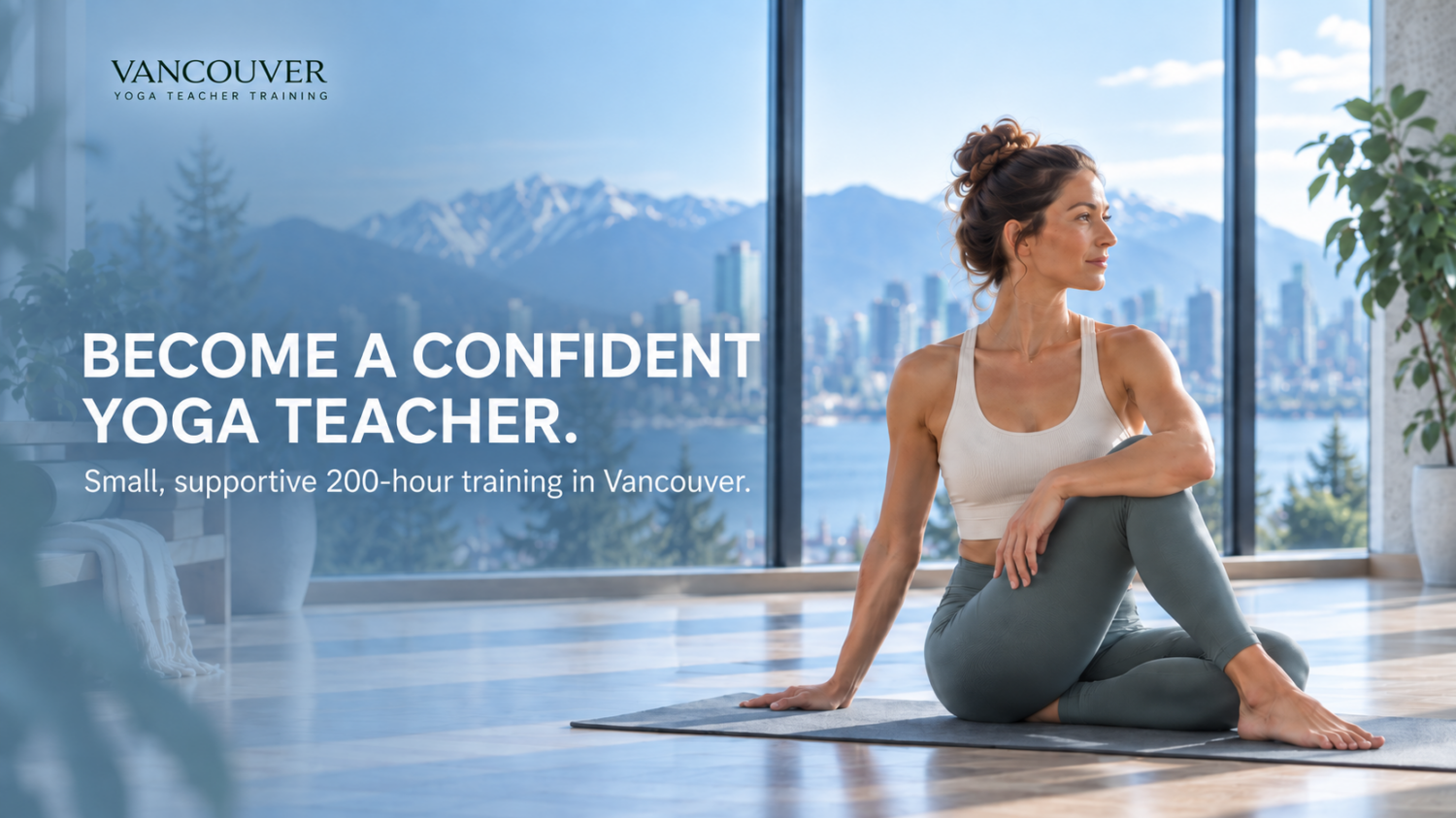
 Yoga Teacher Training in Vancouver Over 40: Is It Too Late to Start Teaching?
You hit 40. Maybe 45. Maybe 55. You roll out your mat most mornings, and somewhere between downward dog and savasana, a quiet thought surfaces: I could teach this. Then a louder thought shuts it down: You’re too old. The studios want twenty-somethings in crop tops.
Let’s settle this right now. Yoga Teacher Training in Vancouver Over 40: Is It Too Late to Start Teaching? The short answer is no. The longer answer is more interesting, and it’s the one worth reading. Vancouver’s yoga community is older, more diverse, and more experienced than the Instagram feed suggests. Studios are quietly desperate for teachers who can hold space for real human bodies, real life stress, and real spiritual depth. Those teachers are usually over 40.
This guide walks you through what training actually looks like at this stage of life. It covers the science of the older body, the financial reality of teaching in Vancouver, what students in their 30s, 40s, and 50s are looking for in a teacher, and how to choose a program that respects your experience instead of treating you like a college freshman. Read it through. By the end, the question won’t feel scary anymore.
The Myth That Yoga Teaching Belongs to the Young
Walk into any yoga teacher training open house in Vancouver, and you’ll see a striking range of ages. The 22-year-old fresh out of UBC sits next to the 58-year-old retired nurse. The 35-year-old new mom sits next to the 47-year-old engineer who’s switching careers. This isn’t unusual. This is the room.
The myth of the young yoga teacher comes from social media, not from studios. Algorithm-friendly content rewards flexibility, novelty, and visual spectacle. Posting a handstand video gets more likes than posting a thoughtful breakdown of pelvic alignment. So we see a curated feed that doesn’t reflect who’s actually teaching the 6 a.m. class at your neighborhood studio in Kitsilano or Mount Pleasant.
Yoga has a long history of being taught by elders. The tradition itself values lineage, lived experience, and patience. Krishnamacharya, often called the father of modern yoga, taught well into his 90s. B.K.S. Iyengar was still teaching workshops in his 80s. Indra Devi taught into her 100s. Closer to home, many of Vancouver’s most respected senior teachers started their training in their 40s or 50s. They didn’t come up through the Lululemon era. They came up through curiosity, life experience, and a deep practice.
What students actually want, especially adult students, is a teacher who has lived. Someone who understands what a sore lower back feels like at 7 a.m. on a Monday. Someone who knows grief, parenting, divorce, job stress, or chronic injury from the inside. That isn’t a 22-year-old’s wheelhouse, and that’s fine. It’s yours.
The Yoga Alliance, the largest international yoga teaching credential body, publishes demographic data showing teacher trainees skewing well into mid-life and beyond. The industry knows what students want. Studios know it too. You’re not the exception. You’re the demographic.
What Your Over-40 Body Actually Brings to the Mat
Let’s talk physiology honestly. Your body at 45 is different than your body at 25. That’s not a deficit. That’s information.
By your 40s, you’ve likely had at least one significant physical experience that informs your teaching. Maybe it was a pregnancy. Maybe a knee surgery, a sprained ankle, a frozen shoulder, a herniated disc, or recurring sciatica. Maybe perimenopause arrived, and with it a new relationship with sleep, mood, and joint stiffness. Maybe you simply noticed that the recovery time from a hard workout doubled.
This is gold for a teacher. Most yoga students who walk into a studio in Vancouver are between 30 and 60. They have stiff hips from sitting at desks. They have neck tension from looking at phones. They have hormonal shifts, parenting fatigue, and unresolved injuries from their twenties. A teacher who has personally navigated these things doesn’t have to imagine what a student is feeling. They know.
Older trainees also tend to bring stronger interoception, which is the ability to sense what’s happening inside the body. Younger practitioners sometimes have so much mobility that they can power through poses without feeling them properly. By your 40s, your body talks back. You feel the difference between a real twist and a faked one. You feel when your shoulder is compensating. That sensory honesty makes you a better cueing teacher, because you describe what’s actually happening, not what the pose is supposed to look like in a photo.
Research from the National Institutes of Health supports yoga’s benefits across the lifespan, including for older adults, with documented effects on balance, flexibility, stress, and chronic pain. You will not be teaching from a body that’s past its prime. You’ll be teaching from a body that finally pays attention.
Yes, you may need to modify your own practice. You may not demonstrate every variation of every pose. Good. That’s what props are for, and prop literacy is one of the most valuable skills a teacher can develop. The teacher who uses a block well is more useful to most students than the teacher who can lift into handstand on cue.
 The Vancouver Yoga Landscape in 2026
Vancouver’s yoga scene is dense, varied, and surprisingly welcoming to second-career teachers. From the West End to East Van, from Kits to North Van to New West, you’ll find studios specializing in vinyasa, hatha, yin, restorative, Iyengar, ashtanga, kundalini, hot yoga, prenatal, and trauma-informed practice. Community centers run accessible classes. Physiotherapy clinics increasingly offer therapeutic yoga. Senior centers want gentle classes. Workplaces book corporate yoga.
The market is bigger than the boutique studio circuit. That matters because the studio model alone is not where most teachers earn a sustainable living. Vancouver studio class rates for teachers typically range from around $40 to $80 per class, sometimes with a small bonus for attendance over a threshold. You can do the math. Teaching ten studio classes a week is exhausting and still doesn’t replace a professional salary on its own.
But teachers over 40 often have an advantage younger teachers don’t: a network, a profession to integrate with, and the credibility to charge well for private sessions. Private clients in Vancouver routinely pay $100 to $150 per hour. Corporate classes for tech companies, law firms, and accounting offices pay similarly well. Specialized work, like teaching nurses, expecting parents, or seniors, commands strong rates and consistent bookings.
Vancouver also hosts a robust wellness ecosystem connected to retreats on Vancouver Island, the Sunshine Coast, and Whistler. Established teachers often co-lead weekend retreats, mentor newer teachers, or build small group programs. None of this is closed to you because of your age. Much of it is opened to you because of your age.
You may also want to verify your continuing education and credentialing path through Yoga Alliance International, which most Vancouver studios still recognize as the standard credential. While Yoga Alliance registration is not legally required to teach in British Columbia, most studios prefer or require it for insurance, hiring, and continuing education.
Choosing the Right 200-Hour Yoga Teacher Training in Vancouver
A 200-hour training is the foundational credential for yoga teachers, and the quality of programs varies enormously. Choosing the right one matters more in your 40s than it did in your 20s, because your time has more competing demands. You want substance, not theater.
Here’s what to look for, especially as a trainee over 40.
First, look at the lead teacher’s experience and age. A lead trainer who is themselves over 40, or who has been teaching for more than fifteen years, will create a different learning environment than a 28-year-old running their first cohort. You want someone who has taught through injuries, life transitions, and decades of student demographics. Their language and curriculum will reflect that.
Second, check the anatomy and physiology hours. A good program spends real time on functional anatomy. Look for at least 30 to 40 hours of dedicated anatomy education, with an emphasis on how bodies actually vary. The outdated model of forcing every body into the same pose shape is being replaced by a more accurate biomechanical approach. Programs grounded in resources like the work of Bernie Clark on skeletal variation, or Jules Mitchell on yoga biomechanics, tend to produce teachers who can actually help adult bodies.
Third, evaluate the schedule. Vancouver programs commonly run as weekend immersions across several months, as evening programs spread across a longer period, or as concentrated immersives over three to four weeks. As an over-40 trainee with work and family commitments, a weekend or evening format usually fits life better than a full-time immersion. Don’t underestimate sleep and recovery. You can’t absorb teaching methodology while running on fumes.
Fourth, ask about practice teaching hours. You learn to teach by teaching. Programs that prioritize repeated practice teaching, peer feedback, and live student teaching produce confident graduates. Programs that focus mostly on lecture and reading produce graduates who freeze when they have to lead a real class.
Fifth, look for trauma-informed and inclusive language training. Vancouver students span a wide range of identities, body types, religious backgrounds, neurotypes, and trauma histories. A program that addresses inclusive cueing, consent in hands-on assists, and basic trauma awareness will prepare you to teach the actual humans who walk through the door.
Finally, pay attention to how the program treats older trainees in marketing and conversation. If the website only features young, hypermobile models, take note. If the lead teacher speaks warmly about second-career trainees, take note of that too.
The Real Time and Money Commitment
Let’s get specific. A 200-hour training in Vancouver typically costs between $3,000 and $4,500 CAD. Some premium programs cost more. Some community-oriented programs offer payment plans, work-study options, or sliding scales.
Time commitment varies by format. A weekend program might run roughly Friday evening through Sunday afternoon, one or two weekends per month, over five to seven months. An evening program might run two or three weeknights for six to nine months. An immersion compresses everything into three or four weeks of full days.
Beyond contact hours, plan for homework. Reading assignments, anatomy quizzes, personal practice logs, observation hours, and teaching practicums add roughly five to ten hours per week outside of class. This is real. If you’re already working full-time, raising kids, or caring for aging parents, you will need to negotiate that time with the people in your life before you sign up.
The financial return on training varies wildly. If your goal is to teach a few community classes for joy and to deepen your practice, you may never fully recoup the cost in teaching income, and that’s fine. Many trainees treat the cost as personal development, the same way someone might pay for a writing workshop or a sabbatical.
If your goal is income, plan strategically. Teachers who reach a sustainable income usually combine streams: a few studio classes, several private clients, a corporate contract or two, and perhaps a workshop or retreat per quarter. Building that takes a year or two of consistent effort post-graduation. Most teachers who quit do so in the first eighteen months, often because they expected studio classes alone to pay the rent.
There may also be ways to reduce upfront costs. Some trainees who work in healthcare or social services can access professional development funds. Some studios offer karma yoga or work-trade. Speak openly with your training director about options. You can also research training-related deductions and credentialing costs with a Canadian tax professional, since teaching income from self-employment opens up legitimate business expense deductions through the Canada Revenue Agency.
 What Students Over 30 Actually Want in a Teacher
Here’s a quiet truth the industry doesn’t market loudly: most paying yoga students in Vancouver are not 22. They are 32, 41, 53, 66. They are tired. They are managing something. They are looking for relief, capacity, and connection.
These students don’t want to be intimidated. They don’t want a teacher who shows off advanced poses or speaks in a falsely soothing voice. They want a teacher who notices them, who adjusts the pace to their breath, who offers options without judgment, and who treats them like an intelligent adult. Almost universally, they want a teacher with a calm presence and clear communication.
A teacher in their 40s or 50s often communicates this naturally. You’ve had decades of professional life. You know how to read a room. You know how to make a person feel seen in thirty seconds. You know how to give clear instructions to people who are nervous or self-conscious. These skills, often dismissed as soft, are exactly what build a loyal class.
Students also gravitate toward teachers who look like them. A 50-year-old executive walking into a studio after a stressful week is reassured to see a 50-year-old teacher leading the class. It tells her this practice is for her body, her stage of life, her concerns. The same applies to a 60-year-old grandfather, a 45-year-old mom in postpartum recovery, or a 55-year-old man easing back into movement after a cardiac event.
Many over-40 teachers in Vancouver have built thriving practices precisely because they serve the demographic that pays for yoga. They teach 7 a.m. classes for professionals, gentle classes for seniors, lunchtime corporate classes, prenatal classes, restorative classes, and grief-and-yoga workshops. None of these markets are saturated. All of them prefer mature teachers.
Specializations That Reward Life Experience
Once you finish your 200-hour, the doors that open often align with what you already know. Your career and life history aren’t separate from your teaching identity. They are an asset.
Former healthcare workers, including nurses, physiotherapists, occupational therapists, and counselors, often specialize in therapeutic yoga, yoga for chronic pain, or yoga for medical populations. Many continue to additional training in yoga therapy accredited by the International Association of Yoga Therapists.
Former educators often gravitate to teaching teens, classroom-based mindfulness, or yoga for kids with neurodivergence. Their pedagogy is already strong, so they pick up sequencing quickly.
Parents, especially those who navigated pregnancy, birth, or postpartum, often pursue prenatal and postnatal certifications. This is one of the most consistently in-demand specialties in Vancouver, with a steady stream of clients and strong word-of-mouth referrals.
People with backgrounds in finance, law, or tech often build corporate yoga practices. They speak the language of those industries. They can walk into a downtown boardroom and run a 30-minute lunch session that feels professional and effective. Companies pay well for this and renew contracts annually.
Long-time athletes, runners, or cyclists often build a clientele of similar athletes, focusing on mobility, recovery, and injury prevention. They understand the population because they are the population.
People who’ve worked through their own grief, addiction recovery, divorce, or chronic illness often build deeply meaningful workshop offerings. There is real demand in Vancouver for grief circles, recovery-informed yoga, and trauma-sensitive practice. These offerings tend to attract committed, long-term students.
In each case, your prior experience isn’t background. It’s the foundation. You can’t fake it, and you don’t need to. You simply teach from where you’ve already lived.
Common Fears and Honest Responses
Let’s name the fears you probably have, and respond to them directly.
I’m not flexible enough. Flexibility is not the qualification to teach yoga. Understanding bodies, communicating clearly, and holding space well are the qualifications. Some of Vancouver’s best-loved teachers have famously tight hamstrings.
I’ll be the oldest in the room. You won’t. Most trainings in Vancouver have a wide age range, and trainees over 40 are common. If you do happen to be the oldest, you’ll often become a quiet anchor for the group. Younger trainees frequently look to older trainees for grounding.
I’ll embarrass myself in practice teaching. You will be nervous. Everyone is. By the third or fourth practice teaching, you’ll find your voice. Your professional experience accelerates this. You’ve presented in meetings, taught your kids, trained colleagues. You can do this.
I don’t know the Sanskrit. You’ll learn what you need. No one expects fluency. Most Vancouver classes use a mix of English and Sanskrit. You’ll be fine.
I have an injury or chronic condition. This often deepens your teaching. Communicate openly with the training director before enrolling. A good program will adapt the physical demands and support you. Most do this well.
I don’t want to quit my job, and I can’t afford to. You don’t have to. Many Vancouver teachers teach part-time alongside other careers for years, sometimes permanently. Yoga teaching can complement your work, not replace it.
I’m worried I’ll never make money at it. Some teachers don’t, and choose not to try. Others build steady income with intention. Either path is valid. Your training is not wasted if you teach two community classes a week and use the rest of the knowledge for your own practice and wellbeing.
The fears are normal. Almost every trainee, regardless of age, walks in feeling underqualified. By graduation, almost every trainee walks out surprised at how much they’ve grown.
 How to Start in the Next 30 Days
If this resonates, here’s what to do in the next month.
Begin attending classes at the studios you’d consider training with. Try a few different teachers. Notice who teaches in a way that resonates. Notice the studio’s culture, lighting, music, and energy. You’ll spend hundreds of hours there. It needs to feel right.
Schedule a phone call or coffee with the lead trainer of any program you’re considering. Ask them direct questions about how they support older trainees, what their teaching career looks like, and how their graduates have built their teaching practices. Listen for whether they respect you.
Talk with the people in your life about the time commitment. Bring your partner, kids, or close friends into the conversation. Their support, or at least their understanding, matters.
Get a basic physical check-in with your doctor or a physiotherapist if you have any unresolved injuries. Knowing what your body can do, and what it needs, lets you train smarter. The HealthLink BC service can help you find practitioners if you don’t already have one.
Then make a decision and enroll. Hesitation is the most expensive part. Most over-40 trainees who delay say they wish they’d started sooner. None say they wish they’d waited longer.
Conclusion
Yoga Teacher Training in Vancouver Over 40: Is It Too Late to Start Teaching? No. It isn’t too late. In many ways, it’s the right time.
Your body knows things now that it didn’t know at 25. Your communication is sharper. Your patience is deeper. The students who fill Vancouver classes, the ones who actually pay for the practice and show up every week, are largely your peers. They want a teacher who looks like them, breathes like them, and has lived something. That teacher is you.
The 200-hour training itself is real work. It will stretch your time, your body, and your confidence. It will also give you a credential, a community, and a skill that travels with you for the rest of your life. Some graduates teach full-time. Some teach one class a week. Some never formally teach and use the training to deepen their own practice and serve their existing community. All of those are legitimate outcomes.
What matters is that the door isn’t closed. It never was. The myth of the young yoga teacher is just that, a myth, and Vancouver studios know the truth even if Instagram doesn’t. Step through.
If you’re ready to become a yoga teacher, check out our 200-hour YTT page to learn more about our program, schedule, and approach to training adult learners of all ages and backgrounds.