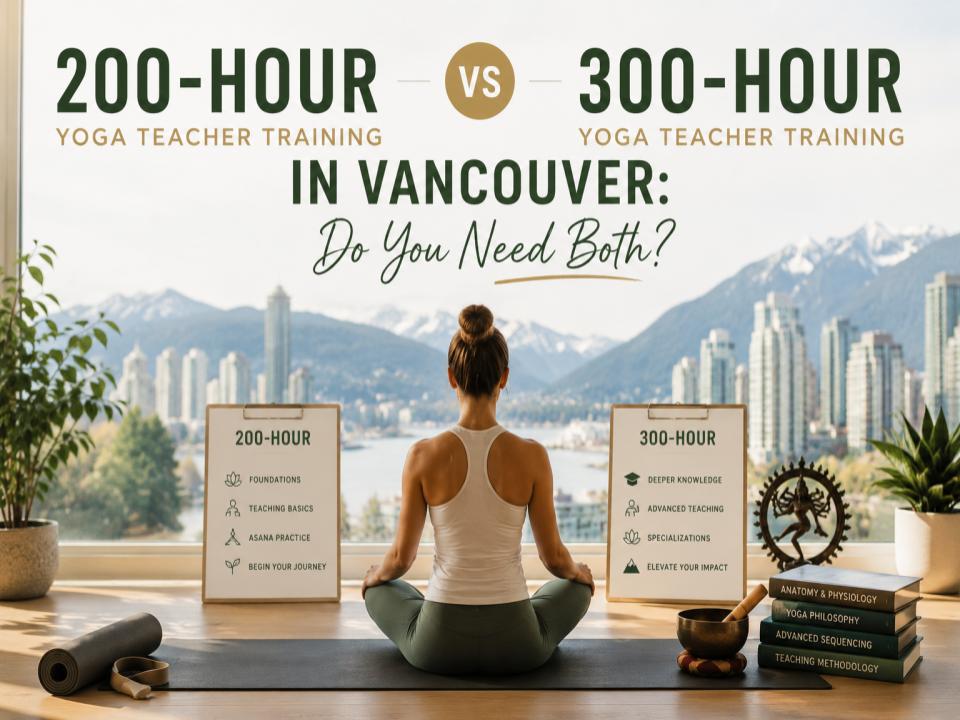
 200-Hour vs 300-Hour Yoga Teacher Training in Vancouver: Do You Need Both?
Choosing a yoga teacher training program is a big decision. You invest time, money, and energy. You also shape your future teaching career. If you live in Vancouver or plan to train here, you have great options. But one question keeps coming up: 200-Hour vs 300-Hour Yoga Teacher Training in Vancouver: Do You Need Both?
The short answer is that most teachers start with the 200-hour program. Some stop there. Others move on to the 300-hour training years later. This guide breaks down what each level means, who each one fits, and how to decide what you actually need.
We’ll cover the differences, the costs, the career paths, and the local Vancouver scene. By the end, you’ll know which path suits your goals.
What Is a 200-Hour Yoga Teacher Training?
A 200-hour yoga teacher training is the standard entry point for new teachers. Most yoga schools around the world use this framework. It follows the guidelines set by Yoga Alliance, the largest registry for yoga teachers.
The 200-hour training covers the foundations. You learn how to teach safe, effective yoga classes. You study anatomy, alignment, philosophy, and teaching methodology. You also gain practical teaching hours through a supervised practicum.
Yoga Alliance sets specific requirements for what schools must teach. These include techniques and practice, teaching methodology, anatomy and physiology, yoga philosophy and ethics, and a practicum. Schools that meet these standards can register as an RYS 200 (Registered Yoga School).
When you complete a 200-hour program at a registered school, you can apply to become an RYT 200 (Registered Yoga Teacher). This credential shows employers and students that you’ve met a recognized baseline.
In Vancouver, 200-hour programs run in many formats. Some schools offer intensive one-month immersions. Others spread the training across weekends over several months. A few run evening programs for people with full-time jobs.
The 200-hour training prepares you to teach general public classes. Most graduates leave feeling confident with basic sequencing, cueing, and hands-on adjustments. You won’t be an expert, but you’ll have a solid foundation to build on.
What Is a 300-Hour Yoga Teacher Training?
A 300-hour yoga teacher training is an advanced program. It builds on the foundation of the 200-hour. Yoga Alliance treats it as a continuation, not a replacement.
The 300-hour program goes deeper into everything. You explore advanced asana. You study subtle anatomy and refined alignment. You dive further into yoga philosophy, including texts like the Yoga Sutras of Patanjali and the Bhagavad Gita. You also examine teaching methodology at a higher level.
Many 300-hour programs include specialized topics. These often cover yoga therapy principles, meditation techniques, pranayama, Ayurveda, and trauma-informed teaching. Some programs focus on specific populations, such as prenatal students, seniors, or athletes.
The 300-hour is not for beginners. You need a 200-hour certification first. Schools require this because the content assumes you already understand basic teaching skills.
When you complete both a 200-hour and a 300-hour training, you have 500 hours total. You can then apply for the RYT 500 credential with Yoga Alliance. This is a signal of deeper study and commitment.
In Vancouver, 300-hour programs vary widely in structure. Some run as immersive retreats. Others take a modular approach, letting you complete different subjects over time. This flexibility appeals to working teachers who want to keep teaching while they study.
The 300-hour is where many teachers find their voice. You move beyond generic sequences. You start to teach with more personality, more skill, and more depth.
Key Differences Between 200-Hour and 300-Hour YTT
The most obvious difference is the level. The 200-hour is entry-level. The 300-hour is advanced. But there’s more to it than that.
The 200-hour focuses on breadth. You get a taste of everything: anatomy, philosophy, sequencing, cueing, ethics. You leave with the tools to teach a standard vinyasa or hatha class. The goal is baseline competence.
The 300-hour focuses on depth. You revisit the same subjects with more nuance. Anatomy shifts from surface muscles to fascia, biomechanics, and joint mechanics. Philosophy shifts from overviews to close readings of primary texts. Sequencing shifts from templates to intelligent, adaptive design.
Another key difference is the entry point. Anyone with a regular yoga practice can enroll in a 200-hour. Most schools ask for six months to a year of consistent practice. The 300-hour requires a 200-hour certification. This is a firm rule.
Cost is another factor. In Vancouver, 200-hour programs typically range from around $2,800 to $4,500. A 300-hour program often costs more, ranging from about $3,500 to $6,000 or higher. The price reflects the deeper content and often more senior faculty.
Time commitment also differs. Both require the stated contact hours, plus homework and personal practice. But 300-hour students often spend more time on self-reflection, primary source reading, and mentored teaching.
Career impact is significant. Studios in Vancouver hire RYT 200 teachers regularly. The 300-hour opens doors to more advanced roles: senior teacher positions, workshop leadership, teacher trainer roles, and specialty offerings such as yoga therapy or corporate wellness.
 Why Vancouver Is a Great Place to Train
Vancouver has one of the most vibrant yoga communities in North America. The city hosts hundreds of studios and thousands of practicing yogis. Yoga is woven into daily life here.
The lifestyle supports it. Vancouver residents value health, mindfulness, and the outdoors. Studios sit next to coffee shops, in high-rises, and along the seawall. You can find a class almost any time of day.
The setting helps too. Training in Vancouver means you can pair intense study with time in nature. Stanley Park, the North Shore mountains, and the Pacific Ocean are all minutes from the city core. Many teacher trainees describe walks by the water or hikes on Grouse Mountain as essential to their process.
Vancouver also draws high-caliber teachers. Senior instructors from around the world visit for workshops and residencies. Local teachers often blend multiple traditions, giving students exposure to a wide range of styles.
The community is welcoming and diverse. You’ll find hot yoga, ashtanga, iyengar, yin, restorative, kundalini, and everything in between. Whatever style calls to you, someone in Vancouver teaches it well.
The city is also home to influential lineages and long-standing schools that have trained generations of instructors. Newer schools bring fresh perspectives on trauma-informed teaching, inclusive practices, and modern movement science.
For international students, Vancouver offers another advantage. It’s a global city with excellent public transit, safe neighborhoods, and world-class food. Studying here feels like both a personal journey and a cultural experience.
Do You Need Both? Understanding the Career Path
The honest answer: it depends on your goals. Not every yoga teacher needs a 300-hour training. Many successful teachers work with only a 200-hour credential.
If you want to teach general classes at studios, gyms, or community centres, the 200-hour is usually enough. Most employers in Vancouver treat RYT 200 as the baseline. They value teaching experience and skill more than extra hours on paper.
If you want to teach specialized populations, workshops, or immersive programs, the 300-hour helps. It signals expertise and gives you a broader toolkit. Some studios prefer or require RYT 500 for senior teaching roles.
If you want to become a teacher trainer, the path is clearer. Yoga Alliance requires E-RYT 500 status to lead 300-hour trainings. That means 500 total hours of training plus 2,000 hours of teaching experience over at least four years. You can find the full requirements on the Yoga Alliance credentials page.
If you want to run retreats or lead workshops internationally, credentials matter less than reputation. Still, deeper training almost always helps. Students often ask about your background before booking. A 500-hour credential adds credibility.
If your goal is personal growth, both trainings serve. But you don’t need to do them back-to-back. Many teachers wait several years between programs. Time to teach, learn, and integrate is often more valuable than more coursework stacked on top of coursework.
Who Should Start with a 200-Hour YTT?
The 200-hour training suits anyone new to teaching. It’s the standard first step. You should start here if you fit any of these categories.
You should start with a 200-hour if you’re a dedicated student who wants to deepen your practice. Many trainees never plan to teach. They enroll to understand yoga at a deeper level. The training transforms your relationship with the practice, whether or not you ever lead a class.
You should start with a 200-hour if you want to teach part-time. Many yoga teachers keep their day jobs. They teach one or two classes a week for extra income and community connection. A 200-hour credential is all you need for this path.
You should start with a 200-hour if you want to make yoga a career. Even full-time teachers begin here. You’ll teach for at least a year or two before considering advanced training. That experience is what turns knowledge into skill.
You should start with a 200-hour if you’re unsure about teaching. The program helps you find out. Some trainees discover a passion for leading classes. Others realize they love yoga but don’t want to teach. Both outcomes are valid, and neither is a waste.
You should start with a 200-hour if you want a foundation for related work. Yoga therapists, movement coaches, mindfulness teachers, and wellness professionals often start with a 200-hour. It gives them a shared vocabulary with the wider yoga world.
The 200-hour is the right entry point for almost everyone. Don’t skip it, and don’t rush through it. Choose a school that matches your values and stay engaged from the first day to the last.
 Who Should Consider a 300-Hour YTT?
The 300-hour is not for everyone. It suits teachers who have been in the field for a while and want to grow. Here’s who should think seriously about it.
You should consider a 300-hour if you’ve been teaching for at least a year or two. Time in the studio shows you what you don’t know. You start to notice gaps in your skills. The 300-hour helps you fill them.
You should consider a 300-hour if you want to specialize. Prenatal yoga, yoga for athletes, trauma-informed practice, yoga therapy, and meditation teaching all benefit from advanced study. Many 300-hour programs let you focus on a specialty. For yoga therapy specifically, you can also explore certification through the International Association of Yoga Therapists.
You should consider a 300-hour if your students ask questions you can’t answer. This is a common signal. You’re teaching consistently, and your students trust you. But they want more than you can offer. Advanced training helps you meet them where they are.
You should consider a 300-hour if you feel stuck. Many teachers hit a plateau after a couple of years. Sequences start to feel repetitive. The magic fades. A 300-hour reignites the fire and gives you new material to work with.
You should consider a 300-hour if you want to teach other teachers. To lead trainings, you need advanced credentials and real classroom experience. The 300-hour is a stepping stone toward that role.
You should not rush into a 300-hour just because it exists. Wait until you’re ready. The program will mean more when you have context to place it in.
What About the 500-Hour Designation?
The RYT 500 is a Yoga Alliance credential earned by completing both a 200-hour and a 300-hour training. It’s not a separate program in most cases. You add the credentials together.
Some schools offer a combined 500-hour pathway. You enter with no prior training and complete all 500 hours through one institution. This can create a more cohesive experience. It also usually takes 18 to 24 months at minimum.
The RYT 500 signals a deeper commitment. It tells students, studios, and peers that you’ve invested more time in your craft. Some employers value it. Others don’t distinguish between RYT 200 and RYT 500 for hiring purposes.
The E-RYT 500 is different. The “E” stands for Experienced. To earn it, you need the 500 hours of training plus at least 2,000 hours of teaching over four years or more. It’s a working credential, not just a study credential.
E-RYT 500 status matters most if you want to lead teacher trainings. Yoga Alliance requires it for lead trainers in 300-hour programs. It also matters for continuing education providers.
For most teachers, the practical difference between RYT 200 and RYT 500 is small in day-to-day teaching. Students rarely ask about credentials. What matters more is how you teach, how you show up, and how your students grow.
That said, credentials do matter for certain jobs, insurance, and professional opportunities. Check with your target employers. Some require specific certifications. If your career depends on RYT 500 or E-RYT 500, plan accordingly.
Costs, Time Commitment, and Practical Considerations in Vancouver
Money and time are real factors. Yoga teacher training is a significant investment. Let’s look at what to expect in Vancouver.
For a 200-hour training in Vancouver, expect to pay between roughly $2,800 and $4,500 in most cases. Prices vary by school, format, and included materials. Some programs include manuals, retreats, or extra workshops. Others charge separately for these.
For a 300-hour training in Vancouver, expect to pay between roughly $3,500 and $6,000 or more. The higher price reflects deeper content and often more experienced faculty. Some programs include international travel or retreat components, which push costs higher.
Time commitment matters as much as cost. A 200-hour training typically runs 4 to 8 weeks in an intensive format. Weekend and evening programs stretch across 4 to 12 months. Plan for at least 10 to 15 hours of study per week during any format.
A 300-hour training often takes longer to complete. Modular formats let you spread study across a year or more. This helps if you’re teaching while you learn. But it can also drag out the process. Set clear timelines for yourself.
Beyond tuition, budget for extras. These include books, mats and props, transportation, food, and any travel for retreat portions. If you attend a full-time intensive, plan for reduced income during that period.
Financial aid is limited in the yoga world. Some schools offer payment plans. A few offer scholarships or work-trade options. Ask early if cost is a concern. Look into small business loans or personal lines of credit if you’re serious about training as a career move.
British Columbia does not regulate yoga teacher training at the government level. That means quality varies. Yoga Alliance registration is voluntary. Some excellent schools choose not to register. Others register but don’t deliver on the promise. Do your homework.
 How to Choose the Right School in Vancouver
Choosing a school is more important than choosing a level. A great 200-hour is better than a mediocre 500-hour. Here’s how to evaluate your options.
Start with the lead trainers. Look at who’s actually teaching, not just who’s on the marketing materials. Read their bios. Take a class with them if you can. Their style, values, and personality will shape your experience more than any curriculum document.
Check the curriculum details. Look for balance across the required areas: techniques, methodology, anatomy, philosophy, and practicum. Ask how much time is spent on each. A program heavy on physical practice but light on philosophy might leave you unprepared.
Ask about class sizes. Smaller cohorts often mean more feedback and attention. Larger groups can offer more diverse peer interactions. Neither is inherently better, but the difference matters for how you learn.
Look at graduate outcomes. Where do alumni teach? How many are still teaching after two years? Schools should be able to answer these questions. If they can’t, or if the answers are vague, be cautious.
Consider the school’s philosophy and values. Some schools emphasize traditional lineages. Others focus on modern movement science. Some are trauma-informed and inclusive. Others take a more classical approach. Choose one that matches how you want to teach.
Talk to alumni. Most schools will connect you with recent graduates. Ask honest questions. What did the training deliver? What was missing? Would they recommend it? Real conversations reveal more than websites.
Visit the space if you can. Feel the energy. Meet the community. Trust your instincts. A yoga teacher training is intense. You’ll spend hundreds of hours in that room. Make sure it feels right.
For research-backed information about yoga safety and evidence, resources like the U.S. National Center for Complementary and Integrative Health offer overviews that can help you ask better questions of any school.
Common Myths About Yoga Teacher Training
A few myths keep circulating in the yoga community. Let’s clear them up.
Myth one: You need a 500-hour to be taken seriously. False. Many respected teachers hold only a 200-hour. Reputation comes from teaching skill, integrity, and community engagement, not paper credentials.
Myth two: The 300-hour is just more of the same. False. A good 300-hour goes far deeper than the 200-hour. It’s not repetition. It’s a different level of study.
Myth three: You must complete a 300-hour within a set time after your 200-hour. False. There’s no deadline. Some teachers train back-to-back. Others wait a decade. Both approaches work.
Myth four: Yoga Alliance registration equals quality. Partly true, partly false. Yoga Alliance sets minimum standards but doesn’t audit teaching quality on an ongoing basis. Registration is a starting point, not a guarantee. Some outstanding schools skip it. Some registered schools are weak.
Myth five: Longer trainings mean better teachers. Not necessarily. Time in the training matters less than what happens after. A 200-hour graduate who teaches ten classes a week for two years often grows more than a 500-hour graduate who barely teaches.
Myth six: You need to be flexible or advanced to train. False. Good yoga teacher trainings welcome students at various levels. Teaching is not about performing advanced poses. It’s about communicating clearly, watching students, and creating a safe environment.
Myth seven: All 200-hour trainings are the same. Very false. Curriculum, teachers, values, and outcomes vary dramatically. Two schools might both be RYS 200 registered and offer wildly different experiences.
 Conclusion: 200-Hour vs 300-Hour Yoga Teacher Training in Vancouver: Do You Need Both?
Let’s return to the original question: 200-Hour vs 300-Hour Yoga Teacher Training in Vancouver: Do You Need Both?
The main takeaway is this: you don’t need both. Most yoga teachers start with a 200-hour training and build their careers from there. The 300-hour is valuable, but it’s not required for a successful teaching life. It’s a tool for teachers who want to specialize, deepen, or grow beyond the basics.
Start with the 200-hour. Choose a school that fits your values and learning style. Give yourself time to integrate what you learn. Teach as much as you can. Notice what excites you, what challenges you, and what you want to explore next.
If a 300-hour calls to you later, take it. If not, keep teaching, keep practicing, and keep growing. Neither path is wrong. What matters is that you show up for your students and for yourself.
Vancouver is a wonderful place to walk this path. The community is strong, the teachers are skilled, and the setting inspires. Whether you complete one training or many, you’re joining a tradition that stretches back thousands of years. Take your time, choose well, and enjoy the journey.
If you’re ready to become a yoga teacher, check out our 200-Hour Yoga Teacher Training in Vancouver page to learn more about our program and how to get started.
Focus Keyphrase: 200-Hour vs 300-Hour Yoga Teacher Training in Vancouver
SEO Title: 200-Hour vs 300-Hour Yoga Teacher Training in Vancouver: Do You Need Both?
SEO Meta Description: Compare 200-hour vs 300-hour yoga teacher training in Vancouver. Learn which credential fits your goals, budget career path, and whether you truly need both.