
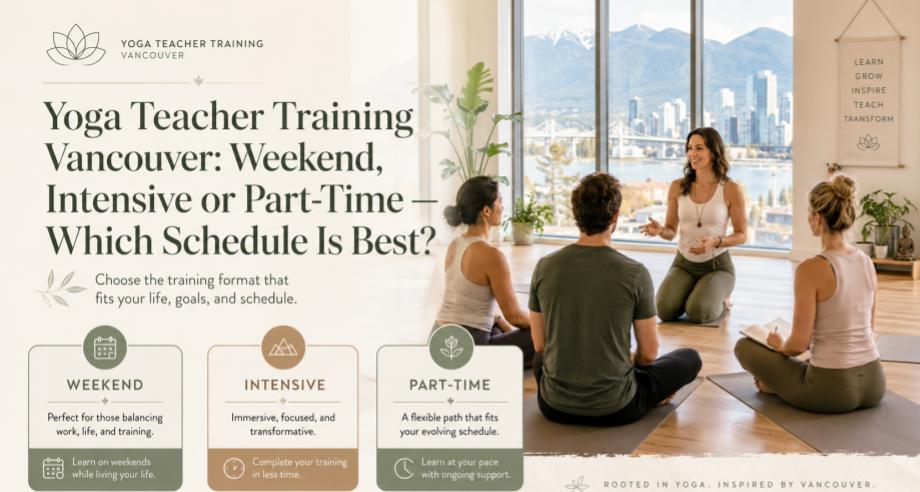
 Yoga Teacher Training Vancouver: Weekend, Intensive or Part-Time — Which Schedule Is Best?
Choosing a yoga teacher training program is a big decision. Choosing when to do it is almost as important. Vancouver has become one of Canada’s most active yoga hubs, and studios across the city now offer training in three main formats: weekend, intensive, and part-time. Each one delivers the same core certification, usually 200 hours, but the path to get there looks completely different depending on your schedule, your budget, and how you learn best.
This guide breaks down each format honestly. No format is “the best” in isolation. The best one is the one that fits your life right now, without burning you out or leaving you half-trained. By the end of this article, you’ll know exactly which schedule makes sense for your situation.
What Yoga Teacher Training Actually Involves
Before comparing schedules, it helps to understand what a training program covers. Most 200-hour programs, whether in Vancouver or anywhere else, follow guidelines set by organizations like Yoga Alliance, the largest yoga credentialing body in the world. A standard 200-hour curriculum includes asana (posture) technique, teaching methodology, anatomy and physiology, yoga philosophy and ethics, and practicum hours where you actually teach.
That’s a lot of ground to cover. It’s why the format matters so much. Cramming 200 hours into two weeks feels very different from spreading it across five months. Neither approach is wrong. They just serve different kinds of students.
Most reputable Vancouver studios will publish their curriculum breakdown before you enrol. Ask to see it. A well-structured program should show you how many hours go into each category, not just a vague total. This transparency is a signal of a credible school, and it’s one of the simplest ways to vet a program before you commit your time and money.
It’s also worth understanding that the hours are cumulative, not symbolic. You are expected to actually complete them, through a combination of live instruction, homework, reading, and teaching practice. The schedule you choose changes how those hours get distributed, not how many there are.
Weekend Yoga Teacher Training: Who It’s For
Weekend training spreads the 200 hours across consecutive weekends, often Friday evening through Sunday, over three to four months. This is the most popular format for people who work full-time Monday to Friday and can’t take extended time off.
The biggest advantage is that your income stays untouched. You keep your job, keep your routine during the week, and dedicate your weekends to training. Many students say this rhythm actually helps them absorb the material better, because they have five weekdays to reflect, journal, and let concepts settle before the next session.
The downside is pacing. Because sessions are spread out, some students forget details between weekends, especially anatomy terms or sequencing logic. Good programs address this with review sessions at the start of each weekend and structured homework in between, like reading assignments from foundational texts such as Light on Yoga by B.K.S. Iyengar.
Weekend training also demands discipline outside class. You won’t have a teacher checking in daily. You need to actually do the reading and the practice teaching on your own time. Students who thrive in this format tend to be self-motivated and comfortable studying independently between sessions.
Socially, weekend cohorts often bond differently than intensive ones. Because you see the same group every few weeks over months, relationships build slowly but tend to last. Many weekend graduates in Vancouver stay connected long after certification, forming teaching partnerships or subbing networks.
 Intensive Yoga Teacher Training: Who It’s For
Intensive training, sometimes called immersion training, compresses the full 200 hours into two to four consecutive weeks. Students attend daily, often six to eight hours a day, and live and breathe the material until certification.
This format suits people who can take real time away from work, whether through vacation time, a sabbatical, or a life transition. It’s also popular with people relocating to Vancouver specifically for training, since the city’s natural surroundings, from Stanley Park to the North Shore mountains, make it an appealing place to spend a few immersive weeks. If you’re travelling from outside the city, it’s worth checking Destination Vancouver’s visitor information for accommodation options near major studio districts like Kitsilano or Mount Pleasant.
The advantage of intensives is momentum. You’re not relearning anatomy every few weeks because you never really left it. Concepts build daily, and many students describe the experience as transformative precisely because of that immersion. Group bonding tends to happen fast too. Spending eight hours a day with the same 15 to 20 people creates a tight cohort quickly.
The tradeoff is intensity, literally. Physically, your body needs to handle daily asana practice on top of long seated study sessions. Mentally, there’s little time to process before the next topic arrives. Burnout is a real risk if you go in already exhausted from work or personal stress. Financially, you also need to cover living costs during the training with no income coming in, unless your employer offers paid leave.
Intensive training works best for people who can fully step away from other responsibilities. If your job, childcare, or health means daily distraction, an intensive format may not let the material land the way it should.
Part-Time Yoga Teacher Training: Who It’s For
Part-time training is the slowest and most flexible option. Rather than weekends or consecutive weeks, classes meet once or twice per week over six months to a year. Some Vancouver studios even offer part-time hybrid models combining in-person weekends with online modules for the theory components.
This format is ideal for people juggling demanding jobs, parenting, or health conditions that make intensive physical training difficult. It also suits students who want to test the waters of teaching without a major disruption to daily life. Because sessions are spread thin, there’s more room to absorb, question, and revisit material slowly, which some students find far less stressful than a compressed schedule.
Part-time training also tends to be gentler on the body. Instead of daily deep asana practice, students get more recovery time between sessions, which matters for people managing injuries or older students returning to movement-based learning after a long break.
The drawback is duration. A year is a long commitment, and life happens during that time. Students sometimes lose momentum, miss sessions, and need make-up classes, which can extend the timeline further. It also requires more long-term planning, since you’re balancing training against work and family calendars for months on end, not just a few weekends.
Cost structures for part-time programs vary. Some studios spread payments over the year, which helps cash flow, but the total cost can sometimes be slightly higher than weekend or intensive formats due to added administrative and material costs. Always ask for a full cost breakdown before enrolling, including whether manuals, props, or online platform access are included.
Comparing Cost, Time Commitment, and Learning Retention
Cost, time, and retention are the three factors that matter most when choosing between formats, so it’s worth comparing them directly.
Cost. In Vancouver, most 200-hour programs range from roughly CAD $2,500 to $4,500, regardless of format. Weekend and intensive programs tend to sit at similar price points. Part-time programs can be slightly higher due to the longer administrative overhead, but not always. Price is rarely the deciding factor between formats; it’s more about what else the price includes, such as mentorship, printed manuals, or post-certification support.
Time commitment. Weekend training typically spans three to four months. Intensive training compresses into two to four weeks. Part-time training stretches across six months to a year. If you need to be certified quickly, say for a seasonal job opportunity, intensive training is the only format that delivers that speed. If you have no urgency, part-time or weekend both work fine.
Retention. This is less black and white. Some research on adult learning, including guidance from the Center for Research on Learning, suggests spaced repetition, learning something, taking a break, then revisiting it, improves long-term retention compared to cramming. That favours weekend and part-time formats. However, intensive formats benefit from constant reinforcement within a short window, which some students find equally effective, especially for physical skills like alignment cues and hands-on adjustments.
The honest answer is that retention depends more on the individual student’s study habits than the format itself. Someone who does their reading and practice teaching consistently will retain material well in any format. Someone who skips homework will struggle in any format too.
 Vancouver-Specific Considerations for Scheduling Your Training
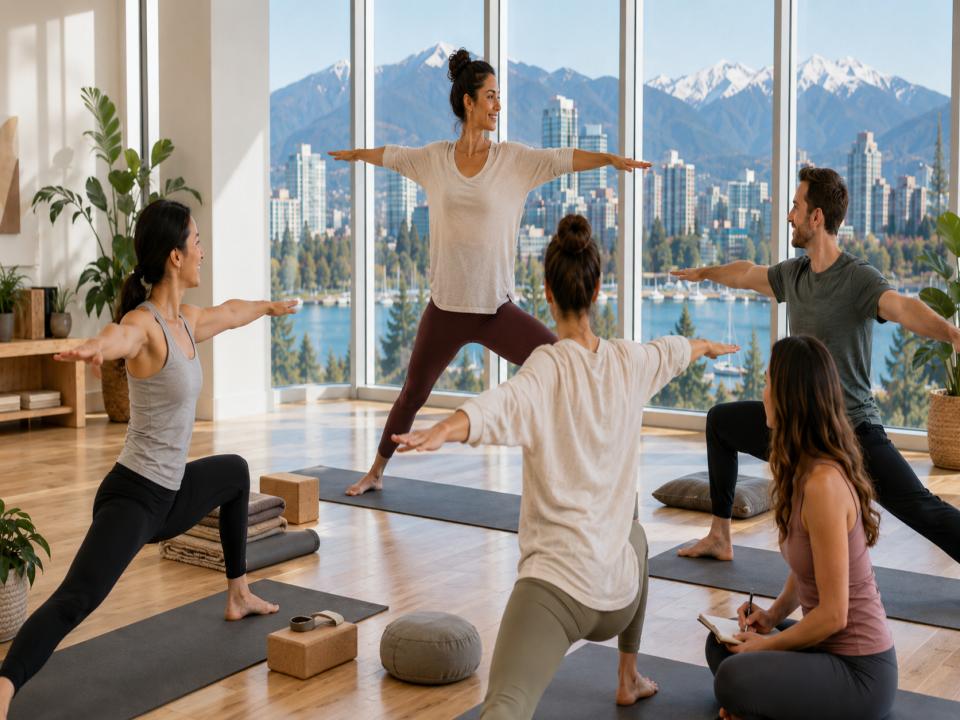
Vancouver’s geography and climate genuinely affect which schedule makes sense. Winters bring heavy rain from November through March, which can make commuting to weekend sessions across the city, especially from areas like Surrey or North Vancouver, more time-consuming due to traffic and transit delays. If you’re considering a weekend program during winter months, factor in extra travel time using TransLink’s trip planner before committing to a schedule.
Summer intensives are popular for a reason. Vancouver’s summer weather, generally dry and mild between June and September, makes outdoor practice sessions, beach walks, and post-class hikes far more appealing. Several studios schedule their intensive trainings deliberately during these months, partly for weather and partly because visiting students from other provinces or countries prefer travelling to Vancouver in summer.
Part-time programs are less weather-dependent since sessions are spread out and manageable even during rainier months, but it’s still worth checking a studio’s location relative to your home or workplace. Vancouver traffic, particularly around bridges like the Lions Gate or Granville, can add unpredictable time to your commute during peak hours.
If you’re relocating temporarily for an intensive, neighbourhoods like Kitsilano, Commercial Drive, and Mount Pleasant have strong concentrations of yoga studios, cafes, and short-term rentals, making them practical bases for a few immersive weeks.
How to Choose the Right Format for Your Life
Here’s a simple way to think about it. Ask yourself three questions.
First, how much time can you actually take off? If the answer is “none, I need to work full-time throughout,” weekend or part-time training makes more sense. If you can genuinely clear two to four weeks, intensive becomes realistic.
Second, how do you learn best? If you retain information better with repetition and time to reflect, part-time or weekend formats suit you. If you thrive on immersion and momentum, intensive training will likely feel more natural.
Third, what’s your physical and mental bandwidth right now? Training, especially intensive training, is demanding on the body and mind. If you’re already stretched thin with work stress, caregiving, or health issues, a slower format protects you from burnout during the very process meant to deepen your wellbeing practice.
There’s no wrong answer here, only an honest one. Studios that genuinely care about student outcomes, rather than just enrolment numbers, will usually ask you similar questions during a consultation call before recommending a format. If a studio pushes you toward one format without understanding your situation, that’s worth noting.
 Common Mistakes to Avoid When Choosing a Schedule
A few mistakes come up again and again among new trainees.
The first is choosing based purely on price. A slightly cheaper program that doesn’t fit your schedule often costs more in the end, through missed sessions, make-up fees, or simply not finishing. Fit matters more than sticker price.
The second is underestimating the physical demand of intensive training. Some students assume daily practice will feel similar to their regular gym or studio routine. It doesn’t. Back-to-back asana sessions combined with hours of seated study is a different kind of fatigue, and it catches people off guard.
The third is overestimating self-discipline in part-time or weekend formats. Without daily accountability, it’s easy to fall behind on readings or practice teaching hours. Before choosing a slower format, be honest about whether you’ll actually do the independent work between sessions.
The fourth mistake is not asking about make-up policies. Life happens. Illness, work emergencies, and family obligations can interrupt any schedule. Ask upfront how a studio handles missed sessions, whether there’s a fee, and whether missed hours can realistically be recovered before your certification date.
Finally, some students choose a format based on what a friend did, rather than their own life circumstances. Your friend’s schedule, income, and learning style aren’t yours. Use their experience as one data point, not the deciding factor.
Conclusion: Weekend, Intensive or Part-Time — Which Is Best?
So, back to the original question: Yoga Teacher Training Vancouver: Weekend, Intensive or Part-Time — Which Schedule Is Best? The honest answer is that the best schedule is the one that matches your actual life, not an idealized version of it. Weekend training suits working professionals who want structure without giving up their weekday income. Intensive training suits people who can step away fully and want fast, immersive progress. Part-time training suits those who need maximum flexibility and prefer a slower, steadier pace.
What matters most isn’t the label on the format. It’s whether you’ll show up, do the reading, complete your practice teaching hours, and finish what you start. Choose the schedule that makes that most likely for you, and the certification, along with the growth that comes with it, will follow.
If you’re ready to become a yoga teacher, check out our 200-hour Yoga Teacher Training page to see upcoming weekend, intensive, and part-time dates in Vancouver.