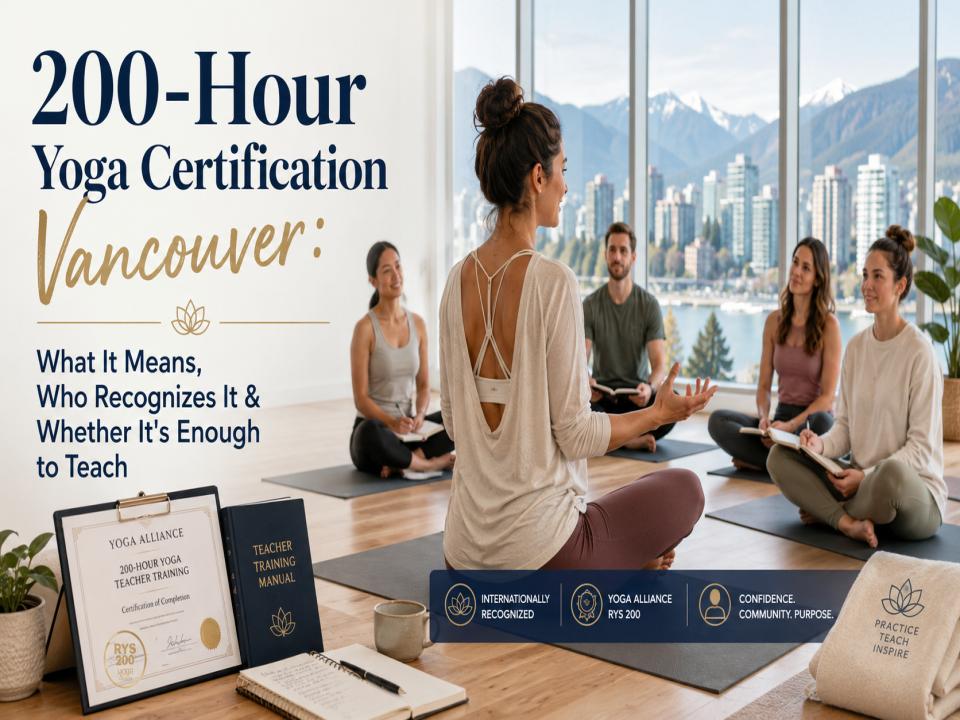
200-Hour Yoga Certification Vancouver: What It Means, Who Recognizes It & Whether It’s Enough to Teach
If you’re researching yoga teacher training in Vancouver, you’ve probably hit a wall of confusing terms. RYT-200. Yoga Alliance. Registered school. Certified vs. licensed. It’s a lot of jargon for what should be a simple question: does a 200-hour yoga certification actually let you teach?
This guide answers that question directly. We’ll cover what a 200-hour certification really is, whether yoga teaching is regulated in British Columbia, what studios in Vancouver actually check before hiring, and how to make sense of Yoga Alliance and the other registries you’ll come across. By the end, you’ll know exactly where a 200-hour certification fits into a real teaching career — and what happens next.
What Is a 200-Hour Yoga Certification?
A 200-hour yoga certification is a training program built around a minimum of 200 contact hours of instruction. That number isn’t arbitrary. It comes from Yoga Alliance, the largest nonprofit registry for yoga teachers and schools in the world. Yoga Alliance set 200 hours as the baseline standard for entry-level teacher training decades ago, and most schools around the world still build their programs to match it.
A typical 200-hour program covers five core areas. You’ll study asana, meaning the physical postures and how to teach them safely. You’ll learn teaching methodology, which includes how to cue a class, sequence a session, and manage a room full of different bodies and ability levels. You’ll cover anatomy and physiology, so you understand what’s happening in the body during a forward fold or a backbend. You’ll study yoga philosophy and history, since yoga is a tradition with roots that go back thousands of years, not just a workout format. And you’ll practice teaching itself, usually through practicums where you lead real classmates through real sequences.
Programs run anywhere from three weeks intensive to six months part-time. Vancouver has both formats. Some students prefer the immersive route because it forces total focus. Others need a slower pace that fits around a job or family. Neither approach is better. What matters is whether the school actually delivers the full 200 hours and covers the material in depth, rather than rushing through a checklist.
It’s worth being clear about one thing here: completing a 200-hour certification does not make you a master of yoga. It makes you a competent, safe entry-level teacher. Most experienced teachers will tell you their real education started the day their training ended, not the day it began.
When you’re comparing programs in Vancouver, look past the marketing copy and check three specific things. First, ask for a detailed hour-by-hour breakdown of the curriculum. A vague syllabus is a warning sign. Second, ask who teaches each module. Anatomy should be taught by someone with real training in anatomy, not just a senior yoga teacher improvising. Philosophy should come from someone who has actually studied the texts, not someone reciting quotes from social media. Third, ask how many students are in each cohort. A program with 40 students and one lead teacher cannot give you meaningful feedback on your alignment or your teaching voice. Smaller cohorts, generally under 20 students, allow for real coaching rather than passive observation.
It also helps to understand what a 200-hour certification is not. It is not a fitness certification in the way a personal training certificate is. It blends physical training with philosophy, breathwork, and often some element of meditation or self-study. If a program markets itself purely as a workout credential with no philosophical or anatomical grounding, it likely won’t meet the standard that Yoga Alliance or comparable registries expect, and studios may notice the gap in your teaching once you start leading classes.
Is Yoga Teaching Regulated in Vancouver or BC?
Here’s a fact that surprises a lot of new students: yoga teaching is not a legally regulated profession anywhere in Canada. There’s no government body that licenses individual yoga teachers, the way there is for nurses, electricians, or lawyers. You don’t need a government-issued credential to call yourself a yoga teacher or to lead a class.
That said, British Columbia does regulate something adjacent: the training schools themselves. Under BC’s Private Training Act, certain private training institutions must register with the Private Training Institutions Branch (PTIB) if their programs meet specific thresholds for tuition cost and program length. This oversight exists to protect consumers. It sets rules around things like refund policies, program disclosure, and quality standards for the school. It does not license the graduates as certified professionals in a legal sense.
So what does this mean in practice? It means nobody can stop you from teaching yoga after a weekend workshop, technically speaking. But it also means the entire profession runs on reputation, training quality, and voluntary registries rather than government licensing. That puts more responsibility on you, the student, to choose a training program carefully. A certificate from a disorganized, under-resourced program and a certificate from a well-established Vancouver school can look similar on paper, but they carry very different weight with employers, insurers, and students.
This is also why the Government of British Columbia’s PTIB oversight matters when you’re comparing schools. A school that holds proper PTIB registration has met a baseline standard for transparency and consumer protection, which is a useful filter when you’re evaluating options.
It’s also worth separating “regulated profession” from “regulated activity.” Yoga teaching itself isn’t regulated, but running a business that offers yoga classes still involves ordinary regulations. If you plan to teach independently in Vancouver, you’ll still need to register a business name if you’re operating under anything other than your own legal name, follow standard tax rules for self-employed income, and carry appropriate liability insurance before working with the public. None of this is unique to yoga. It’s the same baseline that applies to any independent service provider, from personal trainers to massage therapists working outside a regulated college. The absence of a yoga-specific license doesn’t mean the absence of professional responsibility.
 Can You Teach Yoga After a 200-Hour Certification?
Yes. In practical terms, a completed 200-hour certification from a reputable school is the standard entry point into paid yoga teaching in Canada, including in Vancouver. It’s not a legal requirement, as we just covered, but it functions as the de facto professional minimum.
According to Job Bank Canada, which tracks occupational requirements nationally, yoga instruction falls under the recreation, sport, and fitness program leader category, and certification in a specific discipline is generally expected even though it isn’t legally mandated. Three things typically require it. First, most studios won’t hire you without proof of a completed 200-hour training. It’s their basic screening filter. Second, liability insurance providers usually set 200 hours of recognized training as their minimum threshold for issuing a policy, and you cannot responsibly teach group classes without insurance. Third, students themselves look for certification. When someone searches for a yoga teacher in Vancouver, they expect to see a credential listed, even an informal one.
But “can teach” and “will get hired everywhere” are two different things. A fresh 200-hour graduate in a competitive market like Vancouver usually starts with community centre classes, gym studio slots, private one-on-one clients, or covering shifts for more established teachers. Boutique studios with strong reputations and loyal client bases are harder to break into right away. That’s not a failure of your training. It’s simply how any skill-based profession works. Experience compounds.
One more nuance matters here. Some training hours count more than others depending on how they were delivered. A 200-hour program with substantial in-person practicum hours, direct instructor feedback, and hands-on adjustment training will generally prepare you better — and read as more credible to studios — than a program built almost entirely around pre-recorded video. We’ll get into the online-versus-in-person question in more detail below.
What Do Studios Actually Look For?
Studio owners and hiring managers in Vancouver aren’t just checking a box that says “200-hour certificate: yes.” They’re looking at several layers of substance behind that certificate.
Training school reputation is the first filter. Hiring managers in a city like Vancouver generally know which schools in the region have strong reputations, because the yoga teaching community is small and word travels fast. A school known for rigorous anatomy training or strong practicum hours will carry weight that a lesser-known program won’t.
Teaching hours completed since certification matter more than the certification date itself. A teacher who graduated two years ago and has taught 500 classes will usually beat a teacher who graduated last month, even if both hold identical certificates.
Specialization and style fit count too. Some studios run almost entirely on Vinyasa flow. Others focus on Yin, restorative, prenatal, or therapeutic yoga. If your training leaned into a style that matches the studio’s programming, you’re a more efficient hire, since they won’t need to retrain you on their format.
Registry status is a smaller but real factor. Many studios ask whether you’re registered with a recognized body such as Yoga Alliance, mostly because it signals ongoing commitment to the profession and continuing education.
First aid and CPR certification is close to universal as a hiring requirement, separate from your yoga training itself. Most Canadian yoga insurers, including providers referenced by Zensurance, expect current CPR and first aid credentials alongside your 200-hour teacher training before they’ll issue a liability policy.
Communication and presence are the intangible factor. A studio owner sitting in on a practice teach can tell within ten minutes whether someone can hold a room, adjust their pace to the group in front of them, and speak with clarity. No certificate substitutes for this. It’s the single biggest differentiator among candidates with otherwise similar paperwork.
Yoga Alliance, Yoga Alliance International, and Other Registries Explained
This is where most new teachers get genuinely confused, so let’s untangle it clearly.
Yoga Alliance, based in the United States, is the largest and most internationally recognized yoga teacher registry. It doesn’t certify individual teachers directly. Instead, it registers schools whose training programs meet its published curriculum standards, and it registers teachers who graduate from those schools under credentials like RYT-200 (Registered Yoga Teacher, 200-hour level), RYT-500, and E-RYT (Experienced Registered Yoga Teacher, which requires teaching hours logged after certification). It also offers a YACEP designation for providers of continuing education. Because Yoga Alliance is the most globally recognized name in the space, an RYT-200 credential travels well if you ever move cities or countries. You can verify any school’s registration status directly through the Yoga Alliance school directory.
Yoga Alliance International is a separate organization, despite the similar name, and operates its own registry and standards system, with a notable focus on serving the Canadian market. Some Canadian schools register with this body instead of, or alongside, the US-based Yoga Alliance. Both organizations serve a similar function: they set training standards and maintain a public registry of certified schools and teachers, which gives studios and students a way to verify credentials.
There are also smaller, regional, and country-specific registries, along with fitness-industry credentialing bodies like the BC Recreation and Parks Association (BCRPA), which some gym-based yoga instructor roles reference separately from a standard yoga teacher training.
Here’s the key thing to understand: none of these registries are government bodies. They’re private, membership-based organizations. Joining one is optional, not legally mandatory, and each has its own fee structure, renewal requirements, and continuing education rules. Choosing to register isn’t about legal compliance. It’s about signaling to studios, insurers, and students that you trained through a recognized standard and that you’re committed to ongoing professional development. In a market as competitive as Vancouver’s, that signal has real practical value, even though it isn’t legally required.
 Is Online Certification Enough in Vancouver?
Online 200-hour programs expanded rapidly, and many are legitimate, well-structured, and Yoga Alliance registered. So the honest answer is: it depends on the program, and it depends on your goals.
If your goal is teaching in-person group classes at a Vancouver studio, an entirely online, self-paced program with no live instructor interaction and no in-person practicum is likely to be viewed as a weaker credential by hiring studios. Studios want evidence that you can physically demonstrate postures correctly, read a room, offer hands-on adjustments where appropriate, and manage the energy of a live class. Those are difficult skills to build, let alone assess, through pre-recorded video alone.
If your goal is teaching online classes, building a personal practice, deepening your own understanding, or you live somewhere without easy access to in-person training, a well-built online program can absolutely deliver real value. The philosophy, anatomy, and methodology components translate reasonably well to a screen. Live-streamed programs with real-time instructor feedback and small cohort sizes close much of the gap with in-person training.
The strongest option for most Vancouver-based students is a hybrid model: core theory delivered online or asynchronously, paired with in-person intensives for practicum, adjustments, and live teaching practice. This format respects people’s schedules while still building the physical teaching competence that studios actually test for in interviews and trial classes.
Whatever format you choose, verify two things before enrolling. Confirm the school’s registration status with whichever registry matters to you, and ask directly how many of the 200 hours involve live, real-time instruction versus pre-recorded content. A school that’s transparent about this split is a good sign in itself.
 What Comes After Your First 200 Hours?
Your 200-hour certification is a starting credential, not a finish line. Most teachers who build a sustainable career in yoga keep developing well past their first certification, and understanding this upfront helps you set realistic expectations.
Continuing education is the most immediate next step. Workshops, weekend intensives, and specialty trainings in areas like prenatal yoga, yoga for athletes, trauma-informed teaching, or advanced anatomy all build on your foundational training. Many registries, including Yoga Alliance, require continuing education hours to maintain active registration status, so this isn’t optional busywork. It’s built into staying current.
A 300-hour advanced training is the traditional next tier. Completing a 200-hour and a 300-hour program together adds up to a 500-hour credential, which opens doors to more senior teaching roles, mentorship opportunities, and sometimes teacher-training faculty positions down the line. Not every teacher pursues this, and it’s not required to keep teaching, but it’s a common path for those who want to go deeper.
Real teaching experience matters more than any additional certificate. The single biggest factor in a new teacher’s growth is simply logging hours in front of real students, in real rooms, adjusting to real feedback. Community centres, donation-based classes, subbing for established teachers, and private clients are all reasonable ways to build this experience early on.
Specialization tends to happen naturally over time. Most teachers find, after a year or two, that they gravitate toward a particular style, population, or teaching format, whether that’s gentle restorative work, dynamic Vinyasa flow, yoga for older adults, or corporate wellness classes. Building a recognizable niche often does more for a long-term career than accumulating certificates.
Business and marketing skills round out the picture for anyone who wants to teach independently rather than solely through a studio or gym. Understanding how to price private sessions, build a simple website, and communicate your offerings clearly becomes just as important as your teaching skill once you’re managing your own client base.
Final Thoughts
A 200-hour yoga certification in Vancouver gives you exactly what its name promises: a solid, structured foundation in the postures, teaching methods, anatomy, and philosophy needed to lead a safe, competent yoga class. It is not a government license, because yoga teaching isn’t a legally regulated profession in British Columbia or anywhere else in Canada. But in practical terms, it functions as the professional standard that studios expect, insurers require, and students look for.
To recap the title of this guide, 200-Hour Yoga Certification Vancouver: What It Means, Who Recognizes It & Whether It’s Enough to Teach — the honest takeaway is this: yes, a 200-hour certification from a reputable, properly registered school is enough to start teaching yoga professionally in Vancouver. It won’t guarantee you a job at every studio in the city on day one, and it isn’t the end of your education. But it is the recognized entry point into the profession, and everything else — registry status, specialization, additional training, and real classroom experience — builds from that foundation.
If you’re ready to take that first step, look closely at the school’s transparency, its registration status, and how it balances live instruction with independent study. Those details tell you far more about your future teaching career than the number 200 ever will on its own.
Take your time choosing a program. Talk to graduates if you can. Ask to sit in on a class before you commit. A 200-hour certification is a meaningful investment of time and money, and the quality of the school you choose will shape how confident, prepared, and employable you feel on your very first day of teaching.
If you’re ready to become a yoga teacher, check out our 200-hour Yoga Teacher Training page to see how our program is structured and whether it’s the right fit for your goals.