
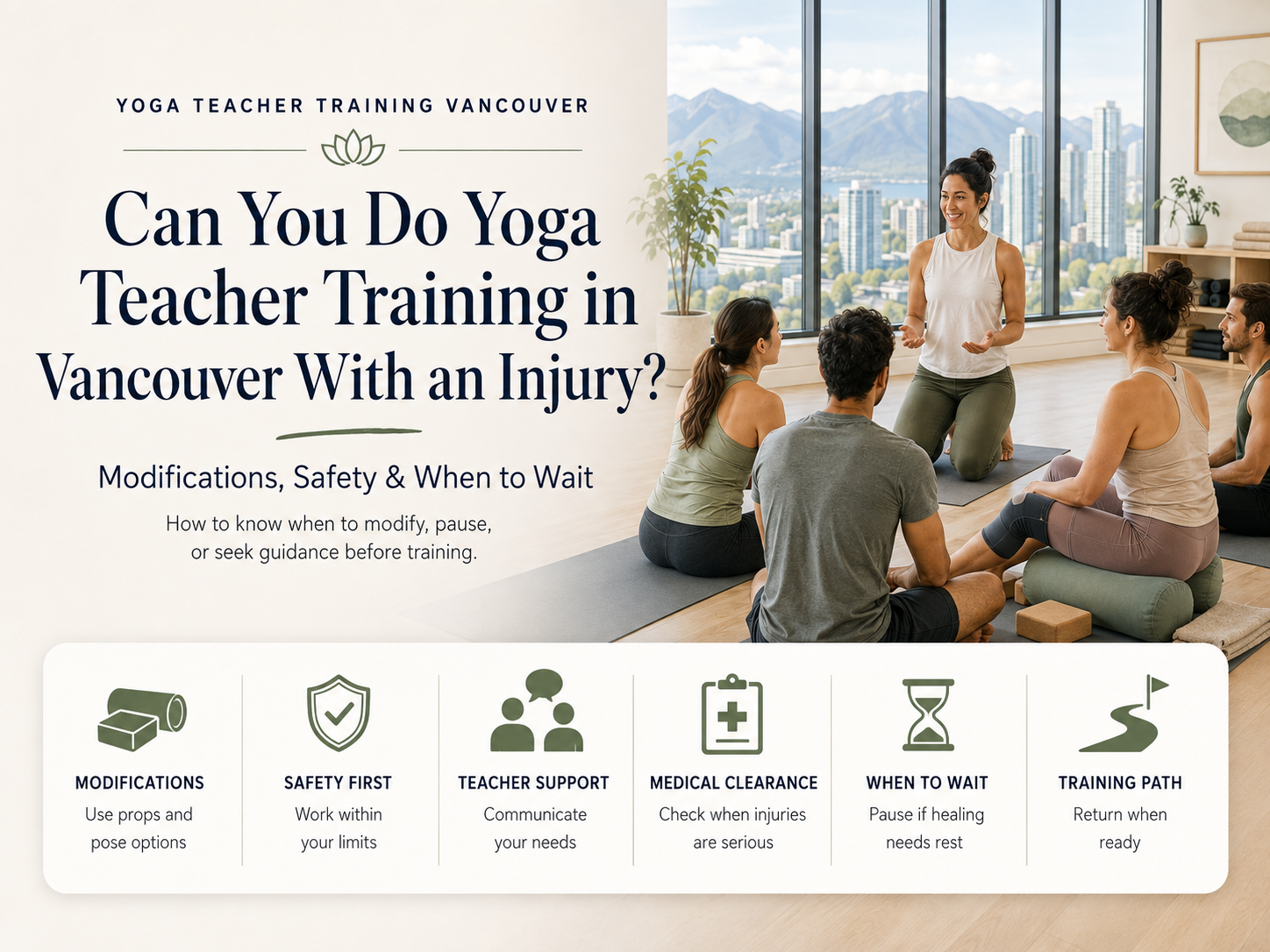
 Can You Do Yoga Teacher Training in Vancouver With an Injury? Modifications, Safety & When to Wait
If you’re nursing a sore knee, a cranky lower back, or an old shoulder injury, you’ve probably wondered: can you do yoga teacher training in Vancouver with an injury? The honest answer is yes, in many cases, but it depends on the injury, the program, and how much you’re willing to modify your practice. This guide walks through what “training with an injury” actually looks like, which injuries are more manageable than others, how a good Vancouver YTT program handles modifications, and when it’s genuinely wiser to wait.
Yoga teacher training (YTT) is not the same as a weekly yoga class. It’s physically demanding, mentally intensive, and often spans several hours a day for weeks at a time. That intensity is exactly why the injury question matters so much. Showing up unprepared, or joining a program that doesn’t know how to modify around your limitations, can turn a transformative experience into a painful setback. Done right, though, training with an injury can deepen your understanding of the body in ways an uninjured trainee never experiences firsthand.
Why This Question Comes Up So Often
Prospective trainees ask this question constantly, and for good reason. Yoga has a reputation as a gentle, low-impact practice, but teacher training pushes that assumption. You’ll hold poses longer, repeat sequences dozens of times to build muscle memory, and practice teaching by demonstrating postures yourself. That repetition and duration is very different from a single 60-minute class.
Research backs up the idea that yoga carries real, if generally modest, injury risk. A systematic review published in PM&R, the journal of the American Academy of Physical Medicine and Rehabilitation, found that adverse events occur in roughly 22.7 percent of yoga classes studied, with serious adverse events occurring in about 1.9 percent of cases. Most of these were musculoskeletal, meaning strains, sprains, and joint irritation rather than anything catastrophic. A separate analysis in Mayo Clinic Proceedings notes that common yoga injuries typically involve repetitive strain or overstretching of the neck, shoulders, spine, legs, and knees.
None of this means yoga is dangerous. It means intensity and repetition matter, and teacher training involves plenty of both. People with old injuries, chronic pain, or recent surgeries reasonably want to know whether they can handle that volume before they commit money and time to a program. The good news is that most reputable training programs have dealt with this question many times before, and most injuries have a workable path forward with the right modifications.
The Short Answer: It Usually Depends on Three Factors
There’s no single yes-or-no answer that applies to everyone, but three factors tend to determine the outcome for most trainees.
First, the type and severity of the injury matters more than the label. A mild rotator cuff strain behaves very differently than a labral tear. A stiff lower back from sitting at a desk is not the same as a herniated disc. Vague self-diagnosis makes this harder to plan around, which is one reason medical clearance (covered later in this guide) is so important.
Second, the structure of the program matters. Vancouver has a range of teacher training styles, from intensive month-long immersions to weekend-based trainings spread across several months. A slower-paced program gives an injury more time to heal between sessions and gives your body more recovery windows. An intensive format compresses that recovery time significantly.
Third, the philosophy and experience of the lead trainers matters. Some schools build anatomy and modification teaching directly into the curriculum, and their instructors are comfortable adjusting poses on the spot. Others assume a baseline level of physical readiness and don’t offer much individualized support. Asking about this directly, before you enroll, tells you a lot about whether the program will work for your body.
Taken together, these three factors mean the real question isn’t “can I do YTT with an injury” in the abstract. It’s “can I do this specific program, with this specific injury, given the support that’s actually on offer.” That’s a much more answerable question, and it’s worth working through before you register.
 Common Injuries Trainees Bring Into Training
Certain injuries show up again and again among yoga teacher trainees, largely because yoga itself, along with running, cycling, and other common activities, tends to stress the same joints repeatedly.
Knee issues are extremely common, particularly for people who’ve spent years in lotus-adjacent poses or who have old sports injuries. Deep knee flexion in postures like hero pose or pigeon can aggravate meniscus or ligament issues. A systematic review in the British Journal of Sports Medicine’s Open Access journal found that nearly two-thirds of musculoskeletal yoga injuries affect the lower extremity, with the knee being a frequent site.
Lower back pain is another frequent complaint, often from years of desk work rather than yoga itself. Backbends, deep forward folds, and twisting postures can either help or aggravate this depending on how they’re performed and how the spine is loaded.
Shoulder and wrist strain shows up often too, especially among trainees with a history of overuse from typing, weightlifting, or other repetitive movement. Weight-bearing poses like plank, chaturanga, and arm balances put direct load through the wrists and shoulders, and repeating them dozens of times a day during training multiplies that load considerably.
Neck tension and hamstring tightness round out the list, frequently tied to posture habits outside of yoga rather than to any single injury event.
The pattern across nearly all of these is that the injury usually isn’t caused by yoga, but existing injuries can be aggravated by yoga’s specific demands, particularly repeated deep flexion, extension, or load-bearing through an already compromised joint. Recognizing which category your injury falls into is the first step toward figuring out what modifications will actually help.
How a Well-Run Vancouver YTT Modifies Practice
A well-designed teacher training program treats modification as a teaching skill, not an afterthought. This matters because you’ll spend part of your training learning how to modify poses for future students, which means your own experience of being modified for becomes part of your education.
Good modification starts with pose-level alternatives. Instead of full pigeon pose, a trainer might offer a supported figure-four stretch. Instead of chaturanga, a trainer might suggest a modified push-up from the knees, or skipping the pose entirely during a vinyasa flow. These aren’t lesser versions of the “real” pose. They’re the same pose adapted to a different body, which is precisely what a teacher will need to do for students throughout their career.
Good modification also extends to props. Blocks, straps, bolsters, and blankets change the geometry of a pose enough to remove strain from an injured area while preserving the pose’s intent. A block under the hand in a standing pose, for example, can reduce strain on a tight hamstring or a compromised lower back by shortening the reach.
Beyond individual poses, strong programs also modify pacing. That might mean allowing a trainee to rest during a demonstration-heavy segment, or building in extra breaks so an inflamed joint gets recovery time between sessions. Trainers who understand anatomy well can usually explain why a modification works, not just that it exists, which helps trainees internalize the reasoning they’ll later pass on to their own students.
Finally, the best programs treat trainees as partners in this process rather than passive recipients. That means an intake conversation before the program starts, ongoing check-ins during training, and openness to trainees stepping back from a pose without judgment. If a program can’t describe how it handles injuries when you ask, that’s useful information in itself.
Questions to Ask a Vancouver Yoga School Before You Enroll
Before committing to any 200 hour or advanced training, it’s worth having a direct conversation with the school about your injury. A few specific questions tend to surface the most useful information.
Ask whether the lead trainers have experience teaching anatomy and injury modification, not just asana sequencing. Yoga Alliance, the leading credentialing body for yoga teacher training programs, requires registered schools to include a minimum number of hours dedicated to anatomy, physiology, and biomechanics as part of their core curriculum. That baseline gives you a starting point, but it’s worth asking how a specific school goes beyond the minimum, especially if your injury is unusual or long-standing.
Ask how the program structures its daily or weekly schedule. Programs with longer breaks between intensive practice sessions generally allow more recovery time than back-to-back all-day formats. If you have an injury that flares with cumulative load, this scheduling detail can matter more than almost anything else.
Ask directly whether you can modify or skip specific poses during practicum and teaching demonstrations, and whether that affects your certification. Reputable schools understand that teaching a pose well doesn’t require performing every variation of it yourself, and most allow trainees to demonstrate verbally or have a peer demonstrate on their behalf when needed.
Ask what happens if your injury flares mid-program. Some schools allow trainees to pause and rejoin a later cohort; others don’t. Knowing this in advance avoids a difficult surprise later.
Finally, ask if you can speak with a former trainee who trained with a similar injury. Direct, first-hand accounts often reveal details that a school’s marketing materials won’t mention. A program that welcomes this kind of question, rather than getting defensive about it, is usually a good sign of how it will treat you once you’re enrolled.
 When You Should Genuinely Wait
Modifications solve a lot of problems, but they don’t solve every problem. There are situations where postponing training is the safer, and ultimately faster, path to becoming a certified teacher.
Wait if you have an acute, unstable injury, meaning something that happened recently and hasn’t been evaluated or treated yet. Training on top of an undiagnosed injury risks turning a manageable problem into a longer-term one. According to Kaiser Permanente’s patient health library, stressing an injury before it has properly healed can make recovery take longer and can worsen the original problem.
Wait if you’re recovering from a recent surgery, particularly anything involving joint repair, spinal procedures, or significant soft tissue work. Surgical recovery timelines are specific to the procedure, and pushing physical activity too early can compromise the surgical repair itself.
Wait if your injury causes sharp, worsening pain during ordinary daily movement, rather than mild discomfort or stiffness. Pain that escalates rather than settling is a signal that tissue is still irritated or unstable, and that’s a poor foundation for the physical demands of a training program.
Wait if a doctor or physiotherapist has specifically told you to avoid certain categories of movement, such as deep flexion, axial loading, or overhead reaching, and those movements make up a large part of the training style you’re considering. Trying to work around a doctor’s restriction inside an intensive training environment is much harder than doing it gradually in your own time.
Waiting doesn’t mean giving up on becoming a teacher. It means sequencing your recovery and your training so that one supports the other instead of working against it. Many trainees find that a few months of focused rehabilitation, followed by training, produces a far better experience than pushing through an unresolved injury.
Getting Medical Clearance Before You Start
Medical clearance is the single most useful step you can take before enrolling in a teacher training program with an existing injury. It replaces guesswork with an actual assessment of what your body can currently handle.
A physiotherapist or sports medicine physician can evaluate the specific injury, not just the general area, and tell you what movements are safe, which ones need modification, and which ones to avoid entirely for now. This is far more useful than general internet research, because it accounts for your specific tissue, your specific history, and your current stage of healing.
According to a physical therapist’s guide published by Primal Physical Therapy, medical clearance for returning to exercise depends heavily on the specific injury and the treating clinician’s assessment of strength, functional movement, and any remaining red flags like swelling or worsening pain. That individualized read is exactly what a written medical clearance can give a yoga school, and it gives you a concrete document to reference if a specific pose or sequence concerns you mid-training.
It’s worth bringing this clearance, or at least a summary of it, to your intake conversation with the school. Trainers aren’t medical professionals, and they shouldn’t be expected to diagnose your injury or decide what’s safe for you. What they can do well is take a clearance from your own healthcare provider and build modifications around it. This division of responsibility, medical judgment from your clinician, movement modification from your trainers, tends to produce the safest outcome.
If you don’t currently have a physiotherapist or sports physician, Vancouver has a wide network of sports medicine clinics and registered physiotherapists who can provide this kind of assessment, often within a week or two of booking.
Building a Modified Practice Plan With Your Trainers
Once you’ve been cleared to train, the next useful step is building an actual plan with your training school rather than improvising modifications day by day. This conversation works best once you’re enrolled and have met the lead trainers directly.
Start by sharing your medical clearance and a plain-language description of your injury and its current limitations. Trainers can’t build a good plan around vague information, so specifics help: which movements are off-limits, which cause mild discomfort but are considered safe, and which are fully cleared.
From there, ask your trainers to help you identify a small list of “avoid for now” poses and a matching list of alternatives. Having this list in writing, even informally, makes it much easier to modify quickly during a fast-moving class without stopping to think it through each time.
It also helps to agree on a signal or check-in system for flare-ups during training. Some trainees prefer a quiet word with the lead trainer before class; others prefer just quietly modifying without discussion. Either approach works, as long as your trainers know it’s coming and won’t be surprised or concerned when they see you step back from a pose.
Finally, build in your own recovery habits outside of training hours. That might mean icing a joint after a long day, doing prescribed physiotherapy exercises in the evening, or simply prioritizing sleep during an intensive week. Teacher training is demanding enough on a healthy body; treating your recovery routine as part of the training, not separate from it, tends to produce the best results for trainees managing an injury.
 The Anatomy Education You’ll Gain Along the Way
One underappreciated benefit of training with an injury is how much it accelerates your understanding of anatomy and biomechanics. Trainees without an injury often learn anatomy academically, memorizing muscle names and joint actions without much personal context. Trainees managing an injury tend to learn it experientially, because they have direct, ongoing feedback about how a specific movement affects a specific joint.
This isn’t a small side benefit. Understanding anatomy well is core to being a good yoga teacher, since you’ll eventually need to modify poses for students with their own injuries and limitations. Yoga Alliance’s core curriculum requirements specifically call out anatomy, physiology, and biomechanics as a mandatory component of any registered 200 hour program, precisely because this knowledge underpins safe teaching.
Trainees who’ve worked through their own injury during training often become the teachers who are most attentive to modification later in their careers, simply because they’ve lived the experience of needing one. That’s not a reason to seek out an injury before training, but it is a reason to see an existing injury as compatible with, rather than opposed to, becoming a thoughtful and safe teacher.
The Mental Side of Training With an Injury
It’s worth naming the psychological piece of this honestly. Training alongside classmates who can move freely into every pose, while you modify or skip certain postures, can feel frustrating or even isolating at times. This is a normal reaction, not a sign you’ve made the wrong choice.
Most experienced trainers have seen this dynamic many times and know how to normalize it for the group. A good training environment treats modification as simply part of practice, not as a lesser version of it, and reinforces that message consistently throughout the program.
It also helps to reframe what success looks like for your training. The goal isn’t to perform every pose perfectly. The goal is to understand the pose well enough to teach it safely to a wide range of future students, including students who will have their own injuries and limitations. Viewed this way, your own modification experience becomes direct, valuable preparation for the students you’ll eventually teach.
Conclusion: Can You Do Yoga Teacher Training in Vancouver With an Injury?
So, can you do yoga teacher training in Vancouver with an injury? In most cases, yes, provided you get medical clearance first, choose a program with trainers who understand modification, and stay honest with yourself about what your body can currently handle. Common injuries like knee strain, lower back tightness, and shoulder overuse are manageable with the right pose modifications, props, and pacing. More serious situations, like recent surgery, unstable acute injuries, or explicit medical restrictions, are usually a sign to wait until you’ve healed further.
The main takeaway is this: training with an injury isn’t a barrier to becoming a teacher, but it does require more preparation than training without one. Get evaluated, ask direct questions before you enroll, build a modification plan with your trainers, and treat your own recovery as part of the process rather than a distraction from it. Do that, and an existing injury can become part of your education rather than an obstacle to it.
If you’re ready to become a yoga teacher, check out our 200 hour teacher training program to learn more about our schedule, curriculum, and how we support trainees managing injuries or physical limitations.