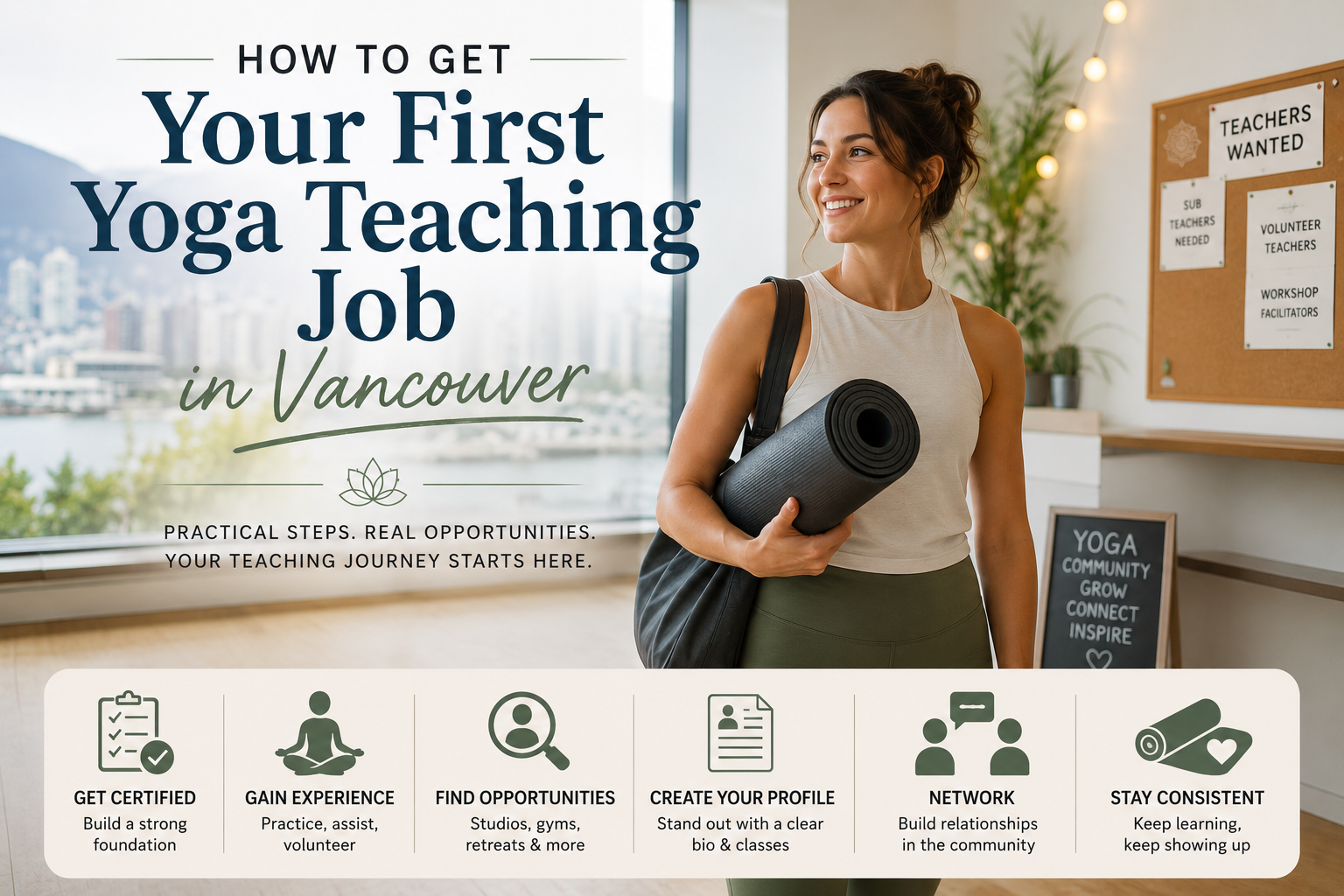
 How to Get Your First Yoga Teaching Job in Vancouver
You finished your teacher training. You feel ready. Then you sit down to actually find a job, and the questions pile up. Which studios are hiring? Do you need insurance? Should you register with Yoga Alliance International? How do new teachers get noticed in a city with hundreds of qualified instructors?
This guide answers all of it. It walks you through what Vancouver studios actually look for, the paperwork you need before your first class, and the practical steps that turn a certificate into a paycheck. None of this is complicated. It just takes the right order of operations, and a bit of patience while you build a reputation.
Let’s start at the beginning: understanding the market you’re stepping into.
Understanding Vancouver’s Yoga Job Market
Vancouver has one of the most saturated yoga markets in Canada. The city is home to major studio chains, dozens of independent studios, community centres with drop-in programs, corporate wellness contracts, and a large population of freelance teachers who supplement studio work with private clients. This is good news and bad news. Good, because demand for yoga classes across the Lower Mainland remains strong, especially in neighbourhoods like Kitsilano, Mount Pleasant, Yaletown, and the North Shore. Bad, because you’re not the only new RYT 200 graduate looking for hours this month.
New teachers often assume the biggest, most recognizable studios are the best place to start. That’s usually backwards. Large chain studios receive dozens of applications for every open subbing slot, and they tend to hire teachers who already have a following or a strong personal referral. Smaller independent studios, community centres, and corporate wellness programs are usually more open to newer teachers, especially if you’re willing to start with early morning or off-peak time slots.
It also helps to understand pricing. Vancouver studios typically pay per class rather than hourly, and rates vary depending on class size, studio prestige, and whether the arrangement is a flat fee or a per-student model. Community centres run through the City of Vancouver’s community centre associations often pay a modest flat rate but offer more consistent scheduling for new instructors. Knowing this landscape before you start applying saves you from wasted effort chasing studios that were never realistic first steps.
Get Certified: Choosing the Right 200-Hour Teacher Training
Every yoga teaching job in Vancouver starts with the same requirement: a completed 200-hour teacher training. This is the industry-standard entry credential, and almost no studio will hire you without it. The training typically covers asana (postures), pranayama (breathwork), anatomy, teaching methodology, and yoga philosophy, and it takes anywhere from a few intensive weeks to several months depending on the schedule format.
Not all trainings are equal, and studios notice the difference. When choosing a program, look for a school registered with Yoga Alliance, the largest nonprofit association for yoga teachers and schools. Registration isn’t legally required to teach, but it signals that the training met a recognized set of hour and curriculum standards. A Yoga Alliance-registered school is officially called a Registered Yoga School (RYS), and completing a program there makes you eligible to register as an RYT 200 afterward.
Beyond the credential itself, pay attention to the quality of practicum hours. A good training gives you real, supervised opportunities to teach in front of a live class, not just theory. Ask how many hours of actual teaching practice are built into the curriculum, and whether you’ll receive feedback from lead trainers. Studios hiring new teachers can usually tell within the first few minutes of an audition class whether someone trained somewhere that emphasized cueing, sequencing, and classroom management, or somewhere that focused mostly on personal practice.
Finally, think about specialization early. Vancouver has strong demand for restorative yoga, prenatal yoga, yoga for seniors, and trauma-informed classes. If your training offers electives or modules in these areas, they can differentiate you later, even before you pursue an advanced certification.
If you’re still deciding where to train, our 200-hour teacher training program is designed around exactly these hiring realities, with a strong practicum component and direct guidance on entering the local job market.
Register with Yoga Alliance and Understand What Credentials Actually Mean
Once you finish your 200-hour training, you’ll face a choice: register with Yoga Alliance International or not. Registration is optional. Yoga Alliance International is not a licensing body, and no law in British Columbia requires it. But in practice, many Vancouver studios use RYT status as a quick screening tool when reviewing applications, especially from teachers they don’t already know.
To register, you create an account on the Yoga Alliance International website, submit proof of your completed training from a Registered Yoga School, and pay the registration fee. As of the current fee structure, this includes a one-time registration charge plus an annual membership fee. Applicants must also complete the platform’s mandatory ethics and scope-of-practice commitment before their profile goes live. Once approved, you’re listed in the searchable directory, and you can use the RYT 200 title on your resume, website, and class descriptions.
It’s worth understanding the credential ladder even at this early stage, because it shapes your long-term career, not just your first job. RYT 200 is the entry-level designation. After two years and a minimum number of teaching hours, you become eligible for E-RYT 200, a designation that lets you mentor newer teachers or assist in trainings. RYT 500 and E-RYT 500 sit further up the ladder and typically require additional 300-hour training plus significant teaching experience. Higher-end studios in Vancouver sometimes prefer E-RYT 500 teachers for lead workshop roles, but this is rarely a barrier for entry-level positions.
If you decide registration isn’t for you right now, that’s fine. You can still say, accurately, that you completed a 200-hour Yoga Alliance International-approved training. You simply can’t use the RYT title itself. Many studios care more about your teaching quality and audition performance than whether you carry the credential, so don’t let this decision stall your job search.
 Get Insured and Handle the Business Basics
Before any reputable Vancouver studio puts you on the schedule, they will almost certainly ask for proof of liability insurance. Canada has no federal law requiring yoga teachers to carry insurance, but studios, gyms, community centres, and corporate wellness clients treat it as a non-negotiable condition of hiring, because it protects them as much as it protects you.
Yoga instructor insurance in Canada typically combines commercial general liability and professional liability coverage. General liability protects you if a student or visitor is injured or their property is damaged in connection with your class. Professional liability, sometimes called errors and omissions coverage, protects you if a student claims your instruction or a hands-on adjustment caused injury, even if you did nothing wrong. Providers such as Zensurance and BrokerLink offer combined policies built specifically for yoga teachers, with basic annual premiums generally starting in the low hundreds of dollars, depending on your coverage limits and class types.
Alongside insurance, most self-employed teachers in BC also need to think about basic business registration. If you plan to operate under your own legal name, you don’t need to register a business with the province. If you want to operate under a business name, such as a personal yoga brand, you’ll need to reserve that name and register it through BC Registries and Online Services, which currently costs a modest combined fee for name reservation and registration. This step isn’t usually urgent for your very first teaching contract, but it matters quickly once you start invoicing multiple studios or offering private sessions under your own name.
None of this paperwork is glamorous, but skipping it can cost you a job offer outright. Studios ask for a certificate of insurance as part of onboarding, not as a courtesy, so have it ready before you start interviewing.
Build Teaching Experience Before You’re Formally Hired
Here’s the part new teachers underestimate: almost nobody gets hired for a paid studio slot the week they finish training. Studios want to see that you can hold a room, manage timing, and adjust a sequence on the fly, and the only way to prove that is by actually teaching.
Start by teaching for free or for a small donation. Offer classes to friends, family, coworkers, or community groups. Many Vancouver community centres and neighbourhood houses welcome volunteer-led wellness sessions, which gives you a real room with real strangers, not just supportive friends who already know your voice and cues. This is a completely different skill than teaching a training practicum, and studios can tell the difference.
Consider approaching smaller studios about a “teacher exchange” or assisting arrangement, where you support a lead teacher’s class in exchange for mentorship and stage time. Some studios also run new-teacher showcases or community class series specifically to let recent graduates build a track record. These slots typically don’t pay much, if anything, but they’re often the fastest route to your first formal booking, because studio owners see you perform in front of an actual class before they commit to paying you.
Keep a simple log of every class you teach: date, location, class size, and style. This becomes useful later, both for your resume and for tracking progress toward higher-level Yoga Alliance International credentials, which require documented teaching hours. Treat these first months as an apprenticeship rather than underemployment. The teachers who get consistent paid work within their first year are almost always the ones who taught constantly, even unpaid, right out of training.
Where to Look for Yoga Teaching Jobs in Vancouver
Vancouver’s yoga job market spreads across several distinct categories, and each one has a different hiring process. Understanding where to look saves you significant time.
Studios. Independent studios post openings on their own websites and social media, and many prefer email applications over formal job boards. Check studio Instagram accounts regularly, since last-minute subbing needs often get posted there first. Larger chains post more formal listings but receive high application volumes, so a personal introduction or in-person visit can help you stand out.
Gyms and fitness chains. Commercial gyms with group fitness programs, including national chains with Vancouver locations, regularly need yoga instructors for scheduled classes. These roles often pay a flat rate and require a somewhat more mainstream teaching style, geared toward general fitness members rather than a dedicated yoga community.
Community centres. The City of Vancouver’s recreation programs and neighbouring municipalities like Burnaby, Richmond, and North Vancouver all hire seasonal and ongoing instructors for public programs. These roles are competitive but tend to be more accessible to newer teachers, and they offer valuable resume-building experience.
Corporate wellness. Companies increasingly bring in yoga instructors for employee wellness programs, either through in-house HR departments or wellness platforms that contract freelance teachers. This work often pays well per session but requires some business development on your part, since it rarely comes through a simple job posting.
Private and online teaching. Many new teachers build income through private one-on-one sessions or small group classes booked directly by students, often found through referrals, local Facebook groups, or platforms connecting freelance instructors with clients. Online and hybrid classes have also become a lasting part of the post-2020 yoga landscape, giving new teachers another avenue that doesn’t depend on studio hiring cycles at all.
Most successful new teachers combine two or three of these categories rather than relying on a single studio, at least in their first year.
 Crafting a Standout Application and Audition Class
Vancouver studio owners read a lot of yoga teacher applications, and most of them look identical: a short bio, a certification mention, and a generic request to teach. To stand out, be specific. Mention the exact style of yoga you specialize in, the population you enjoy teaching most, and any relevant experience outside the studio, such as physical therapy, dance, or coaching backgrounds that inform how you cue movement.
Keep your resume simple and yoga-specific rather than a generic professional CV. List your training, certification status, teaching experience (even unpaid), any specializations, and your availability. Attach a short, warm cover note rather than a form letter. Studio owners notice when an applicant clearly researched their specific class offerings and community, rather than sending an identical message to twenty studios at once.
If you’re invited to teach an audition class, treat it as your actual job interview, not a formality. Studio owners are watching for a few specific things: whether your timing matches the scheduled class length, whether your cues are clear enough for someone who has never taken your class before, how you handle a student with an injury or limitation, and whether your energy fits the studio’s existing community. Bring a fully planned sequence rather than improvising, even if you’re comfortable freestyling in your own practice. A tight, well-paced 60-minute class tells a studio owner more about your readiness than an impressive but chaotic one.
After the audition, send a short thank-you message regardless of outcome. Vancouver’s yoga community is smaller than it looks, and studio owners talk to each other. A gracious, professional follow-up after a “not right now” response often leads to a callback months later when a slot actually opens up.
Networking and Building Relationships in Vancouver’s Yoga Community
Most yoga teaching jobs in Vancouver come from relationships, not job postings. Studio owners prefer hiring someone a trusted teacher recommends over a stranger who applied cold. This means your network matters as much as your certification.
Start by taking classes, not just teaching them. Attend classes at studios you’d like to work for, introduce yourself to the teacher and front desk staff, and let people get to know your face before you ever submit an application. Many studios quietly track which students seem engaged, consistent, and community-minded, and those students are often the first people approached when a substitute teaching slot opens up.
Attend workshops, teacher meetups, and continuing education sessions, even ones outside your specific style. These events are where teachers build the kind of professional relationships that lead to substitute requests, referral introductions, and collaborative workshops down the line. Vancouver also has active online communities, including local Facebook groups and Instagram networks specifically for yoga teachers, where studios sometimes post urgent substitute needs before they ever go to a public job board.
Don’t underestimate your own training cohort, either. The people you trained alongside are some of your most valuable long-term contacts. They hear about openings first, they can vouch for your teaching style from firsthand experience, and many of them go on to open their own studios or teach at multiple locations, creating referral opportunities for years after your training ends. Treat your cohort as a professional network from day one, not just a temporary group of classmates.
 Common Mistakes New Teachers Make When Job Hunting
A few patterns show up again and again among new teachers who struggle to land their first paid role. Recognizing them early can save you months of frustration.
The first mistake is applying only to the biggest, most recognizable studios. These are the hardest doors to open as a brand-new teacher, and rejection from them says very little about your actual readiness to teach. Spread your applications across smaller studios, community centres, and corporate wellness contacts instead.
The second mistake is undervaluing free or low-paid teaching opportunities. New teachers sometimes hold out for a paid contract from day one and turn down community classes or teacher exchanges that would have built their experience and visibility. In a market as competitive as Vancouver’s, those unpaid reps are often what makes a paid offer possible later.
The third mistake is skipping insurance and registration paperwork until a studio asks for it, then scrambling. Have your certificate of insurance ready before you start applying, so you’re never caught off guard during onboarding.
The fourth mistake is treating the audition class as low stakes. A polished, well-timed class matters more than an impressively advanced one. Studios hire teachers who can safely and clearly guide a mixed-level room, not necessarily the teacher with the most advanced personal practice.
Finally, many new teachers stop networking once they’ve submitted a few applications. Consistent presence in the local yoga community, through classes, workshops, and cohort relationships, remains the single most reliable path to steady work in this city.
Conclusion: How to Get Your First Yoga Teaching Job in Vancouver
Landing your first yoga teaching job in Vancouver comes down to a clear sequence: complete a solid 200-hour training, decide whether Yoga Alliance International registration fits your goals, get insured, and start teaching in any room that will have you, paid or not. From there, apply broadly across studios, gyms, community centres, and corporate wellness programs, treat every audition class as a real interview, and stay visible in the local yoga community through classes, workshops, and your training cohort. None of these steps require luck. They require consistency, and a willingness to teach before you feel fully ready.
If you’re ready to take the first step, our 200-hour yoga teacher training is built with this exact hiring landscape in mind. Check it out to see how the program prepares you not just to complete a certification, but to actually get hired.