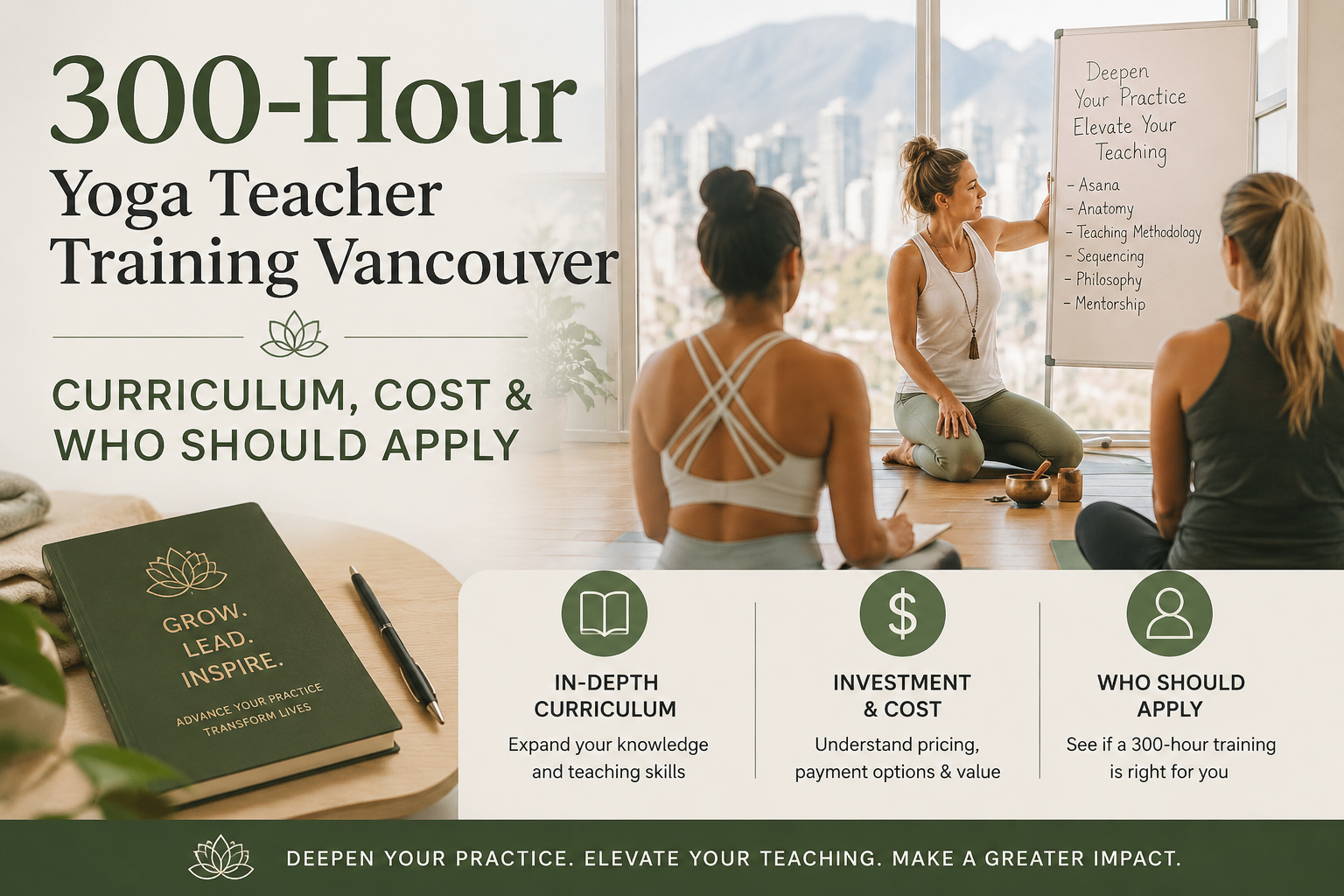
 300-Hour Yoga Teacher Training Vancouver: Curriculum, Cost & Who Should Apply
If you’ve already earned your 200-hour certification, you’ve probably felt the itch to go deeper. That itch has a name: 300-Hour Yoga Teacher Training Vancouver: Curriculum, Cost & Who Should Apply is the exact question most 200-hour graduates start asking within a year of teaching their first classes. This guide walks through what the training actually covers, what it costs in Vancouver, and how to know if you’re ready to apply.
A 300-hour program is not a repeat of your foundational training. It’s a specialization. It takes the skills you already have and sharpens them until you can teach with real confidence, not just competence. This article breaks down the curriculum, the real costs involved, the credentialing behind it, and who tends to thrive in this kind of program.
What Is a 300-Hour Yoga Teacher Training?
A 300-hour yoga teacher training (YTT) is an advanced program designed for teachers who already hold a 200-hour certification. It builds on the basics: anatomy, philosophy, sequencing, and teaching methodology. But it pushes further into specialized skills like therapeutic sequencing, advanced adjustments, and subtle-body anatomy.
Here’s the important distinction. A 300-hour training is not a standalone beginner course. Most reputable schools, including those in Vancouver, require proof of a completed 200-hour RYT certification before you can enroll. This prerequisite exists for a reason. The 300-hour curriculum assumes you already know how to cue a Sun Salutation, explain the difference between the yamas and niyamas, and hold space for a room full of students. Without that foundation, the advanced material moves too fast.
According to Yoga Alliance, the global body that sets training standards, a 300-hour program is meant to deepen and refine what a 200-hour program introduces. Think of the 200-hour training as learning to read, and the 300-hour training as learning to write with style. You already understand the letters. Now you’re learning to use them with precision.
Vancouver’s yoga community has grown steadily over the past decade, and with it, the number of studios offering advanced training. That growth is good for prospective students. More options mean more chances to find a program that fits your teaching style, whether that’s a physically rigorous vinyasa focus or a gentler, more therapeutic approach.
How a 300-Hour Program Differs From a 200-Hour Program
The gap between 200 hours and 300 hours isn’t just 100 extra classroom hours. It’s a shift in depth and expectation.
A 200-hour program is designed to get you teaching safely. It covers the essentials: basic anatomy, an introduction to yoga philosophy, foundational sequencing, and enough practicum hours to graduate with confidence in front of a beginner class. It’s broad by design, because most students walking in have little to no formal background in the subject.
A 300-hour program assumes that foundation is already solid. Instead of introducing anatomy, it explores functional anatomy in far more detail, teaching you how joints move, how injuries happen, and how to modify poses for real bodies with real limitations. Instead of a general overview of philosophy, it might dig into specific texts, like the Bhagavad Gita, with structured seminars and discussion.
The teaching practicum also changes. In a 200-hour training, you practice teaching short segments to classmates. In a 300-hour training, you’re often expected to lead full-length classes, sometimes to the public, and receive detailed feedback on cueing, pacing, and energy management.
Perhaps the biggest shift is specialization. Many 300-hour programs let you choose a focus, such as yin yoga, prenatal yoga, trauma-informed teaching, or yoga therapy fundamentals. A 200-hour program rarely offers this kind of choice because there isn’t time. The extra 300 hours exist precisely to let you go narrow and deep instead of broad and shallow.
 Understanding the RYT 500 Credential
This is where things get a little confusing for new teachers, so it’s worth clarifying directly.
There is no standalone “RYT 300” credential issued by Yoga Alliance. When you complete a 300-hour program, you don’t get a 300-hour certificate that stands alone in the registry. Instead, your 200 hours and your 300 hours combine to total 500 hours, which qualifies you for the RYT 500 designation. According to Yoga Alliance’s official training pathways, you complete an RYT 200 first, then earn an additional 300-hour training at a Registered Yoga School (RYS 300), totaling 500 hours before you’re eligible for the higher designation.
Some schools market their offering as “300-hour YTT” or “RYT 300 training” because that’s the language students search for. That’s fine, and it’s accurate in describing the program length. Just know that the credential waiting for you at the finish line is RYT 500, not a separate 300-hour title.
Why does this matter? Because the RYT 500 designation carries real weight in the industry. Many senior teaching roles, wellness retreats, and even some clinical or hospital-adjacent wellness positions list RYT 500 as a preferred or required qualification. It signals that you’ve gone beyond entry-level training and invested in a genuinely advanced education.
There’s also a path toward E-RYT 500, an “Experienced” designation that requires not just the 500 training hours but a minimum number of teaching hours logged over several years. If long-term career advancement in yoga is part of your plan, understanding this ladder now will help you make smarter decisions about which 300-hour program to choose.
What the Curriculum Typically Covers
Every school structures its 300-hour training a little differently, but most programs in Vancouver and beyond share a common backbone. Expect your curriculum to include the following core areas.
Advanced anatomy and physiology. This goes well beyond “here are the major muscle groups.” You’ll study joint mechanics, common injury patterns, and how to safely adapt poses for students with physical limitations, past injuries, or chronic conditions.
Applied teaching methodology. You’ll spend significant time actually teaching, not just learning theory. Many programs require you to lead public or semi-public classes under supervision, then receive structured feedback on your cueing, pacing, and use of language.
Yoga philosophy and textual study. Where a 200-hour program might touch briefly on the Yoga Sutras of Patanjali, a 300-hour program often dedicates full modules to specific texts, exploring how ancient philosophy applies to modern teaching and modern students.
Specialized tracks. This is often the most exciting part for returning students. Popular specializations include yin yoga, restorative yoga, prenatal and postnatal yoga, trauma-informed teaching, and yoga for athletes. Some schools also offer business modules, covering how to build a private client base or run workshops.
Meditation and pranayama depth. Breathwork and meditation get far more attention here than in foundational training, often including guided practicum in leading meditation sessions for groups.
Practicum and mentorship hours. Expect direct, ongoing feedback from senior teachers, often through smaller cohort sizes than a typical 200-hour program allows.
Most programs also include a final project or capstone, which might involve designing and teaching an original class series, writing a philosophy paper, or developing a specialized workshop you can offer once certified.
 Cost of 300-Hour Yoga Teacher Training in Vancouver
Cost is one of the most practical concerns for anyone considering this next step, and it deserves an honest answer rather than a vague range.
Across North America, 300-hour programs generally run higher than their 200-hour counterparts, largely because of the smaller class sizes, specialized instructors, and additional practicum hours involved. Industry pricing data from established training providers shows 500-hour combined programs, which factor in both the 200 and 300-hour components, often landing well above the price of a standalone 200-hour course, with some international programs ranging from roughly $2,600 to $4,500 USD depending on location and accommodation.
In a city like Vancouver, where studio space, instructor fees, and cost of living run higher than in many training destinations abroad, prospective students should expect the 300-hour tuition alone to sit in a comparable or higher range, before factoring in books, props, or any optional retreat components. Programs delivered in-studio in a major Canadian city typically cost more than the same hour count delivered at an international retreat center, largely due to overhead.
A few cost factors worth asking about before you commit:
- Does the price include manuals, required textbooks, or reading materials?
- Are practicum hours held in-studio, meaning you’ll pay separately for class drop-ins during your training?
- Is there a payment plan option, and does it include any interest or administrative fee?
- Does the school offer early-bird pricing, and how far in advance does that discount close?
- Are there additional certification or registration fees required by Yoga Alliance once you graduate?
Many Vancouver studios offer payment plans specifically because the upfront cost of advanced training is a genuine barrier for working teachers. It’s worth asking directly, since this detail is rarely advertised prominently on a program’s main page.
Who Should Apply for a 300-Hour Training
Not every 200-hour graduate is ready for this step immediately, and that’s completely normal. Here’s how to think through whether now is the right time.
You’ve been teaching for at least several months. Most reputable programs want to see that you’ve applied your 200-hour training in the real world, not just completed it. Teaching experience, even a modest amount, gives you the practical questions and challenges that make advanced material land differently.
You know what you want to specialize in, even loosely. You don’t need a fully formed plan, but having some sense of direction, whether that’s therapeutic yoga, prenatal work, or deepening your philosophical knowledge, helps you choose the right program rather than a generic one.
You’re ready for a more rigorous commitment. A 300-hour program is not casual. Expect intensive weekends, significant reading, and real accountability around attendance and participation. If your schedule is already stretched thin, it’s worth being honest about whether this is the right season for it.
You’re seeking career advancement, not just personal growth. While plenty of people take advanced training purely for their own practice, most 300-hour programs are structured around the assumption that graduates intend to teach professionally at a higher level, lead workshops, or eventually pursue E-RYT status.
You want smaller, more personalized mentorship. Cohorts for 300-hour programs tend to be smaller than 200-hour intakes. If you thrived on individual feedback during your foundational training, you’ll likely enjoy this format even more.
If you’re unsure, most Vancouver studios offering 300-hour programs are happy to have an informal conversation before you apply. Use that conversation. Ask about cohort size, teaching philosophy, and what past graduates have gone on to do.
 How to Choose the Right Program in Vancouver
With several studios in the city now offering advanced training, choosing the right one comes down to a few practical questions rather than marketing claims.
First, confirm the school’s Registered Yoga School status directly through Yoga Alliance’s official school directory. This single step protects you from enrolling somewhere that won’t actually count toward your RYT 500 credential.
Second, ask about the lead instructors’ backgrounds. A 300-hour program lives or dies on the expertise of its teachers. Look for instructors with genuine specialization in the areas you care about, whether that’s anatomy, philosophy, or a specific style of practice, rather than instructors simply repeating 200-hour content at a slower pace.
Third, look closely at the schedule format. Vancouver programs are typically offered as weekend intensives spread across several months, or as a more condensed daily immersion. Weekend formats suit teachers who are still working other jobs. Immersion formats suit those who can take dedicated time off and want the training to move faster.
Fourth, read reviews and, if possible, speak with graduates. Ask what they wish they’d known before enrolling, and whether the specialization tracks lived up to expectations.
Finally, don’t overlook fit. Yoga training is personal. A program with excellent credentials but a teaching style that doesn’t resonate with you will feel like a slog. Trust your instincts about which studio’s philosophy and energy match your own.
Career Paths After Completing Your 300-Hour Training
Graduates of 300-hour programs often find their professional options widen in ways a 200-hour certification alone doesn’t unlock.
Senior teaching positions at established studios frequently list RYT 500 as a preferred qualification, particularly for lead teacher or teacher-trainer roles. Retreat and workshop leadership, both locally and internationally, becomes a realistic option once you’ve built a specialized skill set. Some graduates move into wellness-adjacent settings, including clinics or corporate wellness programs, where a 500-hour credential is often treated as a baseline expectation.
Specialization also opens doors that generalist teaching doesn’t. A teacher certified in trauma-informed yoga or prenatal yoga can market directly to underserved niches, often commanding higher private session rates than a generalist instructor. Others use their advanced training as a stepping stone toward teacher-training roles themselves, eventually helping train the next generation of 200-hour graduates.
None of these outcomes are guaranteed simply by finishing the program. Like most credentials, the RYT 500 opens doors, but building an actual career still requires consistent teaching, networking within your local yoga community, and continued professional development.
 Final Thoughts
300-Hour Yoga Teacher Training Vancouver: Curriculum, Cost & Who Should Apply comes down to this: it’s an advanced, specialized step for teachers who already hold a 200-hour foundation and want to deepen their skills, pursue the RYT 500 credential, and open up more advanced career opportunities. The curriculum goes far beyond the basics, covering advanced anatomy, specialized tracks, deeper philosophy, and real teaching practicum. Costs in Vancouver reflect the city’s studio overhead and instructor expertise, so budgeting ahead matters. And while not every graduate is ready immediately, those with some teaching experience, a rough sense of specialization, and genuine appetite for a more rigorous commitment tend to get the most out of it.
If you haven’t taken that first step yet, the 300-hour path will still be here when you’re ready. But every advanced teacher started with the foundation.
If you’re ready to become a yoga teacher, check out our 200-Hour Yoga Teacher Training page to see where your journey begins.