
 Yoga Teacher Training in Vancouver for Personal Trainers and Fitness Instructors: Is a 200-Hour Certification Worth It? (2026 Guide)
You already coach people through squats, planks, and mobility drills. Clients trust your eye for movement. So why would you spend a few months in yoga teacher training?
Many trainers and instructors ask this question. This guide answers it. It looks at yoga teacher training in Vancouver for personal trainers and fitness instructors and asks whether a 200-hour certification is worth it in 2026. You will see what the training covers, what it costs in time and money, and where it can grow your career. You will also see where it may not help.
The answer depends on your goals. For some trainers, the certification opens new revenue and better client results. For others, it adds little. This article gives you the facts to decide.
Note: Prices, schedules, and program rules change. Confirm current details with any school before you enrol.
What a 200-Hour Yoga Teacher Training Actually Covers
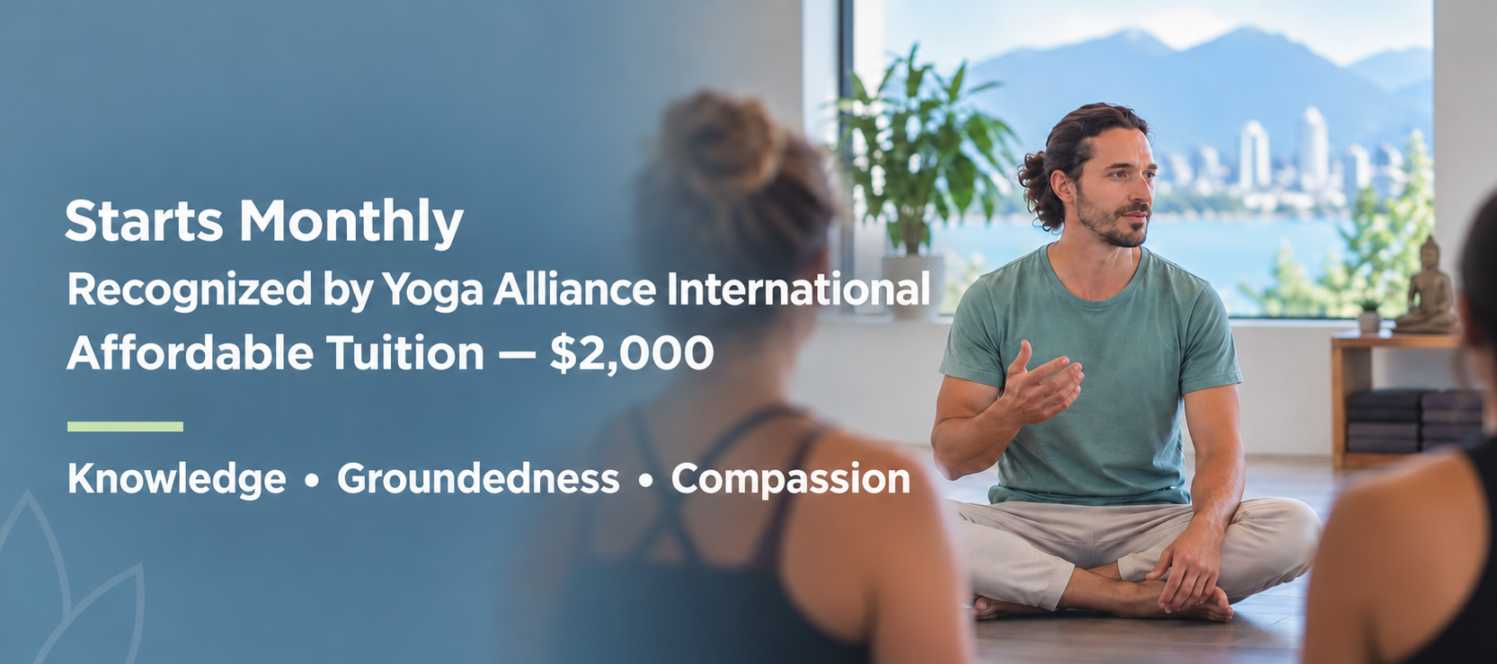
A 200-hour program is the standard entry point for yoga teachers. Most schools in Canada build their curriculum around the standards set by Yoga Alliance, the largest international yoga credentialing body. A school that meets those standards can register as a Registered Yoga School (RYS). Graduates can then apply for the RYT-200 designation.
The 200 hours split across several subject areas. You will study:
- Techniques, training, and practice. You learn asana (postures), pranayama (breathing), and meditation. You also practise them yourself.
- Teaching methodology. You learn to cue, sequence, demonstrate, and adjust. You also learn to hold space for a group.
- Anatomy and physiology. You study how joints, muscles, and the nervous system respond to yoga.
- Yoga humanities. You explore the history, philosophy, and ethics behind the practice.
- Professional essentials. You learn about teaching ethics, boundaries, and running a class.
- Practicum. You teach real people and receive feedback.
Trainers often expect a workout course. It is not one. A good 200-hour program spends real time on philosophy, breath, and stillness. You will sit, breathe, and reflect. You will also study texts such as the Yoga Sutras.
That breadth surprises many fitness professionals. It is also the main reason the training changes how they coach. You learn to guide attention and breath, not only muscles.
Schedules vary. Some programs run on weekends over several months. Others run in an intensive block of a few weeks. Vancouver schools often offer both. Hybrid formats exist too, though you should check how many hours happen in person and how many happen online.
Why Personal Trainers and Fitness Instructors Take Yoga Teacher Training
Trainers pursue yoga training for different reasons. Most reasons fall into four groups.
1. Clients ask for it. Many clients carry stress, stiff hips, and tight shoulders. They want strength, but they also want to feel better. A trainer who can guide a mobility and breathing session meets that need directly.
2. Trainers want a wider skill set. Strength work builds capacity. Yoga builds awareness of how you use that capacity. Trainers who learn both can design more balanced programs.
3. Trainers want to protect their own bodies. Coaching is physically demanding. Long days on your feet, repetitive demonstrations, and heavy loading take a toll. A personal yoga practice supports recovery and mobility. Teacher training deepens that practice.
4. Trainers want another income stream. A yoga certification lets you teach classes, workshops, and private sessions. It can also make your services easier to sell to corporate and wellness clients.
The research behind yoga is also worth noting. The U.S. National Center for Complementary and Integrative Health summarizes the evidence on yoga and health. It reports that yoga may help with low back pain and stress, among other things. Evidence quality varies by condition. Still, those two outcomes matter to many of your clients.
Be honest about motivation, though. Teacher training is not a shortcut to a new career. It rewards people who already love the practice. If you take the course only to add a line to your résumé, you may feel the cost more than the benefit.
What You Already Know, and What Will Be New
Fitness professionals start with a real advantage. You can read bodies, explain movement, and manage a room. You also know basic anatomy and exercise safety. That foundation makes parts of the course easier for you than for a complete beginner.
Where trainers have an edge:
- You understand muscle groups and joint actions.
- You cue clearly and demonstrate well.
- You know how to progress and regress an exercise.
- You are comfortable speaking to a group.
- You respect injury risk and client screening.
Where trainers often struggle:
- Slowing down. Fitness coaching is often fast and goal-driven. Yoga asks you to hold still and observe.
- Sanskrit and philosophy. Terms and texts may feel unfamiliar. Some trainers find this section abstract at first.
- Teaching without counting reps. A yoga class flows by breath and feel, not by sets.
- Letting go of “fixing.” Yoga teachers invite students to explore. They do not always correct. That shift takes practice.
- Personal flexibility. Some trainers are strong but stiff. Yoga postures can feel humbling.
These gaps are normal. Most programs expect students to arrive with mixed backgrounds. Good teachers help you build the missing pieces.
One more point matters here. Your existing credentials do not replace this training, and this training does not replace them. A yoga certification does not make you a physiotherapist or a rehabilitation specialist. Keep your scope of practice clear. If a client has a diagnosed injury, refer them to a qualified health professional and work within your training.
Career and Income Options After Certification
A 200-hour certification can open several doors. None of them is guaranteed, and income depends on your market, your reputation, and your effort. Here are the most common paths for trainers.
Group yoga classes. Studios and gyms hire teachers for regular classes. Pay rates vary widely by venue and experience, and new teachers often start with lower rates. Many gyms prefer to hire instructors who already work in the building.
Yoga-informed personal training. This path often suits trainers best. You keep your current clients and add mobility, breath work, and recovery sessions. You can charge for specialized sessions or build them into packages.
Small group and semi-private sessions. Combining strength and yoga in a small group can feel fresh to clients. It can also improve your hourly earnings, since several people pay for one session.
Workshops and series. You can run a four-week series on hip mobility or stress relief. Short, focused offers often sell well because clients know exactly what they get.
Corporate and community wellness. Vancouver has many workplaces and community groups interested in wellness programs. A trainer with both fitness and yoga credentials can pitch lunchtime classes or stretch breaks.
Online classes. Video and live-stream classes can reach clients beyond your neighbourhood. They also demand extra work on filming, marketing, and tech.
Be realistic about the market. Vancouver has many yoga teachers. New teachers often need months of practice teaching, a clear niche, and strong networking before they build a steady schedule. Trainers have one advantage here: you may already have an audience. If you can offer yoga to existing clients, you skip the hardest step.
The Real Cost: Time, Money, and Return on Investment
Value comes down to cost versus return. Calculate both before you commit.
Direct costs. Tuition is the largest expense. Fees differ by school, format, and what the program includes. Compare what each tuition covers. Look for manuals, mentoring, extra practice classes, and any registration fees. Ask the school for a full written breakdown. Then add the cost of Yoga Alliance registration if you plan to apply, plus liability insurance once you start teaching.
Time costs. 200 hours is a big commitment. Add self-study, homework, and practice teaching on top of class hours. A weekend program may stretch your calendar for months. An intensive may require you to reduce client sessions for a short period. Lost training income during that period is part of your real cost.
Return on investment. Use a simple method:
- Estimate your total cost: tuition, lost income, insurance, and extras.
- Estimate your added monthly income from new classes, upgraded packages, or workshops.
- Divide total cost by monthly gain. The result tells you roughly how many months you need to break even.
Be cautious with optimistic numbers. Use conservative estimates, not best-case ones.
Non-financial returns. Some benefits do not show up in a spreadsheet. You may gain better client retention, stronger coaching skills, and a more sustainable personal routine. You may also find that you enjoy your work more. These benefits are real, but treat them as a bonus. They should not be the only reason you enrol.
If the math works only under perfect conditions, wait. If it works under cautious assumptions, the investment is easier to justify.
 Credentials in Canada: Yoga Alliance, BC Rules, and Insurance
Many trainers ask whether they need a certification to teach yoga in Vancouver. In practice, no government licence is required to teach yoga in British Columbia. The industry is largely self-regulated. Even so, a recognized credential still matters in the real world.
Why credentials matter. Studios and gyms usually want proof of training. Insurers often require it. Clients also use credentials to judge quality. A Yoga Alliance RYT-200 designation is the most widely recognized yoga teaching credential in Canada. Yoga Alliance sets its own standards, and it is not a government body. Confirm current requirements on its site before you enrol.
Fitness credentials still count. If you already hold a certification through a group such as canfitpro, keep it current. Provincial resources like BC Recreation and Parks Association also support fitness leaders in the province. Your fitness credentials show your core competence. Your yoga credential adds a specialty. Together, they make a strong profile.
Insurance. Liability coverage protects you if a client gets hurt. Check whether your current policy covers yoga instruction. Many policies treat yoga as a separate activity, so you may need to update coverage. Ask your insurer directly and keep the answer in writing.
Registration details. To use the RYT-200 designation, you must graduate from a Registered Yoga School and then register with Yoga Alliance. The registry may involve fees and ongoing requirements. Read the current terms before you apply.
Do not assume that every program carries the same recognition. Ask each school whether it is registered. Verify the claim on the Yoga Alliance directory yourself. This quick check protects you from wasting money on a program that does not provide the credential you expect.
Risks and Downsides to Consider
A fair guide must cover the downsides. A 200-hour certification is not right for everyone.
You may not teach much. Many people finish teacher training and never teach a public class. Some do it for personal growth. That outcome is fine if you expected it. It is less fine if you planned to earn income.
The market is crowded. Vancouver has a lot of yoga teachers. Competition can limit class availability and keep pay modest, especially early on.
200 hours is only a starting point. The course gives you a foundation. It does not make you an expert. Good teachers keep learning through workshops, mentorship, and years of practice. If you want to work with special populations, such as prenatal students or people with chronic pain, you will likely need further training.
Scope of practice. Yoga language sometimes drifts into therapy claims. Avoid promising that yoga will cure or treat a condition. Teach within your training and refer out when needed.
Philosophy may not fit. Yoga has roots in South Asian spiritual traditions. Some programs lean heavily on those traditions, while others focus on modern fitness-style yoga. Choose a school that matches your comfort level, and respect the culture the practice comes from.
Personal strain. Intensive formats can leave you tired. Trainers who already work long days may find the schedule hard. Pick a format you can sustain.
These risks do not make the training a bad idea. They make planning important. Go in with a clear goal and a realistic view of the market.
How to Choose a Yoga Teacher Training in Vancouver
Not all programs deliver the same value. Use these criteria to compare schools.
1. Registration and credentials. Confirm the school is a Registered Yoga School with Yoga Alliance. Look up the school in the official directory instead of relying on a logo on a website.
2. Lead teacher experience. Look at the lead trainers’ backgrounds. How long have they taught? How long have they trained other teachers? Experience in training teachers is different from experience in teaching classes.
3. Curriculum fit. Ask for a full syllabus. See how many hours go to anatomy, teaching practice, and philosophy. If you are a trainer, look for a strong anatomy and teaching methodology component. You will use it every day.
4. Practice teaching. Real teaching practice builds confidence. Ask how many hours you will spend teaching and how often you will get feedback.
5. Class size and mentoring. Smaller groups often allow more personal feedback. Ask what support continues after graduation.
6. Schedule and format. Match the format to your life. Weekend programs suit busy trainers who cannot step away from clients. Intensives suit those who can take time off.
7. Cost transparency. Ask for a written list of what tuition includes. Ask about payment plans, refund policies, and any extra fees.
8. Graduate outcomes. Ask what past graduates now do. Speak to alumni if you can. Their experiences tell you more than a brochure.
9. Community and values. You will spend many hours with these teachers and classmates. Visit a class or attend an info session. See whether the culture feels welcoming.
If you are comparing local options, our 200-hour yoga teacher training in Vancouver page lays out the curriculum, format, and what graduates receive. Use it as one reference point as you compare schools.
How Trainers Can Apply Yoga Skills Right Away
One strong argument for the certification is how quickly you can use it. Many trainers see changes in their sessions within weeks.
Warm-ups and cool-downs. Yoga offers a rich menu of mobility drills. You can build warm-ups that prepare the hips, spine, and shoulders for lifting. You can end sessions with calming stretches and breath work.
Better cueing. Yoga teachers learn to use clear, simple language. They also learn to use silence. Many trainers find that cueing less, but better, improves client focus.
Breath awareness. Yoga training teaches you to notice and guide breathing. Clients can use that skill under load and during stress.
Recovery days. Instead of telling clients to “go stretch,” you can lead a recovery session. This gives clients a reason to keep seeing you on lighter days.
Stress management. Many clients lift weights to cope with pressure. A short breathing or relaxation practice can complement their training. Present it as a tool, not a medical treatment.
Program variety. Mixing strength and mobility can keep long-term clients engaged. Variety reduces boredom and may improve adherence.
 Who Should Take the Training, and Who Should Wait
Here is a quick way to decide.
The training is likely worth it if:
- You already practise yoga and want to deepen your understanding.
- Your clients ask for stretching, mobility, or stress relief.
- You want to add classes, workshops, or small-group offers.
- You can afford the time and tuition without financial strain.
- You value learning for its own sake, not only for income.
You may want to wait if:
- You have never tried yoga. Take classes for a few months first.
- Your schedule is already stretched thin.
- You expect fast, high income from teaching.
- You want a therapeutic or rehabilitation role. Other training paths fit that goal better.
- You feel pressure to enrol quickly because of a sales deadline.
Consider a middle path as well. Take a few weeks of classes at the school you are considering. Talk with the teachers. Attend an information session. A trial period lowers the risk of a mismatch.
Also consider your timeline. Some trainers prefer to enrol during a slower season for their business, so the workload feels lighter. Others prefer to start sooner and build new offers as they learn.
Conclusion: Is a 200-Hour Certification Worth It for Trainers?
So, is yoga teacher training in Vancouver for personal trainers and fitness instructors worth it? Is a 200-hour certification worth the investment in 2026?
For many trainers, yes, if they approach it with clear goals. The training deepens your understanding of movement, breath, and stress. It gives you a recognized credential. It can also help you grow client results, add services, and extend your career. Trainers who already love yoga often get the most value.
It is not worth it for everyone. The Vancouver market is competitive. Teaching income takes time to build. A 200-hour course gives you a foundation, not mastery. Run the numbers conservatively, check each school’s registration, and make sure the format fits your life.
The main takeaway is simple. A 200-hour yoga certification can be a strong investment for trainers who want to expand their skills and offers, and who plan how they will use it.
If you are ready to become a yoga teacher, visit our 200-hour yoga teacher training in Vancouver page to see the schedule, curriculum, and next steps. You can also read more and review the standards at Yoga Alliance before you decide.