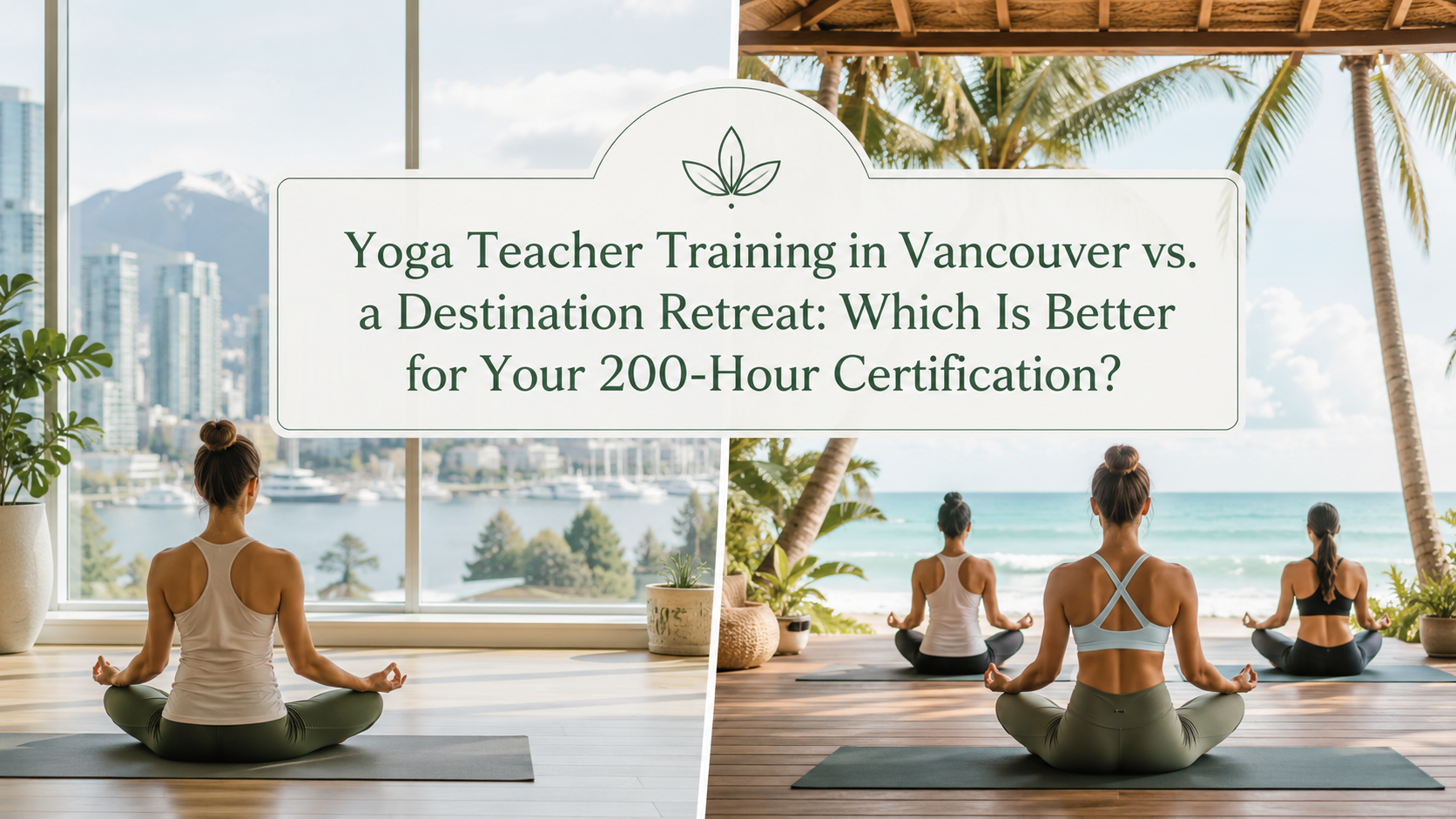
 Yoga Teacher Training in Vancouver vs. a Destination Retreat: Which Is Better for Your 200-Hour Certification?
Choosing where to complete your 200-hour yoga teacher training is one of the biggest decisions in your yoga journey. Two paths dominate the conversation: staying local and training in a city like Vancouver, or flying somewhere exotic for an immersive destination retreat. Both routes can lead to the same credential. Both can make you a capable, confident teacher. But the experience of getting there looks very different.
This guide breaks down Yoga Teacher Training in Vancouver vs. a Destination Retreat: Which Is Better for Your 200-Hour Certification? so you can choose the format that actually fits your life, your goals, and your budget — not just the one with the prettiest Instagram feed.
What a 200-Hour YTT Actually Requires
Before comparing formats, it helps to understand what you’re signing up for. A 200-hour yoga teacher training is the entry-level credential recognized across the industry. Yoga Alliance, the largest credentialing body in the U.S. and widely referenced in Canada, sets the benchmark that most reputable schools follow.
Under Yoga Alliance’s standards, a Registered Yoga School (RYS) must cover five core educational categories: techniques and practice, teaching methodology, anatomy and physiology, yoga philosophy and lifestyle, and practicum (supervised teaching practice). Training providers must deliver a minimum number of hours in each category to reach the full 200. Since 2020, Yoga Alliance has also required schools to assess student learning rather than simply track attendance, which raised the bar for what “certification” actually means.
This matters because location doesn’t change the curriculum requirements — a well-run 200-hour program in Vancouver and a well-run one on a beach in Bali should both hit these same five categories. What changes is the pacing, the environment, and how much of your daily life gets absorbed into the training. That’s the real decision in front of you.
It’s also worth knowing that Yoga Alliance registration isn’t legally mandatory to teach yoga — anyone can technically call themselves an instructor. But most studios, gyms, and insurance providers expect (or require) an RYT-200 credential from a Registered Yoga School before they’ll hire you or issue liability coverage. That’s why the accreditation question matters just as much as the location question, no matter which format you eventually choose.
Yoga Teacher Training in Vancouver: What to Expect
Training locally in Vancouver typically means a part-time format spread across weekends or evenings over several months, rather than one intensive block. This structure suits people who can’t step away from work, caregiving, or other responsibilities for three or four consecutive weeks.
A Vancouver-based program lets you keep your job, your gym, your regular sleep schedule, and your support network intact while you train. You go home after each session, which gives you time to actually digest what you learned before returning for the next module. Many graduates say this spaced-out rhythm helps the material stick, because you’re not cramming five categories of content into 21 straight days.
Vancouver also offers something destination retreats can’t: ongoing community. You train alongside people who live in your city, which means your classmates can become your first yoga community — the people who show up to your practice-teaching sessions, refer students to your first classes, and remain part of your professional network for years. That local network is worth more than it sounds like on paper; teaching is a relationship-based profession, and word of mouth from a local studio matters.
Cost is another practical factor. Local training removes the expense of international flights, extended accommodation, and time off work, which can make the total investment lower even if the tuition itself looks similar to a retreat program. For a closer look at what a Vancouver-based curriculum covers, see our 200-Hour Yoga Teacher Training page.
There’s also a practical, day-to-day advantage that’s easy to overlook: familiarity. You already know the studios, the transit routes, the grocery stores, and the climate. None of your mental energy goes toward adjusting to a new time zone, unfamiliar food, or an unpredictable travel schedule. That energy stays available for the actual work of learning anatomy, refining your alignment cues, and building confidence at the front of the room. For students juggling a job, a family, or health considerations that make travel complicated, this stability isn’t a minor convenience — it’s often the difference between finishing the training and dropping out partway through.
 The Destination Retreat Experience: What to Expect
A destination YTT compresses the same 200 hours into an intensive, often residential format — commonly three to four weeks abroad in a location known for yoga, such as Rishikesh, Bali, or Costa Rica. You live, eat, and practice with your cohort for the entire training, with little contact with your normal routine.
This immersion is the main draw. Removing yourself from work emails, household chores, and daily distractions lets you focus almost entirely on yoga for the duration of the course. Many students describe it as transformative precisely because there’s nowhere else for their attention to go. Training in a place with deep roots in yoga’s history, like India, can also add a layer of cultural and philosophical context that’s harder to replicate elsewhere.
Destination retreats appeal strongly to people with flexible schedules — recent graduates, career-changers between jobs, or remote workers who can travel. If you’ve been dreaming of study in Southeast Asia or South Asia anyway, folding your certification into that trip can be efficient and meaningful at once.
But the format has real trade-offs. Yoga Journal’s guide to evaluating destination programs points out that destination trainings vary enormously in quality, and that slick marketing doesn’t always match the substance of the teaching. Because you’re evaluating a school from another country, often without meeting the lead trainer beforehand, due diligence takes more effort. You’re also compressing a demanding curriculum — anatomy, philosophy, teaching methodology, practicum — into a short window, which can feel rushed for students who process information more slowly or who are newer to yoga.
Logistics deserve attention too. Traveling internationally for a destination YTT means factoring in visas, travel insurance, vaccination requirements, and the possibility of flight delays eating into your first few days of training. Climate and seasonality matter as well — training during a region’s rainy or extreme-heat season can affect everything from your energy levels to the condition of the practice space. None of this is a reason to avoid destination training, but it does mean the planning workload starts well before day one of the course itself.
Comparing Cost: Vancouver vs. Destination Training
Money is rarely the only factor, but it’s usually the deciding one. On the surface, destination trainings in countries with a lower cost of living can look cheaper per week. Tuition abroad frequently includes lodging and some meals, which can make the headline price attractive.
However, the full cost comparison needs to include everything: flights, visas, travel insurance, vaccinations, time off work, and any pre- or post-trip travel you add to the itinerary. A three-week program abroad often means unpaid leave on top of tuition, which adds up fast if you’re not independently wealthy or between jobs. Currency exchange and unexpected costs at the destination — transportation, incidentals, tips — also nudge the real total higher than the marketing price suggests.
A Vancouver-based training, spread over months, lets you spread the tuition cost too, since many local schools offer payment plans. You avoid airfare and extended lodging altogether. You keep earning income throughout the training instead of taking weeks of unpaid leave. For many working adults, that’s the difference between a program that’s actually affordable and one that stays a someday-dream.
That said, if you’re already planning international travel — a sabbatical, a gap year, or a work-from-anywhere stretch — folding a destination YTT into that trip can be genuinely cost-effective, since you’d be paying for travel regardless. The honest answer is to build a real line-item budget for both options before deciding, rather than comparing sticker prices alone.
 Curriculum Depth and Quality Control
Curriculum quality is not automatically tied to location, but the format does affect how deeply material gets taught. Here are the factors worth examining closely before you compare programs side by side:
Pacing and retention. A months-long local program gives you repeated exposure to anatomy, philosophy, and teaching methodology over time, with practice teaching sessions spread across weeks. Spaced repetition is well-documented to improve retention compared with mass cramming, which matters when you’re trying to genuinely absorb enough anatomy and alignment knowledge to teach safely.
Instructor consistency. Local trainings in an established studio often mean you’re learning from instructors with an ongoing reputation in your community — people other local teachers already know and can vouch for. Destination retreats sometimes rotate international faculty or rely heavily on one lead trainer for nearly the entire immersive block, which can be excellent if that trainer is exceptional, or thin if they’re not.
Accreditation verification. Wherever you train, confirm the school is a Registered Yoga School with Yoga Alliance (or another recognized body relevant to where you plan to teach) before enrolling. Ask specifically how many hours are allocated to each of the five required categories, and ask to see a sample day or week’s schedule. A program that’s vague about its hour breakdown is a red flag, regardless of how beautiful the location looks in photos.
Practicum quality. Practice teaching is where the training becomes real. Ask how many opportunities you’ll get to teach a full class to real students (not just classmates), and whether you’ll receive individual, recorded, or written feedback. This is one area where a longer, local program sometimes has an edge, since practicum can be spread across multiple real community classes rather than compressed into a handful of peer-teaching sessions during a retreat.
Physical Demands and Recovery Time
A 200-hour training is physically demanding no matter where you take it, but the two formats put different kinds of stress on your body.
In a destination retreat, you’re typically practicing asana multiple hours a day, several days a week, for three or four consecutive weeks, often on top of jet lag and an unfamiliar climate. There’s little built-in recovery time between sessions, which can lead to overuse injuries or fatigue, especially for students newer to a consistent practice. Heat, humidity, and unfamiliar food can also affect energy levels and digestion in ways that make an already intense schedule harder to sustain.
A Vancouver-based program spread across weekends gives your body time to recover between sessions. You can ice a sore shoulder, see a physiotherapist, or simply rest during the week before the next module. This matters more than it might seem: teachers who train through injury or chronic fatigue often carry poor habits — and sometimes actual physical setbacks — into their early teaching career. If you have a pre-existing injury, a chronic condition, or you’re newer to a regular asana practice, ask any program (local or destination) directly how they modify pacing and poses for students who need it, and how much rest is built into the schedule.
Career Outcomes: What Happens After Certification
Certification alone doesn’t guarantee students walk through the door. What actually launches a teaching career is a mix of confidence, connections, and consistent opportunities to teach — and this is another area where format influences outcome.
Graduates of local programs often start teaching sooner because they already have a foot in the door: a training studio that needs sub coverage, a network of classmates hiring each other for community classes, or a mentor who’s watched them grow over months and is willing to vouch for them. Some Vancouver programs also build practicum requirements around real community classes, so graduates walk away having already taught dozens of real students by the time they’re certified — a meaningful head start compared with practicing primarily on a small peer cohort.
Destination retreat graduates sometimes face a gap after returning home: the excitement and bond of the immersive experience is real, but it doesn’t automatically translate into local teaching gigs. Many graduates end up needing to introduce themselves to studios from scratch, build a local reputation, and in some cases take additional local workshops or mentorship to feel fully ready. This isn’t a dealbreaker — plenty of destination-trained teachers build thriving careers — but it’s worth planning for rather than assuming certification alone will open doors.
Whichever path you choose, ask what happens in the weeks and months immediately after graduation. A program that has a clear answer — mentorship, sub lists, community class opportunities, continuing education pathways — is setting you up for more than just a certificate on a wall.
Which Format Suits Your Learning Style?
Choosing between Vancouver and a destination retreat isn’t only about logistics — it’s about how you personally learn best.
If you thrive with structure, routine, and time to process new information between sessions, a Vancouver-based program is likely the better fit. You’ll get to sit with anatomy concepts for a week before the next module builds on them. You’ll practice teaching real, varied students in ongoing classes rather than the same small peer group for three weeks straight. If you’re someone who needs sleep, familiar food, and a stable environment to learn well, an intensive residential format in an unfamiliar country and climate can actually work against you — decision fatigue and travel stress compete with your ability to absorb dense material.
If you learn best through total immersion — and you know from experience that stepping away from routine sharpens your focus rather than scattering it — a destination retreat can accelerate the process. Some students genuinely do better without the option to “go home and deal with it later.” The intensity is the point.
It’s also worth being honest about your motivation. If part of the appeal is the trip itself, that’s a completely valid reason to choose a destination program — just be clear-eyed that you’re paying for two experiences (travel and certification) bundled together, and evaluate the training component on its own merits rather than getting swept up in the destination’s appeal.
 Community, Support, and Life After Certification
Certification is the beginning of your teaching career, not the end of it, and this is where format matters more than most people expect going in.
A local Vancouver training plugs you directly into a teaching community you can actually use. Your classmates become people you might co-teach with, sub for, or refer students to. Your training studio may offer new-graduate mentorship, and you’re building relationships with instructors who are physically present in your city and can watch you grow as a teacher over months, not weeks. When you’re ready to find your first teaching opportunities, that local network — studio owners, senior teachers, fellow graduates — is often the fastest path in.
A destination retreat builds a different kind of community: an intense, often deeply bonded cohort forged through shared immersion, sometimes across time zones once everyone goes home. Those friendships can be meaningful and lasting, but they’re less likely to translate into local teaching opportunities once you’re back home and looking for your first class to lead. You may find yourself needing to build a local network from scratch anyway, after the training is already over.
Consider also that many studios hiring new teachers like to see some connection to the local yoga scene — familiarity with the community, existing relationships, a sense of who you are as a teacher in that specific context. A Vancouver-based training builds that naturally as a byproduct of where you trained.
Questions to Ask Before You Enroll (Either Option)
Whichever format you’re leaning toward, ask these questions before committing:
- Is the school a Registered Yoga School with Yoga Alliance or an equivalent recognized body, and can they confirm this in writing?
- How many hours are allocated to each of the five required educational categories?
- Who is teaching each module, and what are their qualifications and experience?
- How much real practice-teaching time will you get, and with what kind of feedback?
- What is the total cost, including everything — not just tuition?
- What does the schedule look like day-to-day or week-to-week?
- Can you speak with recent graduates about their experience?
- What support, if any, is offered after certification (mentorship, job leads, continuing education)?
A reputable program — local or abroad — should answer all of these clearly and without hesitation. If a school is evasive about hours or accreditation, that’s worth taking seriously regardless of how appealing the format or location is.
Vancouver or Destination Retreat: Making Your Decision
There’s no universally “better” option — only the option that’s better for your circumstances, budget, and learning style. If you value routine, an ongoing local community, manageable costs spread over time, and the ability to keep working while you train, Vancouver is likely the stronger choice. If you have the flexibility to travel, thrive on immersion, and want to combine certification with a life-changing trip, a destination retreat can be equally valid — as long as you vet the school carefully.
Both paths, done through a properly accredited program, lead to the same recognized 200-hour credential. What differs is the road you take to get there, and how well that road matches how you actually live and learn.
Conclusion: Weighing Vancouver Against a Destination Retreat
Yoga Teacher Training in Vancouver vs. a Destination Retreat: Which Is Better for Your 200-Hour Certification? ultimately comes down to fit, not superiority. Vancouver training offers structure, affordability, and a local teaching community you can lean on long after graduation. A destination retreat offers immersion, travel, and an intensive pace that suits certain learners and life stages. Both can produce excellent, well-prepared teachers when the school is properly accredited and transparent about its curriculum.
The main takeaway: evaluate the program’s quality and structure first, and let your budget, schedule, and learning style guide the format — not the marketing photos.
If you’re ready to become a yoga teacher, check out our 200-Hour Yoga Teacher Training page to see how our locally rooted program is structured and whether it fits your goals.