 Your First Yoga Class as a Teacher in Vancouver Will Humble You. Here’s How to Prepare.
You studied. You practiced. You earned your certification. And now, standing at the front of a studio in Vancouver with fifteen pairs of eyes looking at you, everything you thought you knew suddenly feels very far away.
That’s the moment most new yoga teachers describe as their real education.
Vancouver is one of the most yoga-saturated cities in Canada. The market is competitive, the students are experienced, and the expectations — spoken or not — are high. Teaching your first class here is not just a milestone. It’s a full-body lesson in humility, adaptability, and courage.
This guide is for new teachers stepping into that moment. It covers what to expect, how to prepare practically, how to handle what goes wrong (and something will), and how to build your reputation in one of Canada’s most vibrant wellness communities.
The Vancouver Yoga Landscape: Know Before You Go
Before you walk into any studio, understand the city you’re teaching in.
Vancouver has an exceptionally active yoga community. The city consistently ranks among the most health-conscious in Canada, and yoga has been woven into the fabric of the West Coast lifestyle for decades. Studios range from large, well-established chains like YYoga and Lululemon Lab pop-ups to intimate neighbourhood gems in Kitsilano, Mount Pleasant, and Commercial Drive.
The student base reflects this depth. Many Vancouver yogis have been practicing for years. Some have their own teacher training behind them. You will likely have students in your first class who know more about specific postures, anatomy, or lineages than you currently do. That is not a reason to panic. It is a reason to be honest.
Vancouver studios also tend to attract a culturally diverse and socially conscious clientele. Students here often care about the ethical dimensions of yoga — cultural appropriation, inclusivity, accessible pricing, and environmental sustainability are live conversations. Being aware of these values, and approaching your teaching with sensitivity, will matter.
The city also has a strong outdoor culture. Many students come to yoga from running, cycling, climbing, or paddleboarding. They may present with specific tightness patterns — hip flexors, IT bands, shoulders — and will appreciate when you acknowledge the body’s relationship to active lifestyles.
Finally, Vancouver’s yoga market is genuinely competitive. Studios receive many applications from new teachers. Expect to sub classes, teach to small groups, or even teach free community classes before landing a regular paid slot. This is normal. Use every one of those early sessions as a training ground.
 What “Humble” Actually Means for New Teachers
The word humble comes up constantly when experienced yoga teachers reflect on their early days. It’s worth unpacking what that actually looks like in practice — because it rarely looks the way new teachers expect.
Humility in your first class doesn’t mean falling apart. It doesn’t mean apologizing every thirty seconds or telling students you’re new (more on that later). It means recognizing the gap between knowing yoga and teaching yoga — and staying curious in that gap instead of afraid.
Here’s what typically catches new teachers off guard:
The silence. You cue a pose, and nobody moves exactly the way you expected. The room feels heavier than it did in practice teaches. You lose your place in the sequence. The silence feels enormous. Learning to be comfortable in that silence — to slow down rather than fill every moment with words — takes time.
Your own body. Many new teachers are so focused on the class that they forget their own nervous system is firing at full capacity. Your voice may sound different to you. Your hands may shake slightly. You may forget left and right. These are normal physiological responses to performing under pressure.
The unexpected student. In a real class, you will encounter a student with an injury you didn’t anticipate, a person who ignores every modification you offer, someone who falls asleep in a flow class, or a student who asks a question you genuinely don’t know the answer to. Real classes are messier than training simulations.
Time. New teachers almost always run either five minutes short or five minutes over. Managing the arc of a sixty or seventy-five minute class — holding space for breath, movement, transitions, and savasana — is a skill that develops slowly. Give yourself permission to be imprecise at first.
Understanding these moments in advance doesn’t make them disappear. But it removes the layer of shame that can make them feel catastrophic.
Build a Sequence You Know Cold — Then Be Ready to Let It Go
Your sequence is your foundation. Without it, you have nothing to fall back on when your mind goes blank (and it will go blank). With it, you have a structure that can hold you even when everything else feels unstable.
Build your first sequence conservatively. A sixty-minute class for a mixed-level group in Vancouver should follow a clear arc: grounding and breath awareness, warm-up movement, progressive building toward peak postures, a cooldown, and savasana. Keep the peak postures accessible. Save the advanced variations for when you know your students.
Yoga International and Yoga Journal offer solid sequence-building resources that align with evidence-based teaching principles. Use them as reference, but build the sequence yourself — you need to own every transition.
Practice the sequence out loud, alone, at least ten times before you teach it. Not in your head. Out loud, with your voice, moving through it in real time. Record yourself and listen back. You will notice things you cannot catch while you’re doing it.
Then — and this is the part new teachers resist — be willing to let the sequence go in the room. If students are struggling with a transition, simplify it. If energy in the room drops, change the pacing. If someone is visibly uncomfortable, offer a modification before they ask for one. The sequence is your map, not your cage.
A rigid attachment to your planned sequence often shows up as a kind of tunnel vision that cuts you off from the actual room. The goal is always the students in front of you, not the choreography in your notebook.
Cueing: Less Is Usually More
New teachers talk too much. This is nearly universal, and almost every experienced teacher will tell you the same thing.
It comes from a good place — you want to be helpful, to ensure safety, to demonstrate your knowledge. But verbal overload confuses students and disrupts the practice. A student cannot focus on the physical sensation of a posture if they’re processing a stream of words.
Aim for cues that are clear, embodied, and specific. Instead of “engage your core, lengthen your spine, draw your shoulder blades together, soften your jaw, breathe into the back body, and notice the sensation in your hip flexors,” try “root through your feet, lift your chest, breathe.” Then stop. Let them be in the pose for a moment before you speak again.
Yoga Medicine and other anatomy-forward teacher resources emphasize functional cueing — language that produces a physical outcome rather than language that sounds impressive. Prioritize function over poetry, especially early on.
Also be precise about left and right. This sounds elementary, but the spatial confusion of facing a room (where your right is their left) trips up almost every new teacher. Practise mirroring movements slowly during your preparation so it becomes second nature. Some teachers find it helpful to place a small mark on their right hand or wrist as a reminder during early classes.
Silence is a cue too. When students are settled in a posture and breathing steadily, the most powerful thing you can do is say nothing. Let the practice breathe.
 Studying the Room: What to Watch For
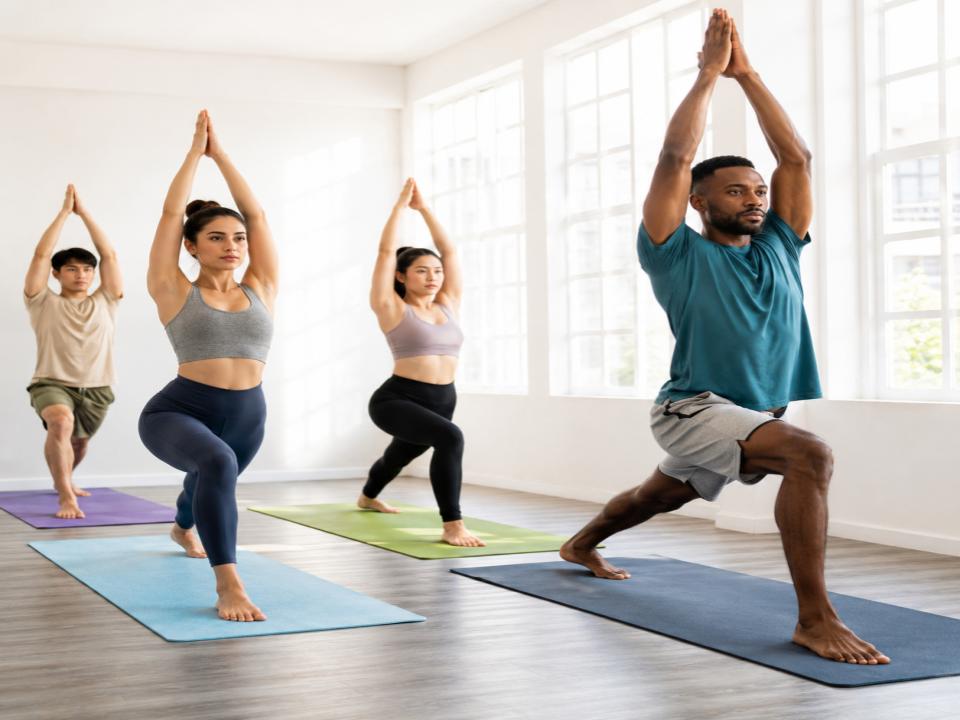
Teaching yoga is not a performance. It is an act of attention. Your most important skill as a new teacher is learning to see your students while you’re speaking, moving, and holding the space simultaneously.
This is hard. At first, your attention will be mostly on yourself — remembering your sequence, managing your nerves, monitoring the clock. That’s okay. It shifts with experience. But start building the habit of scanning the room from your very first class.
Watch for distress signals: collapsed breath, gripped jaws, braced necks, knees tracking inward. Watch for micro-expressions that tell you someone is lost or in discomfort. Watch for the student at the back who always modifies independently — they know their body, trust them, and acknowledge it with a nod.
Vancouver students, on the whole, are not passive. Many will speak up if something doesn’t feel right. But many others won’t, out of politeness or stoicism. Building the skill of reading the room without depending on verbal feedback is essential.
After class, take five minutes to write brief notes. Which cues landed? Which transitions were unclear? Who in the room seemed to struggle, and what could you offer differently next time? This practice accelerates growth faster than almost anything else.
Handling What Goes Wrong
Something will go wrong in your first class. Almost certainly in your second and third, too. The measure of a good teacher isn’t whether things go wrong. It’s how you respond.
When you lose your place in the sequence: Pause. Take a breath with the class. Say “let’s settle here for a moment” and use those few seconds to recalibrate. Students rarely notice when you take an intentional pause. They always notice when you panic.
When a student is injured: Stop the class if necessary. Approach calmly and quietly. Ask what they need. Know the studio’s first aid protocol before you teach your first class, not during it. Never adjust an injury you don’t understand. Know where the first aid kit is and who to call.
When a student challenges you: This happens. A student may correct your Sanskrit, question your anatomy cue, or openly disagree with a suggestion. Stay calm. Thank them sincerely. If they’re right, acknowledge it. If you’re unsure, say so. Confidence does not require infallibility. “That’s a great point — I’d like to look into that further and follow up” is a perfectly respectable answer.
When the music fails, the heat breaks, or another teacher is running late: Adapt without drama. Students in Vancouver are accustomed to studios that run smoothly. But they are also human beings who appreciate grace under pressure. Your composure in the face of logistical chaos is one of the most powerful demonstrations of what yoga practice actually produces.
The Ethics of Teaching: Consent, Adjustments, and Inclusivity
In Vancouver, these are not optional conversations. The yoga community here has been actively reckoning with issues of consent, touch, trauma-informed teaching, and cultural sensitivity for years. As a new teacher, it is your responsibility to enter that conversation prepared.
Physical adjustments: Do not assume students want to be touched. At the start of class, offer a clear consent check — this can be as simple as “if you’d prefer no hands-on assists today, please place a block at the top of your mat as a signal.” Then honour that choice without comment or pressure. Accessible Yoga has free resources on trauma-informed and consent-based teaching that every new teacher should read.
Language: Be thoughtful about the language you use around bodies and effort. Phrases like “get deeper,” “push harder,” or comparative language (“everyone else can do this”) have no place in an inclusive yoga class. Focus on sensation and breath, not performance or appearance.
Cultural context: Yoga is a practice rooted in South Asian traditions. Teaching it thoughtfully means acknowledging that lineage, educating yourself about the philosophical foundations, and not reducing the practice to a fitness class with Sanskrit words sprinkled in. You don’t need to be an expert in Hindu philosophy to teach hatha yoga. But you should be able to speak honestly about where the practice comes from.
Inclusivity also means thinking about physical accessibility. Not every student can use a standard mat on the floor. Know your studio’s adaptive props and be willing to offer chair-based or supported alternatives without making the student feel singled out.
 Building Your Reputation in Vancouver’s Yoga Community
Your first class is one data point. Building a reputation as a teacher in this city is a longer game — one that rewards consistency, humility, and genuine care for students.
Start by becoming a reliable substitute. Studios in Vancouver depend on sub teachers constantly. Say yes when you can, show up early, learn the regular students’ names, and leave the space exactly as you found it. Sub work turns into regular spots. Regular spots build your following.
Show up as a student too. Take classes at studios where you want to teach. Take classes from teachers whose work you admire. The Vancouver yoga community is smaller than it looks, and relationships matter. Being a generous, engaged student signals that you approach the practice with integrity — not just ambition.
Connect with local teacher communities. The BC Yoga Teachers Association offers networking, professional development, and community for teachers at all stages of their career. Online communities like Yoga Teachers on Facebook can also provide peer support during the early months.
Be careful about social media. A strong Instagram presence can help build a following, but it can also distort your priorities. Spend more time in the room with students than crafting your feed. The best advertisement for your teaching is a room full of people who feel better when they leave than when they arrived.
Be patient with your own development. The teachers who last in this field are not the ones who were perfect in their first year. They’re the ones who were honest about their limitations, kept learning, and showed up again and again with full attention.
What Vancouver Students Actually Want From a New Teacher
Students are perceptive. They can feel the difference between a teacher who is performing confidence and a teacher who is genuinely present. They almost always prefer the latter.
What students in Vancouver consistently describe as valuable in a teacher has very little to do with advanced sequencing or impressive demos. They want:
A teacher who sees them. Who notices when they’re struggling and offers something useful without making them feel inadequate.
A teacher who is calm. Who doesn’t telegraph anxiety or rush through transitions to stay on schedule.
A teacher who is honest. Who says “I don’t know” when they don’t know, and “let’s try this” when something isn’t working.
A teacher who respects their intelligence. Who doesn’t over-explain, over-cue, or treat them as a passive recipient of wisdom.
You already have the capacity to offer all of this. It doesn’t require years of experience. It requires presence and care. That is both simpler and harder than it sounds.
 The Night Before: A Practical Pre-Class Checklist
The logistics matter. Many first-class disasters happen not because of poor teaching skills but because of preventable practical oversights.
The evening before your first class:
Visit the studio if you haven’t already. Know where the props are stored, how to work the sound system, and where the thermostat is. Meet the front desk staff if possible.
Confirm your sequence is set and you’ve run through it out loud at least once that day. Prepare your playlist if you’re using music, and have a backup — technology fails. Have an idea for the class if the music doesn’t work at all.
Prepare any arrival setup you want — blocks at each mat, bolsters in a corner, music queued. Know what time students are typically in the space before class begins.
Get eight hours of sleep. This is not optional.
On the morning of class, eat something light at least ninety minutes before teaching. Hydrate. Arrive thirty minutes early. Breathe. You have prepared. You are ready enough.
Conclusion: Your First Yoga Class as a Teacher in Vancouver Will Humble You. Here’s How to Prepare.
No amount of reading, planning, or mental rehearsal will fully prepare you for the moment you stand at the front of a room and teach your first class. The gap between knowing and doing is real. The only way across it is through.
Your first class in Vancouver may be messy. Your voice may shake. You may forget a transition, lose the sequence, or encounter a student situation you have no idea how to handle. These are not signs that you don’t belong at the front of the room. They are the beginning of your real teacher training.
Prepare your sequence and know it cold. Cue with clarity and restraint. Study the room with genuine attention. Handle what goes wrong with grace. Respect your students’ intelligence, consent, and dignity. Show up consistently and keep learning.
Vancouver is a city that takes yoga seriously. And it has room — enthusiastic, generous room — for teachers who take it seriously too.
The mat at the front of the studio is waiting. Step onto it.
Ready to take the first step toward becoming a yoga teacher? If you’re feeling called to make teaching your path, our 200-Hour Yoga Teacher Training program gives you the skills, the community, and the confidence to walk into that room ready.