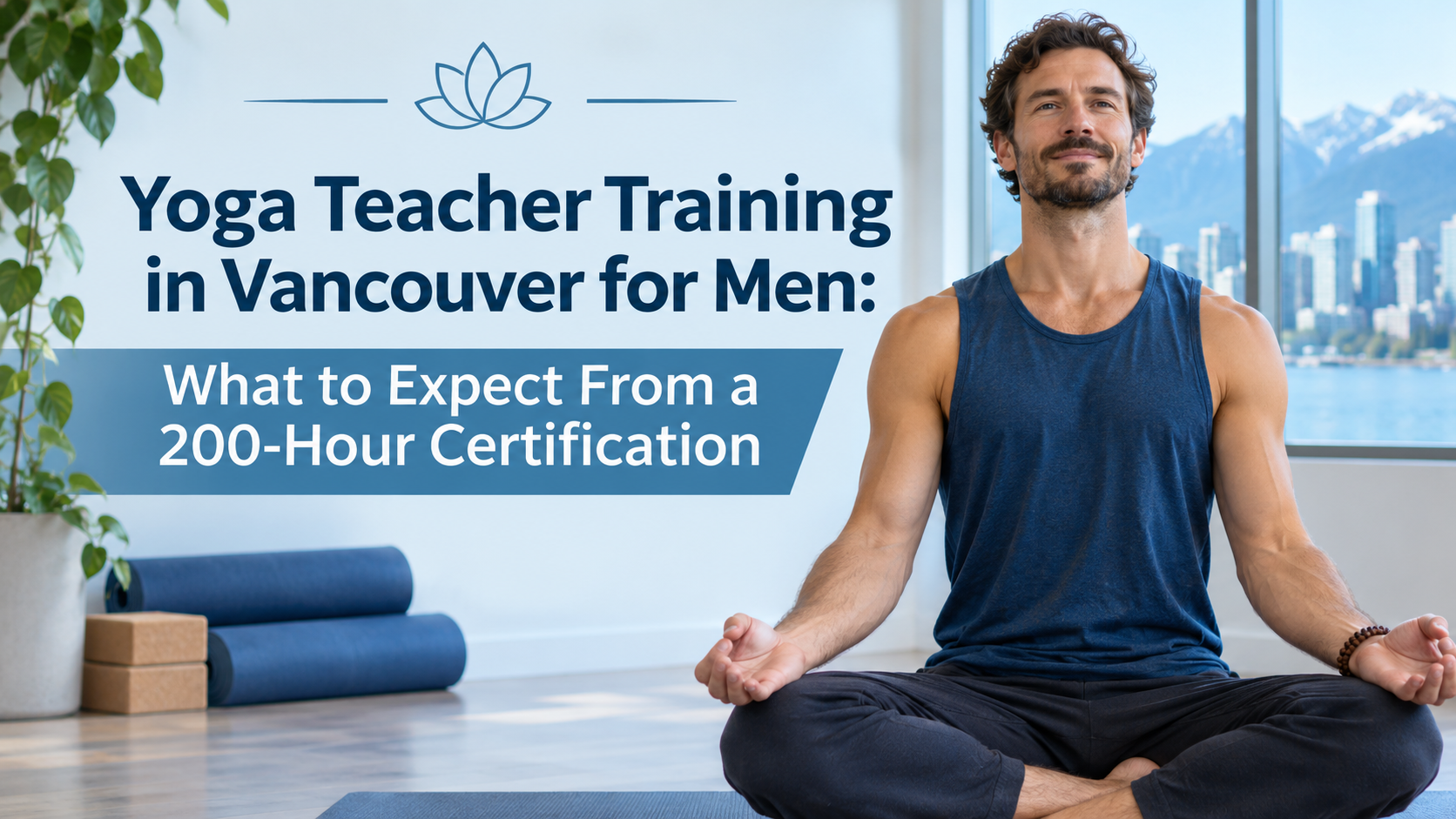
 Yoga Teacher Training in Vancouver for Men: What to Expect From a 200-Hour Certification
Yoga teacher training in Vancouver for men is no longer a rare choice. More men are signing up. Some want to teach. Some want to understand their own bodies and minds better. Many want both.
If you are a man considering this step, you probably have questions. Will you be the only guy in the room? Do you need to be flexible? What will you study? Will you actually be ready to teach?
This guide answers those questions. It explains Yoga Teacher Training in Vancouver for Men: What to Expect From a 200-Hour Certification in plain language. You will learn what the certification means, how a typical program runs, what the physical and mental demands feel like, and what it costs. You will also find questions to ask any school before you pay a deposit.
The guide draws on published standards, health research, and the program details of Vancouver Yoga Academy. Where a claim applies to one school only, the text says so.
Why Men Choose Yoga Teacher Training
Men enter teacher training for different reasons. Some arrive with a long practice. Others have taken a handful of classes. A few come after an injury, a stressful period, or a career change.
Common motivations include:
- Better movement. Many men train in gyms, run, cycle, or play sports. Teacher training teaches them how to move with more control and range.
- Stress management. Yoga combines movement, breathing, and focused attention. Harvard Health reports that many of yoga’s benefits come from stress reduction and its related effects on the body.
- A new career or side income. Some men want to teach classes, private sessions, or workplace sessions. Others want to add yoga to a fitness or coaching business.
- Personal growth. Teacher training pushes you to speak in front of people, give clear instructions, and take feedback. Those skills carry over to work and relationships.
Mental health is also part of the picture. The Canadian Men’s Health Foundation’s 2025 national survey, reported by CMHA Halton, found that 23% of men were at risk of moderate to severe depression. It also found that half of men lacked enough social support. A training group can give men a steady, structured community. That is not a treatment for any condition. It is simply one place to build connection and healthy routines.
You do not need a specific reason. Curiosity is enough. Many programs welcome students who never plan to teach. Vancouver Yoga Academy covers this question in detail in its post, Can You Take Yoga Teacher Training in Vancouver If You Don’t Want to Teach?
What a 200-Hour Yoga Certification Actually Means
The number “200” refers to the total hours of study. It is the standard entry-level credential in yoga teaching. Most new teachers start here.
Yoga Alliance, a large international registry, sets standards for 200-hour trainings. Its standards group the content into five educational categories. They cover technique and practice, teaching methodology, anatomy and physiology, yoga humanities, and professionalism and ethics. Many schools build their curriculum around these categories, even when they do not register with Yoga Alliance.
Here is a point many students miss. Different organizations issue different credentials. Yoga Alliance is the best-known registry. It lets graduates of a Registered Yoga School apply for the RYT 200 designation. Its credential requirements state that a teacher must complete a 200-hour training with a Registered Yoga School to qualify.
Vancouver Yoga Academy follows a different route. Its 200-hour training is recognized by Yoga Alliance International, a separate organization. The two groups share similar names, but they are not the same body. This difference matters. Before you enroll anywhere, confirm which organization recognizes the program. Then ask whether the studios you hope to work with accept that credential.
A certificate also does not make someone a good teacher. Skill comes from practice and feedback. Look for a program that tests your teaching, not just your attendance. Vancouver Yoga Academy describes its certification as competency-based. That means you must show you can structure a class, cue clearly, and guide students safely.
Finally, a 200-hour certificate is a starting point. It does not make you an expert. Most teachers keep studying for years.
How the Training Format Works in Vancouver
Programs in Vancouver vary a great deal. Some run for several weeks of full-time study. Others stretch across months of weekends. Some mix in-person and online learning.
Vancouver Yoga Academy uses a blended model. The details below come from the school’s own 200-hour program page, so confirm them before you enroll.
- One in-person weekend each month. Students attend a two-day training weekend in Vancouver. Recent dates run through summer 2027.
- Guided self-study. You complete the rest of the coursework on your own schedule, using provided materials.
- Practical teaching assignments. You practise leading classes and receive feedback.
- Flexible scheduling. You can choose any available training weekend within 12 months of enrolling, with at least 30 days’ notice. Space is limited.
This format suits men who work full-time, run businesses, or travel. You do not have to leave your job for a month. You can fit study into evenings and weekends.
The trade-off is self-discipline. Nobody will stand over you at home. You must set a study routine and keep it. A destination retreat works differently. It immerses you for weeks, but it costs more in travel and time away. If you are weighing those options, read Yoga Teacher Training in Vancouver vs. a Destination Retreat for a side-by-side look.
Class size also shapes your experience. Smaller groups give you more chances to teach and more direct feedback. Ask any school how many students each trainer supervises.
 What You Will Study: The Curriculum
A good 200-hour program covers more than poses. You will study theory, movement science, teaching skills, and the business side of yoga. Vancouver Yoga Academy’s curriculum includes six areas.
Philosophy. You will learn the basic principles of yoga and some essential texts. You will also explore how to apply those ideas to teaching. Expect reading and discussion. Many men find this section more interesting than they expected.
Anatomy. This area covers human movement, posture, and alignment. You will learn how joints work, why injuries happen, and how to adapt a pose to different bodies. For men who lift weights or play sports, this section often clicks quickly.
Teaching methodology. You will study how to structure a class and how to give clear verbal cues. You will also work on your voice, presence, and confidence. Cueing is harder than it looks. You must describe a movement in a few words while watching the room.
Sequencing. You will learn to build a class that flows logically. That includes warming up, building toward a peak, and cooling down. You will also learn to design classes for different levels.
Practicum. This is the hands-on teaching component. You teach, get feedback, and teach again.
Professional development. You will explore the move from student to teacher. Topics include teaching in studios versus independently, plus basic business considerations. After training, you may need liability coverage. The school’s posts on yoga teacher insurance in British Columbia and liability insurance costs explain what to expect.
Notice what the list leaves out. A strong program does not spend all its hours on advanced poses. It spends them on teaching.
The Physical Side: Flexibility, Strength, and Honest Limits
Many men worry about flexibility first. The worry is understandable. Yoga photos often show deep backbends and splits. Teacher training does not require any of that.
You do not need to touch your toes to enroll. You need a willingness to practise regularly and listen to your body. The school’s guide, Do You Have to Be Flexible to Become a Yoga Teacher?, covers this in depth.
Still, expect your body to work. Some men notice tightness in the hamstrings, hips, and shoulders, especially after years of desk work, cycling, or heavy lifting. That pattern is common, but it is not universal. Every body differs. Your teachers will show you modifications. They will also show you how to use props such as blocks and straps. Props are tools, not signs of weakness.
The physical benefits are well documented in general terms. Harvard Health notes that yoga can build strength, flexibility, and cardio-respiratory fitness. It cites a program where people practised at least twice a week for eight weeks and improved on those measures. Harvard also reports that yoga may help with back pain by increasing flexibility and muscle strength. Research quality varies, and Harvard advises talking to your doctor before starting a new exercise program.
Training also asks for stamina. A teaching weekend can mean many hours of practice, lectures, and teaching. If you want to know what to expect, read How Hard Is Yoga Teacher Training in Vancouver? It breaks down the physical, academic, and time demands.
If you carry an injury, talk to the school early. A sore knee or shoulder does not always rule you out, but it does call for planning. The school’s article on yoga teacher training with an injury explains modifications and when to wait.
Learning to Teach: Practice, Feedback, and Confidence
Teaching is the heart of the certification. You can know every pose and still freeze in front of a room. That is why practice time matters more than lecture time.
Here is how teaching practice typically builds. First, you teach small pieces, such as one pose or a short sequence. Next, you teach a full segment to a small group. Then you plan and lead a complete class. Trainers watch, take notes, and tell you what worked.
Good feedback is specific. “Nice job” teaches you nothing. “Your cue for the lunge was clear, but you rushed the transition” teaches you a lot. Ask schools how often you will teach and who will give you feedback.
Men often face particular habits in this stage. Some speak too fast. Some over-explain. Some cue only for strong, flexible bodies and forget beginners. Others hold back their voice because they feel self-conscious. None of these habits is fixed. Repetition fixes them.
You will also learn to teach for different bodies. A class might include a retired person, a new parent, and a runner with tight calves. Your job is to keep all of them safe. That skill separates a good teacher from someone who only knows poses.
Vancouver Yoga Academy states that it emphasizes repeated teaching opportunities and direct feedback over passive observation. Student testimonials on its testimonials page describe the practical approach in their own words. Read them with a critical eye, as you would for any school.
The Mental and Emotional Side of Training
Teacher training changes more than your body. Many students report that it changes how they think and relate to others.
The first change is self-awareness. Yoga asks you to notice your breath, your tension, and your reactions. That attention can feel unfamiliar at first. Some men find it uncomfortable. Others find it a relief.
The second change is communication. You will give and receive feedback regularly. You will also speak in front of your peers. Over time, that builds a calmer, clearer voice.
The third change involves community. Men often have fewer close friendships as adults. The CMHA Halton article mentioned earlier notes that social isolation is a real concern for men, especially younger men and those who live alone. A training cohort gives you a built-in group. You share a goal, a schedule, and a set of challenges. Many students stay in touch after graduation.
Be realistic, though. Teacher training is not therapy. It will not replace professional care for depression, anxiety, or trauma. If you struggle with your mental health, talk with a doctor or counsellor. Yoga can support that care, but it should not substitute for it.
Also expect some discomfort. You may feel nervous before your first practice teach. You may feel frustrated when a pose does not work. Those moments are part of the process. Good trainers expect them and help you work through them.
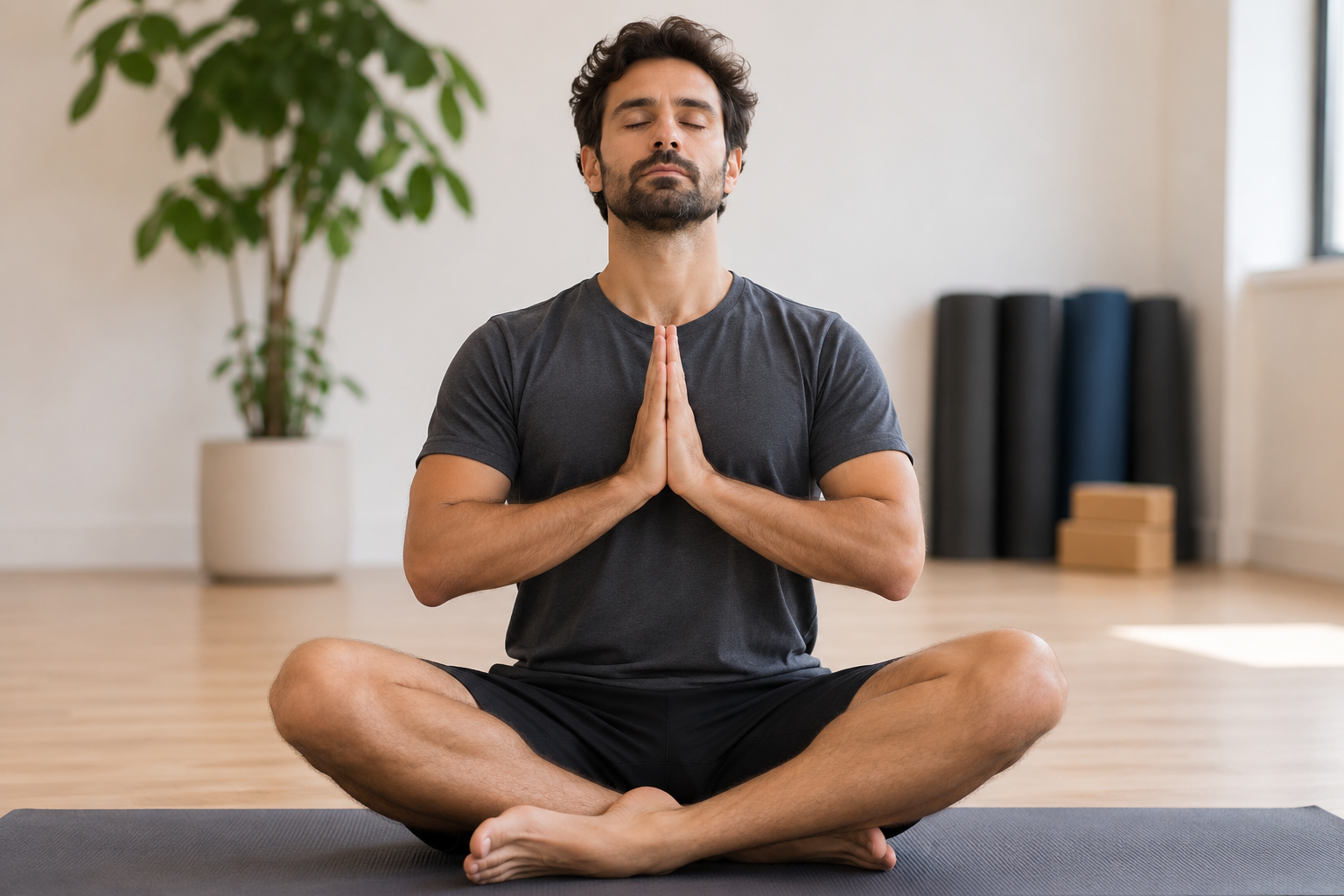 Being One of the Few Men in the Room
This question comes up often, so it deserves a direct answer. In many yoga classes and teacher trainings, women make up most of the group. Men are often a minority. The exact mix varies by school and by cohort, and no public data gives a reliable local figure.
Is that a problem? For most men, no. Yoga training focuses on skill, not gender. Your trainers care about whether you can teach clearly and safely. Your classmates care about whether you show up and support the group.
Still, a few practical points help.
- Ask about the group. Ask a school who usually enrolls. Ask whether men have graduated from the program.
- Talk to a former student. A graduate can tell you what the atmosphere feels like.
- Look at the teaching staff. Vancouver Yoga Academy’s program is led by two trainers, Kim and Robert, both listed as E-RYT 500 teachers. You can read their backgrounds on the staff page. Having a male lead trainer is not required for a good experience, but some men find it reassuring.
- Notice the language. A good school speaks to all students without stereotypes.
Being a minority can even help you. You will stand out in a good way when you teach, and many studios want a mix of voices. Still, do not choose yoga for that reason. Choose it because you want the skills.
What It Costs and How to Plan
Money matters, so look at it early. Prices vary widely across Vancouver. Always compare the full cost, not just the headline number.
Here are the figures from Vancouver Yoga Academy’s 200-hour program page, as listed at the time of writing:
- Regular tuition: $2,395 CAD
- Early bird (60+ days before the start date): $2,195
- Super early bird (120+ days before the start date): $1,995
- Payment plan: a $500 deposit, then the balance in two to four monthly payments
Tuition at this school includes digital eBooks, lifetime access to course materials, printable class-planning templates, and a digital certificate. Prices and inclusions can change, so check the page before you plan.
Ask every school what is not included. Common extra costs include books, props, a mat, studio memberships for practice, travel, and insurance after graduation.
If the cost feels high, look for help. Some schools offer payment plans, and some offer bursaries. The school’s guide to yoga teacher training scholarships and funding in Vancouver lists options.
Think about the return, too. Yoga teaching pays modestly in many studios, and most new teachers do not replace a full-time income right away. Private sessions and workplace classes can pay better. Two of the school’s posts explain how to start teaching private yoga and teach corporate yoga in Vancouver. Treat the training as an investment in skill first and income second.
How to Choose the Right Program
No single school fits every man. Use a short checklist to compare your options.
Check the credential. Ask which organization recognizes the certificate. Then confirm that the studios or employers you care about accept it.
Ask about teaching time. How many times will you teach during the program? Who watches you? How do they give feedback?
Look at class size. Smaller groups usually mean more attention.
Read the schedule closely. Confirm the dates, the number of in-person days, and how much self-study you must do alone.
Meet the teachers. Read their bios. Ask how long they have taught and how many teachers they have trained.
Check the fine print. Read the refund policy, the missed-session policy, and the graduation requirements.
Talk to graduates. Ask what they would change. Ask whether they felt ready to teach.
Trust the school’s honesty. A good school tells you who the program is not for. Vancouver Yoga Academy, for example, says its training may not suit people who want a retreat-style experience or who dislike practising teaching. That kind of candour helps you decide.
Be wary of promises that sound too good. No school can guarantee you a job. No school can promise instant confidence. A clear, honest description beats a flashy one.
Life After Graduation
Finishing the 200 hours is a milestone. It is not the finish line. Your first year of teaching is where you grow most.
Start small. Many new teachers begin with a community class, a friend’s group, or a short private session. Teach regularly. Ask for feedback. Record yourself and listen back. Keep taking classes from teachers you admire.
Handle the practical details early. Get insurance before you teach for pay. Learn what studios expect. If you plan to work for yourself, find out what business licence rules apply in your area.
Think about your niche as well. Men bring different backgrounds to teaching. A former athlete may teach yoga for sports recovery. An office worker may teach desk-friendly stretches. A tradesperson may teach mobility for physical jobs. Your own experience can shape a teaching voice that stands out.
Finally, stay humble. Yoga is a lifelong study. Teachers who keep learning tend to teach better and last longer.
Conclusion: Yoga Teacher Training in Vancouver for Men
Yoga Teacher Training in Vancouver for Men: What to Expect From a 200-Hour Certification comes down to one idea. This training teaches you to teach, and it also teaches you about yourself. You do not need to be flexible, experienced, or sure about a career. You need steady effort, honest feedback, and a program that values real teaching skill over simple attendance.
Expect to study philosophy, anatomy, teaching methods, and sequencing. Expect to practise teaching often. Expect your body and your mind to feel challenged. Check the credential, the group size, the teaching time, and the full cost before you commit.
If you are ready to become a yoga teacher, visit the 200-hour yoga teacher training page to see current dates and tuition. For more details, read the FAQ, learn about the school, or browse the blog for guides on every stage of the journey.