
 YYoga Teacher Training in Vancouver: How to Teach Yoga to Beginners Safely and Confidently
You finish your training. You roll out your mat. Then a room of first-time students looks at you and waits.
That moment decides whether you stay calm or freeze. Beginners come with nerves, stiff bodies, and big questions. They trust you to keep them safe. This guide shows how to do that.
In this post, “YYoga Teacher Training in Vancouver: How to Teach Yoga to Beginners Safely and Confidently,” we cover the skills every new teacher needs. Vancouver has many strong options. YYOGA is one of the best-known studio brands in the city, and it runs a 200-hour program at its Downtown Flow studio. Other schools offer training too. The skills below apply whichever program you choose.
You will learn how to screen students, plan a beginner class, cue clearly, offer options, and handle injuries. You will also learn how to build your own confidence. Each section gives steps you can use in your next class.
Why Beginners Need a Different Kind of Teaching
Teaching a beginner is not the same as teaching an experienced student. Beginners do not know the poses. They do not know the language. Many do not know how their bodies feel in each shape.
Think about what a beginner faces in one class. They learn new names. They copy shapes they have never tried. They watch others for clues. They worry about falling, looking silly, or hurting themselves. That is a lot to process at once.
Your job is to lower the load. Use simple words. Teach fewer poses. Repeat the ones you teach. Give the class time to settle into each shape.
Safety matters here for a clear reason. Yoga is generally considered low risk when taught well. The U.S. National Center for Complementary and Integrative Health says yoga is safe for most healthy people when they practise under a trained teacher. It also notes that injuries can happen, mostly in muscles and joints. A beginner’s first class sets the tone. A good one builds trust. A rushed, advanced one can cause pain and send a student away for good.
Beginners also give you the best feedback on your teaching. If a beginner understands you, anyone will. Many teachers say they became clearer after they taught new students.
Keep one goal in mind: every student leaves feeling safe, capable, and welcome. That goal shapes every choice you make. It guides your sequence, your voice, and the way you respond to a struggling student.
Strong training prepares you for this. A good program gives you teaching practice, not just theory. If you want to see how demanding that process is, read our guide on how hard yoga teacher training in Vancouver really is.
Choose Training That Teaches You to Teach
Your training shapes how you handle beginners. Not every program prepares you equally. Some focus on personal practice. Others focus on teaching skills. You need the second kind.
When you compare programs, look for a few things. Start with practice teaching. Ask how many times you will lead a class, or part of one, before you graduate. Repeated practice builds skill faster than watching.
Next, check the feedback. You should hear what worked and what to fix. Vague praise does not help you grow. Specific notes do.
Then look at the curriculum. A solid program covers anatomy, sequencing, teaching methods, philosophy, and professional skills. The anatomy section matters most for safety. You need to know how joints move and where common strain happens.
Finally, look at credentials. Yoga Alliance is the best-known registry for yoga schools and teachers. Many studios ask for a certificate from a recognized program. Policies differ by studio, so ask each employer what it requires.
Vancouver offers several formats. YYOGA runs part-time programs with weekend and evening sessions. Other schools use monthly weekends or full-time blocks. Our own 200-hour yoga teacher training in Vancouver uses a monthly weekend format. It also centres on repeated teaching practice and direct feedback.
Format matters too. Some people learn best in an intensive retreat. Others need time to absorb ideas between sessions. Our comparison of Vancouver training versus a destination retreat can help you decide.
Whichever school you pick, ask to speak with the lead trainers. Ask how they teach beginner safety. Their answer will tell you a lot. You can also meet our trainers on the staff page and read what graduates say on the testimonials page.
Know Who Walks Into Your Beginner Class
Beginner classes attract many kinds of people. You might see a runner with tight hips. You might see an office worker with a sore neck. You might meet someone recovering from surgery, or someone who has never exercised.
You cannot see everything by looking. So build a habit of asking.
Many studios use a short intake form or a welcome conversation. Arrive early. Greet each new student by name. Ask two simple questions. “Is this your first yoga class?” and “Is there anything I should know about your body today?” Keep your tone warm and casual.
Listen for key points. Injuries matter. So do pregnancy, recent surgery, high or low blood pressure, and chronic pain. You do not need a diagnosis. You need enough information to offer smart options.
Know your limits. You are a yoga teacher, not a medical professional. Do not diagnose or treat. If a student describes a serious condition, suggest they check with their doctor or physiotherapist. HealthLink BC is a trusted provincial resource students can use to find health information or speak with a nurse.
Some conditions call for extra care. The NCCIH notes that people with certain conditions, such as glaucoma, sciatica, or pregnancy, may need to change or avoid some poses. Your training should show you how to adapt.
Also remember that age and fitness vary. A twenty-five-year-old athlete and a seventy-year-old beginner need different options in the same class. Plan for that range from the start.
Do not assume flexibility equals readiness. Very flexible beginners can overstretch because they feel no resistance. Stiff beginners may push too hard to keep up. Both groups need clear guidance. Our post on whether you have to be flexible to become a yoga teacher explains why range of motion is not the point of yoga.
Build a Simple, Safe Class Structure
A clear structure helps beginners feel safe. It also helps you stay calm. When you know your plan, you can focus on your students.
A typical 60-minute beginner class has five parts.
Arrival and centring (about five minutes). Let students settle. Invite them to notice their breath. Keep the language plain.
Warm-up (about ten to fifteen minutes). Start with gentle movement. Use cat-cow, neck rolls, shoulder circles, and easy side stretches. Warm muscles move more safely than cold ones.
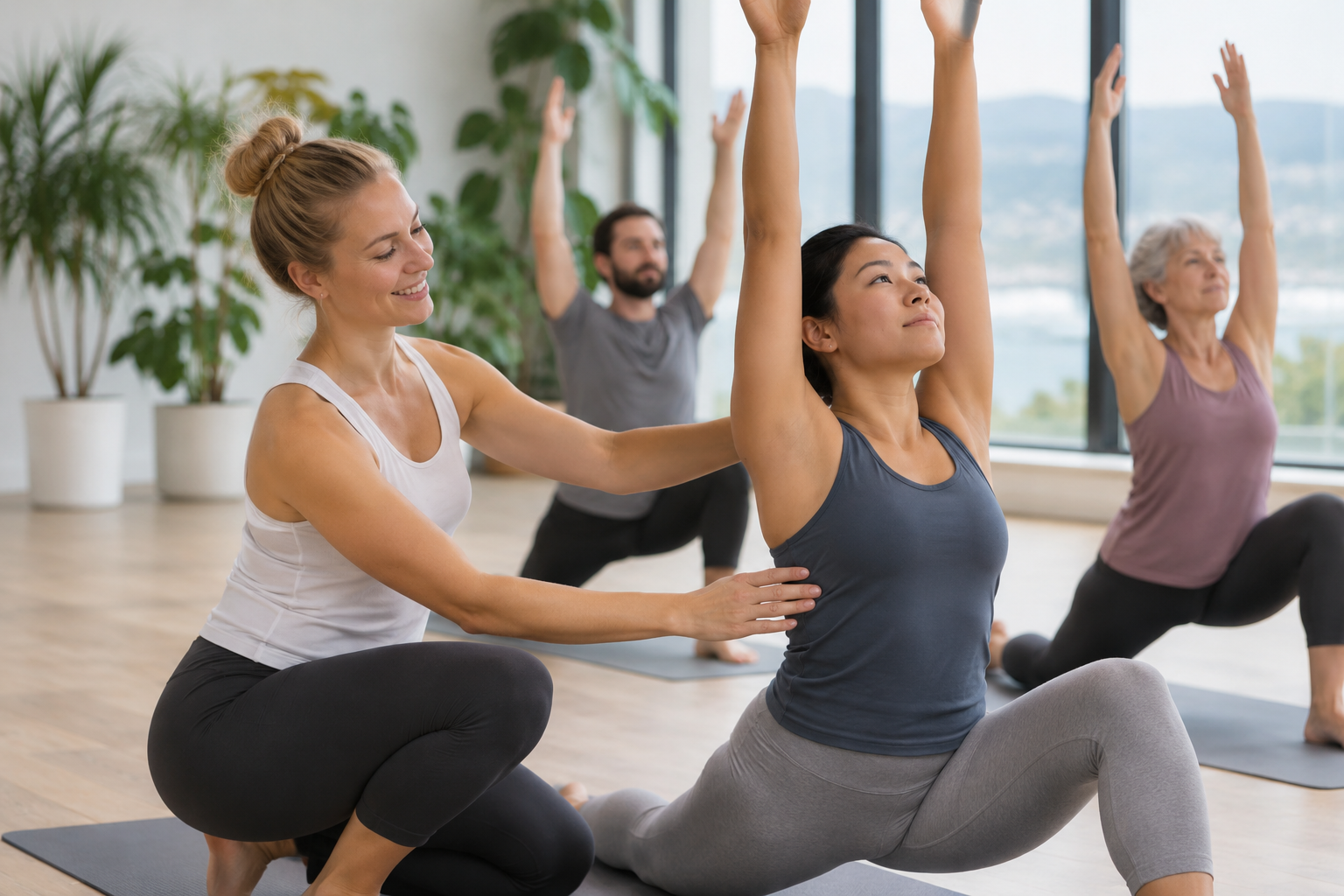
Main sequence (about twenty-five minutes). Teach basic standing poses, simple balances, and a few floor poses. Choose shapes that suit most bodies. Mountain pose, warrior II, triangle, and a low lunge work well. Add a few floor stretches after that.
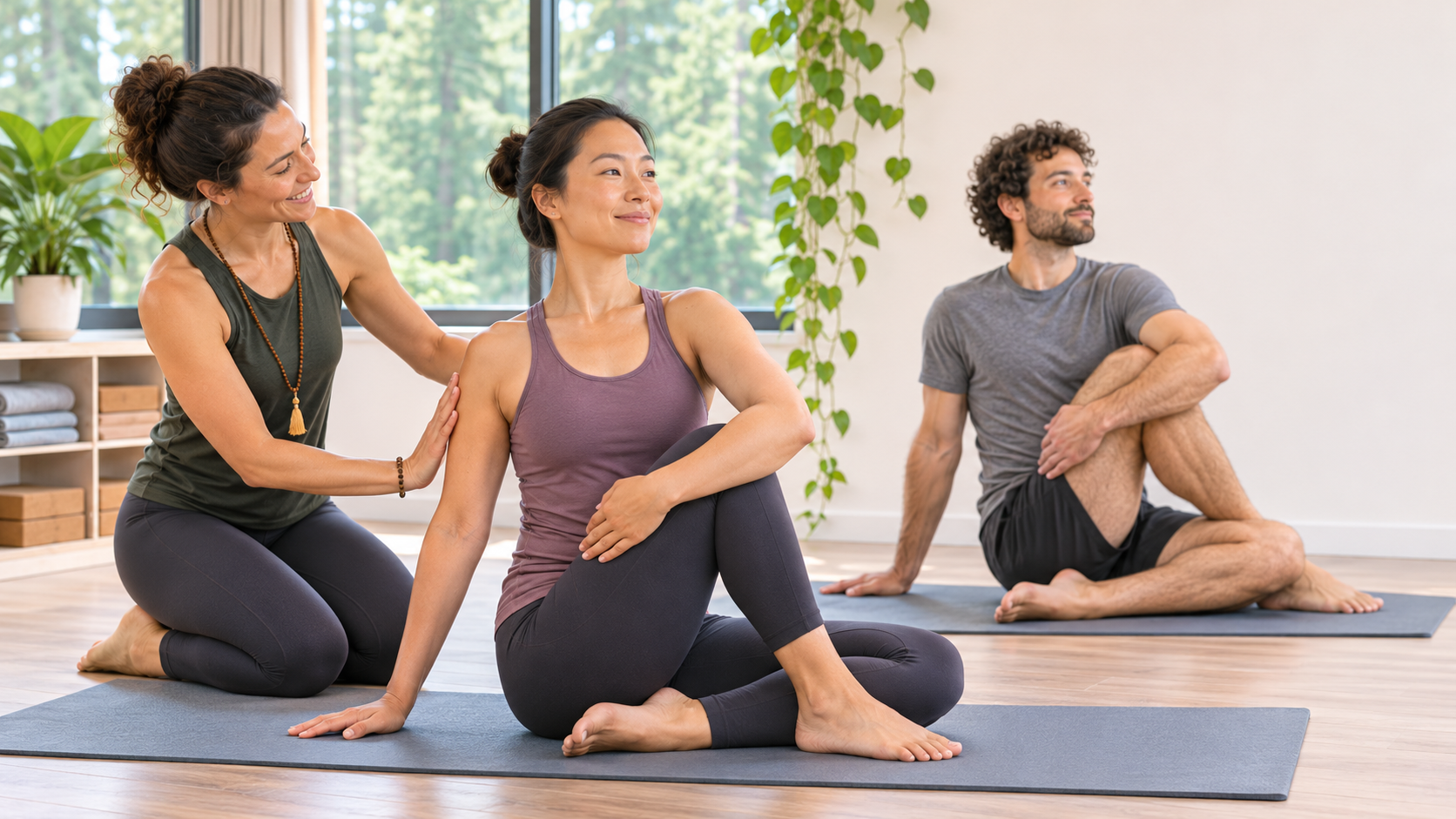
Cool-down (about five to eight minutes). Slow the pace. Use seated twists, gentle forward folds, and hip openers.
Final rest (about five minutes). Teach savasana. Many beginners find stillness hard, so explain it kindly.
Keep the sequence simple. Repeat key poses so students can improve. A beginner learns more from doing warrior II three times than from doing ten different poses once.
Some poses carry more risk for new students. Headstand, shoulder stand, and deep backbends are common examples. Many teachers save these for experienced groups with proper preparation. Leave them out of beginner classes.
Move slowly between shapes. Rushing causes sloppy form. It also leaves students behind, which makes them feel anxious.
Plan transitions as carefully as poses. Many strains happen when a student moves too fast between shapes. Give clear directions before they move. Tell them what is coming next.
Write your plan on paper. Teach from it. Then note what worked. This habit speeds up your growth. Our training emphasizes sequencing practice for this reason.
 Cue Clearly and Keep Language Simple
Cueing is the most important teaching skill. A cue is a spoken instruction. Good cues keep students safe and help them feel the pose.
Use short sentences. Say one thing at a time. “Step your right foot back.” Pause. “Turn your back toes out slightly.” Pause. “Bend your front knee.”
Follow a pattern. Name the pose. Say how to enter it. Give one or two alignment points. Then offer a breath cue. This order helps beginners follow along.
Use plain words. Skip Sanskrit at first, or pair it with the English name. A beginner does not need to learn “Utthita Parsvakonasana” in the first week. “Side angle pose” works fine.
Say what to do, not what to avoid. “Press your feet into the floor” is clearer than “don’t collapse your arches.” Positive cues give students something to try.
Cue the safest points first. In a lunge, remind students to keep the front knee over the ankle. In a forward fold, invite a soft bend in the knees. In a twist, suggest lengthening the spine before rotating.
Also use your voice well. Speak slowly. Project your voice, but do not shout. Vary your pace so you do not sound flat. Pause often. Silence gives students time to apply what you said.
Demonstrate when it helps. Show a pose briefly, then walk the room. Do not practise the whole class with your eyes closed. Watch your students.
Be careful with hands-on adjustments. Always ask for consent first. Some students dislike touch. Others have trauma or injuries you cannot see. Many beginners do better with verbal cues and props. You can ask, “Would you like a hands-on adjustment, or would you prefer I just describe it?”
Practise your cues out loud before you teach. Record yourself. Listen for filler words and long sentences. Then trim them. This simple habit improves clarity quickly.
Offer Options, Props, and Modifications
No two bodies are the same. A pose that feels easy for one student can strain another. Options solve this problem.
Offer a choice in nearly every pose. Say, “You can keep your hand on your shin, or bring it to a block.” Make each option sound equal. Do not frame the easier version as a lesser one.
Props make poses safer and more accessible. Blocks bring the floor closer. Straps extend reach in forward folds. Blankets cushion knees and lift hips. Bolsters support restorative shapes. Chairs help students with limited mobility or balance concerns.
Teach students to use props early. Many beginners feel embarrassed to use them. Say that experienced students use props too. Normalize them.
Learn common modifications for popular poses. In downward-facing dog, students with tight hamstrings can bend their knees. Students with sore wrists can use fists or forearms. In a low lunge, students can pad the back knee. In seated poses, students with stiff hips can sit on a folded blanket.
Teach the “ease before depth” principle. Tell students to stop before pain. Explain the difference between sensation and pain. Stretching sensation feels broad and dull. Sharp, pinching, or burning pain means stop. Say this at the start of every class.
Give permission to rest. Child’s pose is always available. Say it often. Students who feel free to rest are less likely to overreach.
Avoid comparing students. Do not praise the deepest version. Praise effort and attention instead. “I love how carefully you’re working” encourages mindfulness over performance.
Finally, think about the room. Leave space between mats. Keep the floor clear. Keep props where students can reach them without getting up often. A safe space starts with simple logistics.
Handle Injuries, Pain, and Emergencies Wisely
Even in a well-run class, students will sometimes report pain or discomfort. Know how to respond before it happens.
Start with a calm voice. If a student says something hurts, ask them to come out of the pose. Offer a gentler option or invite them to rest. Do not push or pressure them.
Ask simple questions. “Where do you feel it?” “Is it sharp or dull?” Do not diagnose. Do not suggest treatments. Your role is to adjust the class, not manage the injury.
After class, check in. A short, kind conversation matters. If the pain continues, suggest the student see a doctor or physiotherapist. Keep notes on what happened. Some studios have an incident form. Use it.
Know your emergency plan. Learn where the first aid kit sits. Know the studio’s address and the nearest exit. In Canada, call 911 in a serious emergency. Consider taking a first aid and CPR course. Many studios prefer or require teachers to hold current certification. Ask your employer what applies.
Pregnancy needs special attention. Many people practise yoga during pregnancy, but they need modifications. Avoid deep twists that compress the belly. Skip lying flat on the back for long periods later in pregnancy. Encourage students to talk to their health provider first. A prenatal specialization gives you deeper knowledge.
Also watch for signs of dizziness, overheating, or fainting. Beginners sometimes hold their breath or stand up too quickly. Remind students to breathe steadily and rise slowly.
Insurance protects you and your students. Most studios require teachers to carry liability coverage, and independent teachers need it even more. Our guides on yoga teacher insurance in British Columbia and yoga teacher liability insurance in BC explain coverage and costs. If you already live with an injury yourself, read our post on doing yoga teacher training with an injury.
Create a Welcoming Space Where Beginners Return
Safety is physical and emotional. A student who feels judged will not relax. A student who feels welcome will come back.
Start before class begins. Smile. Learn names. Show first-timers where to place their mats, where to find props, and where the washrooms are. These small steps ease nerves.
Set the tone with your first words. Say, “Welcome. Move at your own pace. There is no wrong way to do this.” Students relax when they hear that.
Use inclusive language. Avoid assuming bodies, abilities, or backgrounds. Say “everyone” instead of “ladies and gentlemen.” Offer choices instead of commands. Replace “you should” with “you might” or “you can.”
Be careful with commentary on bodies. Do not mention weight, shape, or appearance. Avoid phrases like “burn off that dessert.” They can harm students with complicated relationships to food or body image. Focus on how movement feels, not how it looks.
Keep spiritual and philosophical content accessible. Many beginners come for stretching or stress relief, not religion. Share ideas lightly. Offer them as invitations, not rules. Respect yoga’s roots and teach with care. Vancouver is a diverse city, and your class will reflect that.
Watch your energy. Beginners notice a teacher’s tone. If you seem tense, they will tense up. Breathe. Slow down. Smile. Your calm presence is a teaching tool.
Check in during class. Walk around. Make eye contact. Offer a quiet word of encouragement. Say “Nice work” to someone who looks uncertain. Small notes of support matter.
End with kindness. Thank students for coming. Invite questions. Let them know when your next class runs. Consistent, friendly teaching builds loyal students and a steady schedule.
 Build Your Own Confidence as a New Teacher
Nerves are normal. Almost every new teacher feels them. The goal is not to remove nerves. It is to teach well in spite of them.
Confidence grows from preparation. Know your sequence. Rehearse it. Practise your cues out loud. Time your class so you do not rush or run short.
Teach friends and family first. Ask for honest feedback on your clarity, pacing, and tone. Teach community classes or free sessions. Each class builds experience.
Record yourself and review it. Notice habits. Do you speak too fast? Do you say “um” often? Do you forget to cue the breath? Small fixes make a big difference.
Find a mentor. A more experienced teacher can watch you, give feedback, and answer questions. Many Vancouver teachers welcome mentorship. Your training school may offer support after graduation.
Keep your own practice alive. Take classes from other teachers. Watch how they cue, handle beginners, and manage the room. Notice what you like and borrow it. Stay curious.
Accept mistakes. You will forget a cue. You will mix up left and right. A student might look lost. Smile, correct yourself, and move on. Students respect honesty more than perfection.
Keep learning after your first certificate. Anatomy workshops, trauma-informed training, and prenatal or gentle yoga courses all deepen your skill. Continuing education is a mark of a responsible teacher.
Think about where you want to teach. Studios, gyms, community centres, and private clients all offer different paths. Our guides on starting private yoga in Vancouver and teaching corporate yoga in Vancouver show how to grow once you feel ready.
Cost can feel like a barrier at the start. Our overview of yoga teacher training scholarships in Vancouver lists financial aid ideas. You can also learn more about our approach on the About Us page or check the FAQ for common questions.
Conclusion: Teach Beginners With Care, Clarity, and Confidence
Teaching beginners is a skill you can learn. It starts with understanding who your students are. It grows through simple sequencing, clear cues, and smart options. It deepens when you respond calmly to pain and create a space where people feel welcome.
That is the main takeaway of “YYoga Teacher Training in Vancouver: How to Teach Yoga to Beginners Safely and Confidently.” Safety and confidence come from preparation, not perfection. Ask about health needs. Teach fewer poses and teach them well. Use plain language. Offer props and choices. Know your limits and refer students when needed. Then practise often, and ask for feedback.
Vancouver offers many paths into teaching, from YYOGA’s part-time program to monthly weekend trainings and beyond. Choose the one that gives you repeated teaching practice and honest feedback. Those two things turn knowledge into skill.
If you’re ready to become a yoga teacher, explore our 200-hour yoga teacher training in Vancouver program. You can also meet our trainers, read graduate testimonials, and see more guides on our blog. For health and safety background, the NCCIH yoga overview is a trustworthy place to start.